
No luthier-made classical guitar is listed among these products, so this selection cannot identify or compare a handmade classical guitar to buy. It does include a book about master luthier Danny Ferrington and four guitar-maintenance tools. The book is best for readers exploring custom guitar making; the tools are better for people checking necks, supporting instruments during maintenance, or dressing fret ends. Use the buying guide below to separate workshop accessories from the instrument features to look for in a classical guitar.
| Product | Best suited for | What it is |
|---|---|---|
| Classic Ferrington Guitars | Readers interested in custom guitar making | Hardcover book |
| iLuiz Notched Straight Edge | Checking neck and fretboard straightness | Guitar setup tool |
| COENGWO Guitar Neck Rest | Supporting an instrument during maintenance | Cork neck cradle |
| 4mm Aluminum Notched Straight Edge | Guitar setup and neck checks | Guitar setup tool |
| 2PCS Fret End Dressing File | Shaping or deburring fret ends | Fret file set |
Classic Ferrington Guitars Book

Best for: Readers who want a book about custom-made guitars and the work of master luthier Danny Ferrington. The listed product is a hardcover title by Kate Giel, not a guitar or a guitar-making tool.
It is the most directly relevant choice here for someone researching luthier-built instruments. A book can offer a point of reference for the craft and custom designs, but the supplied listing does not provide details about construction techniques, guitar specifications, or whether the book focuses on classical guitars specifically.
Why it was selected: It is the only item in this group explicitly about a named master luthier and custom-made guitars. Limitation: Do not treat it as a product listing for a playable classical guitar.
iLuiz Notched Guitar Neck Straight Edge

Best for: Guitarists or repairers who need a straight edge for checking a guitar neck and fretboard. The product is designed around 25.5-inch and 24.75-inch scales, and its listing says the notched spacing is intended to fit Fender, Gibson, and other guitars.
It has two checking surfaces: the notched side is for checking fingerboard straightness, while the solid side is for checking fret-wire levelness. The listed dimensions are 16.9 by 1.2 by 0.08 inches, and the listed weight is 3.53 ounces. These details make it a compact setup tool rather than an instrument-specific accessory for classical guitar.
Why it was selected: Neck and fretboard checks are relevant to guitar setup and repair. Limitation: The listed scale lengths are 25.5 and 24.75 inches; confirm that the tool suits the instrument being worked on before choosing it.
COENGWO Cork Guitar Neck Rest

Best for: People who want a support cradle for string-instrument maintenance, such as restringing, cleaning, or repair work. The listing describes a lightweight, non-slip rest made from fine-grain cork, with two heights and two curved shapes intended to cradle the back of a neck.
The product is presented for use with guitars, ukuleles, violins, banjos, and mandolins. Its purpose is to support an instrument on a work surface while maintenance is being performed. That makes it a workshop accessory, not a guitar or a tool for measuring fretboard geometry.
Why it was selected: A stable neck support can be useful during routine work on a string instrument. Limitation: The listing does not provide dimensions or specify a fit for a particular classical guitar model, so check the cradle’s shape and size for the instrument you plan to support.
4mm Aluminum Notched Straight Edge
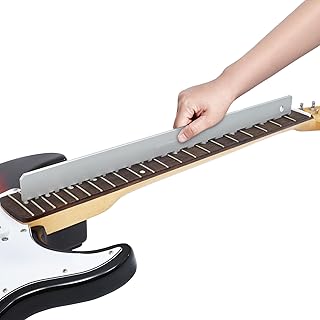
Best for: Guitarists or repairers looking for a notched straight edge for neck maintenance and setup. The product name specifies 4mm aluminum and references 25.5-inch Fender and 24.75-inch Gibson scale guitars, as well as fretboard and fret work.
Its intended category is similar to the iLuiz straight edge: a measuring and checking tool for guitar setup, rather than an instrument. The listed information does not give dimensions, weight, or a detailed description of its checking surfaces. Compare those details with the iLuiz model before deciding which tool better matches a particular job.
Why it was selected: It is directly relevant to neck and fretboard maintenance. Limitation: The listing information supplied here does not establish its measurements beyond the stated 4mm thickness or confirm suitability for a classical guitar’s dimensions.
Two-Piece Fret End Dressing File Set

Best for: Luthiers and do-it-yourself guitar repairers who need files for shaping or deburring fret ends. The product name describes a two-piece set for rounding, shaping, and addressing sharp frets or fret sprout, and says it works on all guitar frets.
Fret-end dressing is a repair task, not a way to evaluate whether a guitar is handmade or classical. This tool may interest a player maintaining a fretted guitar, but it is separate from choosing the instrument itself.
Why it was selected: It is the only listed product specifically described for working on fret ends. Limitation: The supplied details do not specify file dimensions or materials. Fret filing removes material, so buyers should understand the task before using a file on an instrument.
Buying Guide: How To Choose A Luthier-Made Classical Guitar
Are These Products Classical Guitars?
No. The five listings include a book and guitar-maintenance accessories. None is a playable classical guitar, and none provides the specifications needed to compare handmade instruments. If the goal is to purchase a luthier-made classical guitar, look for an actual instrument listing with clear construction details, dimensions, condition, and seller information.
What Should You Check In A Handmade Classical Guitar Listing?
Start by confirming that the instrument is a classical guitar and that the seller identifies who made it. Look for a description of the top, back, sides, neck, fingerboard, and finish. The listing should distinguish solid wood from laminated construction rather than relying on broad terms such as “custom” or “handmade.” Ask the seller for missing details instead of assuming a specification from a photograph.
Check the instrument’s scale length, nut width, body dimensions, and string setup if those measurements matter to your playing comfort. Confirm whether it is new or used, whether it has been repaired, and whether the listing documents any cracks, finish damage, or structural concerns. The products in this selection do not supply those guitar-specific facts.
Do You Need A Neck Straight Edge Or A Neck Rest?
Choose a notched straight edge if the job involves checking neck or fretboard straightness. The iLuiz product describes separate notched and solid sides for checking the fingerboard and fret-wire levelness. The 4mm aluminum tool is also presented for guitar neck maintenance, but its supplied listing details are less complete.
Choose a neck rest when the main need is to support an instrument during cleaning, restringing, or repair. The COENGWO cradle is described as a cork support with two heights and curved shapes. A neck rest does not measure the neck, and a straight edge does not serve as a padded work support; they solve different workshop needs.
When Is A Fret End File Relevant?
A fret end dressing file is relevant when sharp fret edges or fret sprout need attention. It is a specialized repair tool, not an essential purchase for every classical guitar buyer. If you are unfamiliar with fret work, consider consulting an experienced repairer before filing because the tool removes material from the frets.
What Makes A Listing Useful For Comparing Luthiers?
Look for specific, verifiable information: the maker’s name, instrument type, materials, measurements, condition, and photographs of the actual guitar. Ask how the instrument can be inspected and what documentation is available. A book about a luthier can provide background reading, but it cannot verify the maker or condition of a separate guitar for sale.
Frequently Asked Questions
Is any product here a luthier-made classical guitar?
No. The selection contains one hardcover book and four maintenance tools. It does not include a classical guitar for sale.
Which item is most relevant to learning about custom guitars?
Classic Ferrington Guitars is the most relevant item for readers interested in custom-made guitars and luthier Danny Ferrington. The supplied information does not establish whether it focuses specifically on classical guitars.
Which tool checks fretboard straightness?
The iLuiz notched straight edge is described as using its notched side to check fingerboard straightness and its solid side to check fret-wire levelness.
Which product supports an instrument during restringing?
The COENGWO cork guitar neck rest is described as a support cradle for maintenance tasks including restringing, cleaning, and repair.
Can the listed straight edges be assumed to fit every classical guitar?
No. The supplied information references 25.5-inch and 24.75-inch scales, but it does not confirm fit for every classical guitar. Check the instrument’s measurements and the tool’s specifications before use.