
A high pass passive crossover limits low-frequency signal reaching a speaker, which can help direct treble to a tweeter or protect a driver from bass. The best choice depends on the crossover frequency, speaker impedance, power handling, and whether you need a simple bass blocker or a two-way crossover. The Thrixen is best for a compact tweeter filter with a stated PTC protector, Dayton Audio models suit specific 3,500 Hz or 5,000 Hz crossover points, and Audiopipe is a broader two-way option.
| Product | Best suited to | Listed crossover information |
|---|---|---|
| Thrixen T-5B | Tweeter filtering with a stated PTC protector | 2,350 Hz; 12 dB/octave |
| Dayton Audio 3.5k-HPF-4 | A 3,500 Hz high pass point | 3,500 Hz; 12 dB/octave |
| Dayton Audio 5k-HPF-4 | A 5,000 Hz high pass point | 5,000 Hz; 12 dB/octave |
| Audiopipe CRX-203 | Two-way tweeter and mid/high routing | Tweeter frequency: 3.39–20 kHz |
| RonDexy RDBB-5600 | A simple high-frequency tweeter blocker | Blocks 0–5,600 Hz at 4 ohms |
Thrixen T-5B Passive Tweeter Crossover

The Thrixen T-5B is a compact one-way passive crossover intended to send high frequencies to a tweeter. Its listed 2.5 μF capacitor corresponds to a stated crossover frequency of about 2,350 Hz for compatible 4–8 ohm tweeters. The product description gives a 12 dB/octave slope and a maximum handling figure of 40 watts RMS.
It is best for a buyer who wants more than a single-capacitor bass blocker. Thrixen lists an inductor, audio-grade capacitor, and PTC protector as components. The insulated sleeve and labeled input and output wires can also help with a tidy installation: black and red are input leads, while blue and black are output leads to the tweeter.
- Choose this if your tweeter impedance matches the specified 4–8 ohm range and the 2,350 Hz crossover point suits the speaker setup.
- Limitation: The listed 40-watt RMS handling and specific crossover point may not suit higher-power systems or tweeters needing a different transition frequency.
Dayton Audio 3.5k-HPF-4 Crossover
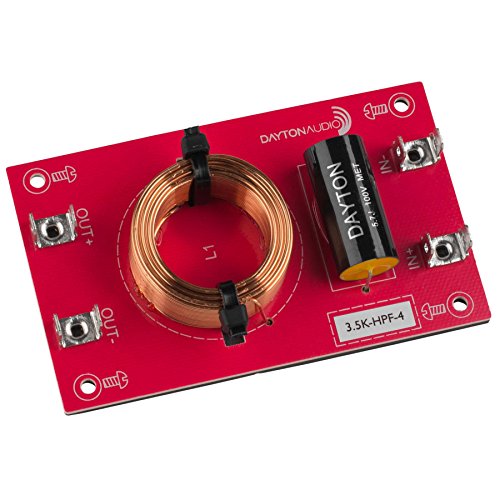
This Dayton Audio high pass crossover is specified for 3,500 Hz with a 12 dB/octave slope. It uses a high-quality poly capacitor in series with the driver, and its components are secured to a printed circuit board. The product information also notes that crossover frequencies can be staggered or overlapped to shape the combined response of drivers.
It is best for a buyer who needs a defined 3,500 Hz high pass point and wants a board-mounted component arrangement. The stated frequency makes it easier to compare with a tweeter or other high-frequency driver’s requirements than a generic blocker with no clearly stated target point.
- Choose this if 3,500 Hz and a 12 dB/octave slope are appropriate for the intended speaker system.
- Limitation: The supplied details do not state a power-handling rating or a specific compatible impedance, so confirm those requirements before purchase.
Dayton Audio 5k-HPF-4 Crossover

The Dayton Audio 5k-HPF-4 is a high pass speaker crossover rated at 5,000 Hz with a 12 dB/octave slope. Like the 3.5k model, it places a poly capacitor in series with the driver and secures the components to a PCB. Dayton also identifies frequency staggering or overlap as a way to adjust the combined response when multiple drivers are used.
This model is best for a setup that calls for a 5,000 Hz transition rather than a lower crossover point. It provides a straightforward option for buyers comparing two specified high pass frequencies from the same product family.
- Better for a driver arrangement where the intended high pass point is 5,000 Hz.
- Limitation: The listing information provided does not give power handling or impedance details. Check that the crossover is appropriate for the speaker and amplifier before connecting it.
Audiopipe CRX-203 Two-Way Crossover

The Audiopipe CRX-203 is a two-way passive crossover sold as a two-pack. Its listed specifications include 150 watts RMS and 300 watts peak, gold-plated screw terminals, and a tweeter frequency range of 3.39–20 kHz. The product is described for car audio speakers, tweeters, mids, and high frequencies.
It is best for a buyer who wants a two-way crossover arrangement rather than a single inline high pass filter. Screw terminals offer a connection style different from bare wire leads, and the stated power figures provide useful comparison information. Its broad listed tweeter frequency range may be relevant when routing the high-frequency signal to a tweeter.
- Choose this if you need a two-way car-audio crossover and its listed power handling and frequency information match your system requirements.
- Limitation: The supplied details do not specify the crossover slope or exact crossover point between outputs. Confirm that these details meet the needs of your drivers.
RonDexy RDBB-5600 Tweeter Bass Blockers

The RonDexy RDBB-5600 is a pair of inline bass blockers designed to keep lower frequencies away from car-audio tweeters. The product information states that it blocks 0–5,600 Hz at 4 ohms and 0–2,800 Hz at 8 ohms, and handles up to 50 watts. Each blocker has attached six-inch speaker wires on both ends.
This is best for a buyer seeking a simple inline high pass filter for a tweeter, rather than a multi-driver crossover network. It includes two units and gives separate frequency information for 4-ohm and 8-ohm loads, making impedance an important selection detail.
- Choose this if you want a basic tweeter blocker and your speaker impedance and power needs align with the listed specifications.
- Limitation: The listing does not state a crossover slope. Its stated frequency behavior differs by impedance, so do not assume the same cutoff for 4-ohm and 8-ohm speakers.
Buying Guide: How To Choose A High Pass Passive Crossover
A passive high pass crossover sits between an amplifier and a speaker. It reduces signal below a chosen frequency while allowing higher frequencies to pass. Some products are one-way filters for a single tweeter, while two-way crossovers split the signal between more than one driver. Match the device to the speaker’s specifications and the role it will perform.
What crossover frequency should you choose?
Start with the speaker or tweeter manufacturer’s recommended frequency range when that information is available. The crossover frequency affects how much low-frequency signal reaches the tweeter and where it begins playing. A 2,350 Hz tweeter filter, a 3,500 Hz high pass, and a 5,000 Hz high pass are not interchangeable choices. Select the frequency based on the driver’s requirements and the design of the speaker system.
Does speaker impedance change the filter behavior?
Yes. Passive crossover components interact with the connected speaker’s impedance, so the effective frequency response can change when impedance differs. The RonDexy RDBB-5600 listing, for example, gives different blocked-frequency ranges for 4-ohm and 8-ohm loads. Check the product’s stated impedance requirements and compare them with the speaker’s specification instead of relying on a model name or assumed compatibility.
How much power handling do you need?
Compare the crossover’s listed power handling with the power expected at the connected driver. Product figures may distinguish RMS from peak power, as Audiopipe does, while other listings give only one rating. Avoid treating peak power as equivalent to continuous RMS handling. Several products in this selection do not provide a power rating in the supplied information, so verify that detail if it is important to your setup.
Should you use a bass blocker or a two-way crossover?
A bass blocker is generally a simpler inline option intended to keep low frequencies away from one speaker, often a tweeter. A two-way crossover routes different frequency ranges to separate drivers. Choose a bass blocker when you need a basic high pass function and its frequency behavior suits the speaker. Choose a two-way unit when the system needs separate outputs for drivers. A product’s actual wiring and specifications should guide the decision.
What does the slope mean?
The slope describes how quickly the crossover reduces signal beyond its transition point. The Thrixen and Dayton Audio products in this list specify a 12 dB/octave slope. The Audiopipe and RonDexy details supplied here do not state a slope, so avoid assuming they share the same filtering behavior. A steeper or gentler slope can affect how drivers overlap, but the correct choice depends on the speaker design.
What should you check before installation?
- Confirm the crossover frequency and speaker impedance are suitable for the driver.
- Check the product’s power rating and whether it is stated as RMS, peak, or another measure.
- Follow input and output markings. The Thrixen listing identifies its input and tweeter-output wires.
- Keep exposed connections from contacting metal. An insulated sleeve is listed with the Thrixen model.
- Check whether you need a single-speaker filter or a crossover that routes signal to multiple drivers.
- Do not infer a missing slope, cutoff, or power rating; consult the manufacturer’s product details.
Frequently Asked Questions
What does a high pass passive crossover do?
It reduces lower-frequency signal sent to a speaker and allows higher frequencies to pass. It is commonly used to filter signal going to a tweeter or other high-frequency driver.
Can a bass blocker protect a tweeter?
A bass blocker can limit low-frequency signal reaching a tweeter. Its suitability depends on the blocker’s frequency behavior, the tweeter’s impedance, and the tweeter’s requirements. It should not be assumed to replace every type of crossover protection.
Are 3,500 Hz and 5,000 Hz crossovers interchangeable?
No. They provide different high pass points. Choose the one that fits the driver specifications and the intended transition between speakers in the system.
Does a 12 dB/octave slope mean the speaker receives no bass?
No. A crossover reduces signal progressively below its transition region; it does not necessarily create an abrupt cutoff. The supplied products with a stated 12 dB/octave slope identify the rate of reduction, not a guarantee of zero output below the crossover point.
Can I choose a crossover based only on its power rating?
No. Power handling is one consideration. Frequency, slope, impedance, wiring, and whether the unit is a single high pass filter or a two-way crossover also matter.