
The best car charger adapter converter depends on which direction you need to convert power: from a car’s 12V socket to household-style AC, from a wall outlet to a 12V car socket, or between electric-vehicle charging connectors. The PiSFAU 200W inverter suits buyers who want multiple outlets and USB ports; BESTEK is a stronger choice for higher continuous output. The AC-to-DC adapter is for low-power car accessories used indoors, while Lectron serves a specific EV charging need.
| Product | Best For | Power Direction |
|---|---|---|
| PiSFAU 200W inverter | Several devices in a compact setup | 12V DC to 110V AC |
| PiSFAU 150W inverter | Basic AC and USB charging | 12V DC to 110V AC |
| AC-to-DC 24W adapter | Low-power car accessories indoors | 110–240V AC to 12V DC |
| Lectron Tesla-to-J1772 adapter | J1772 EVs using specified Tesla chargers | EV charging connector conversion |
| BESTEK 300W inverter | Higher continuous AC output | 12–17V DC to 110V AC |
PiSFAU 200W Car Power Inverter
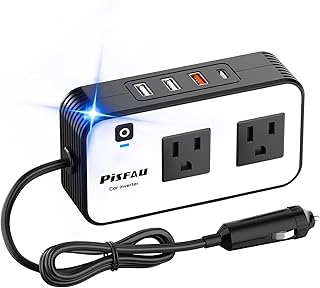
Best for: Drivers who want to power several small electronics from a vehicle socket using both AC outlets and USB ports. This inverter converts a vehicle’s 12V DC supply to 110V AC and provides two standard AC outlets alongside four USB charging ports.
Its combination of outlets makes it useful when a trip involves devices with different plug types, such as a laptop and USB-powered phones. The listed compact dimensions and lightweight design may also suit buyers who want an inverter that is easier to carry and store than a larger unit. The manufacturer describes the circuit and heat-dissipation design as intended to reduce energy consumption and operating noise.
Limitation: The listed features do not specify a continuous wattage rating for this model. Check the device’s power requirements and the inverter’s complete product specifications before connecting equipment; do not assume that the “200W” name guarantees suitability for every appliance.
PiSFAU 150W Power Inverter
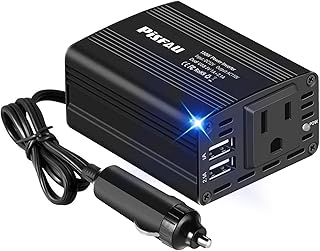
Best for: Buyers who want a clearly stated 150W continuous output, two AC outlets, and two USB ports in one vehicle power converter. It converts 12V DC to 110V AC and lists 300W peak power, giving shoppers useful continuous-versus-peak figures to compare against their devices.
Choose this model if you need to plug in AC-powered electronics while also charging USB-compatible devices. The product information names laptops, tablets, game consoles, lights, and certain medical devices among possible uses. Those examples do not replace checking the device label: its actual operating wattage and startup demands must fit the inverter’s limits.
The inverter includes a smart-chip and built-in-fuse protection mechanism. According to the listing, it can shut off output and show a red light when it detects a fault.
Limitation: Its 150W continuous rating is lower than the BESTEK model’s listed 300W continuous output. Avoid choosing it for a device whose power draw exceeds its stated limit.
AC-to-DC 24W Car Socket Adapter

Best for: Someone who wants to power a low-wattage car accessory from a household wall outlet. Unlike a car inverter, this adapter converts 110–240V AC from a wall supply into regulated 12V DC through a car cigarette-lighter-style socket.
The listed maximum is 24W and 2A. The product description identifies low-power vehicle electronics such as dash cams, FM transmitters, air purifiers, and humidifiers as possible uses, provided their rated requirements stay within those limits. It also lists short-circuit, overheating, and overload protection.
Important limitation: This is a power supply adapter, not a battery charger. The listing warns against using it with devices above 24W or 2A, including car inflators, vacuum cleaners, refrigerators, heating pads, and coolers. Check the accessory’s label before plugging it in.
Lectron Tesla-to-J1772 EV Adapter

Best for: Owners of J1772 electric vehicles who need an adapter for the Tesla charging equipment identified in the listing. This product is a connector converter for EV charging, not an accessory for a standard 12V car socket or for charging phones and laptops.
Lectron states that the adapter supports up to 48A and 240V. The listed compatible charging equipment includes Tesla High Powered Wall Connectors, Destination Chargers across generations, and Mobile Connectors. Its purpose is to let a compatible J1772 vehicle connect to those specified Tesla/NACS charging sources.
Choose this adapter if its connector types match both the vehicle and the charging equipment you plan to use. Confirm the exact vehicle and charger compatibility before buying; an adapter’s connector shape alone does not establish compatibility with every charging station.
Limitation: It has a specialized EV-charging use and does not convert household AC into a 12V cigarette-lighter socket or provide conventional USB charging ports.
BESTEK 300W Car Power Inverter

Best for: Buyers who need more stated continuous AC output than the 150W option provides. This converter changes 12–17V DC to 110V AC and lists 300W continuous power with 700W instantaneous power. It has two AC outlets and two USB ports.
The two AC outlets can serve devices that use household-style plugs, while the USB ports are listed at 4.8A for USB-compatible equipment. The product description highlights an iPhone-sized form and a 32-inch cigarette-lighter plug, details that may help shoppers planning a portable travel, work-trip, or camping setup.
Limitation: The 300W continuous rating is not a guarantee that every appliance will work. Check both the device’s running wattage and any startup surge requirement, and confirm that the vehicle’s socket can supply the needed power.
Buying Guide: How to Choose a Car Charger Adapter Converter
What kind of power conversion do you need?
Start by identifying the power source and the device you want to run. “Car charger adapter converter” can describe products that do opposite jobs, so the phrase alone is not enough to determine the right type.
- Car socket to AC outlets: Choose a DC-to-AC power inverter when you want to plug in an AC device while in a vehicle.
- Car socket to USB: Look for an inverter or car charger with USB outputs if the device charges through USB. Confirm the port type and output details.
- Wall outlet to car socket: Choose an AC-to-DC adapter when a low-power 12V car accessory needs to operate indoors.
- EV connector to EV connector: Choose a dedicated charging adapter only after confirming the vehicle and charging equipment are compatible.
How much wattage should the converter support?
Check the label or manual for the device’s power consumption, then compare it with the converter’s continuous output rating. Continuous output is the key figure for equipment that runs for more than a brief moment. Peak or instantaneous output refers to a higher short-term level, not a rating to use for ongoing operation.
For example, the PiSFAU 150W model lists 150W continuous and 300W peak output, while BESTEK lists 300W continuous and 700W instantaneous output. These figures make the BESTEK the higher-output option of those two based on the provided specifications. They do not establish that either will run a particular appliance without checking its requirements.
How many ports and outlets do you need?
Count the devices you expect to power at the same time and note how each connects. The PiSFAU 200W model lists two AC outlets and four USB ports; the 150W model lists two AC outlets and two USB ports; BESTEK lists two AC outlets and two USB ports. More ports can make a setup convenient, but they do not increase the converter’s total power capacity.
If several devices will run together, add their power demands and ensure the combined load stays within the inverter’s limit. Also verify that the USB output is suitable for the device. The provided feature descriptions do not give detailed USB charging protocols for every model.
Do you need a car inverter or a wall adapter?
A car inverter takes DC power from a vehicle and supplies AC output. The 24W AC-to-DC adapter works in the reverse direction: it takes household AC and supplies 12V DC through a car-style socket. It is intended for low-power accessories, not for recharging a car battery or operating high-draw equipment.
Do not use a 24W adapter with a device rated above its stated 24W or 2A maximum. In particular, the listing warns against high-power accessories such as inflators and vacuums. The product’s safety features do not make an over-limit load appropriate.
What should you check before using an inverter?
- Read the connected device’s voltage and wattage requirements.
- Compare the combined load of all connected devices with the inverter’s continuous rating.
- Check for startup surges, especially for equipment with motors or compressors.
- Confirm how the inverter receives vehicle power and follow its product instructions.
- Keep the total connected load within the vehicle socket and inverter limits.
These checks matter even when a product description names a device as a possible use. A general example does not ensure that every model of that device has compatible power requirements.
How do you select an EV charging adapter?
EV adapters are not universal merely because their connectors appear to fit. Confirm the vehicle’s inlet standard, the charging equipment’s connector, and the adapter’s stated compatibility. The Lectron model described here is for J1772 vehicles and specified Tesla charging equipment, with a listed maximum of 48A and 240V. Use those details as a starting point and verify the exact equipment combination before purchase.
Frequently Asked Questions
What is a car power inverter used for?
A car power inverter converts a vehicle’s DC power into AC output for compatible devices with household-style plugs. Some models also include USB ports. The connected devices must remain within the inverter’s power limits.
Can an AC-to-DC car socket adapter charge a car battery?
No. The 24W adapter described here is a power supply for low-power car electronics, not a battery charger. Use a charger designed for the battery type and charging task.
Can I connect a vacuum or air pump to a 24W adapter?
No, not according to the product listing. It specifically warns against high-power devices such as car vacuum cleaners and inflators and limits use to devices rated below 24W and 2A.
Is a 300W inverter always better than a 150W inverter?
Not for every buyer. A 300W continuous model offers a higher stated output, but it may be unnecessary for lower-power devices. Choose based on your actual load, outlet needs, and vehicle power limits.
Can I use a Tesla-to-J1772 adapter with any EV charger?
No. Compatibility depends on the vehicle, adapter, and charging equipment. The Lectron listing identifies particular Tesla charging equipment and J1772 vehicles; verify your exact combination before use.