
The right adapter depends on which direction you need to convert power. For a car outlet powering household-style AC devices, choose a DC-to-AC inverter such as the Ampeak 150W model. For using a household US outlet to power a 12V car accessory, choose an AC-to-DC converter such as the ALITOVE 120W or Herfair 24W adapter. These five options cover both use cases, with output limits that help distinguish light-duty accessories from higher-draw devices.
| Product | Best For | Power Direction |
|---|---|---|
| Ampeak 150W Car Power Inverter | AC outlet and USB charging in a vehicle | 12V DC to 120V AC |
| 150W Vehicle Power Inverter | Road trips and dual-USB charging | 12V DC to 110V AC |
| ALITOVE 120W Converter | Higher-draw 12V car accessories at home | 100–240V AC to 12V DC |
| BYGD 120W Adapter | 12V devices needing a wall-powered supply | 100–240V AC to 12V DC |
| Herfair 24W Converter | Low-power car electronics indoors | 100–240V AC to 12V DC |
Ampeak 150W Car Power Inverter
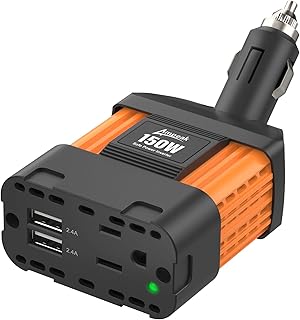
Best for: Drivers who need a standard AC outlet and USB charging from a vehicle’s 12V power source. This is the clearest match for someone searching for a car DC-to-AC converter with a US-style outlet.
The Ampeak inverter converts 12V DC to 120V AC and includes one AC outlet and two USB ports rated at 2.4A. The product information lists use with electronics and accessories such as laptops, phones, and lighting. It also describes 11 layers of protection and an 88% conversion efficiency for the AC outlets.
Why it was selected: It provides both an AC outlet and USB charging, making it more versatile than an adapter with only one type of output. Choose it if your device uses an AC plug, and check the device’s power requirements before connecting it.
Limitation: The listed power rating is 150W. It is not presented as an option for appliances that require more power than that rating.
150W Vehicle Power Inverter

Best for: Drivers looking for a compact vehicle inverter for AC-powered electronics and USB-charged devices. The product title specifies 12V DC input, 110V AC output, a 150W rating, and dual USB charging rated at 3.1A.
This model is intended to plug into a vehicle power outlet and provide an AC outlet alongside USB ports. Its stated use cases include laptops, drones, camping, road trips, and mobile-office needs. The dual USB output is a useful difference for travelers charging more than one USB device at a time.
Why it was selected: It addresses the core DC-to-AC search intent while offering both wall-style AC and USB outputs. Choose it if you want a vehicle-powered outlet for devices whose power draw stays within the inverter’s stated capacity.
Limitation: The supplied product details do not identify specific protection features or provide additional output specifications beyond those in the title. Confirm your device’s requirements before use.
ALITOVE 120W AC-to-DC Converter

Best for: People who want to power a 12V car accessory from a household outlet, especially a device that needs more current than a small 2A converter can provide.
This adapter works in the opposite direction from a car inverter: it accepts 100–240V AC and outputs 12V DC at up to 10A, with a maximum stated output of 120W. It has an 8-foot power cord and a car cigarette-lighter-style output connection. Listed compatible device types include car refrigerators, TVs, cleaners, dash cameras, humidifiers, and fans, provided they remain within the stated output limits.
The manufacturer describes overload, overvoltage, overtemperature, and short-circuit cutoffs. Why it was selected: Its 10A maximum and long cord make it a better fit than a 24W converter for higher-draw 12V accessories used indoors.
Limitation: The product details advise against running devices over 120W for extended periods. It does not convert a car’s DC power into household AC.
BYGD 120W 10A Power Adapter
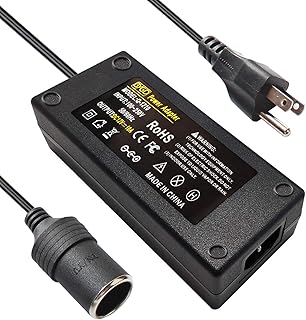
Best for: Buyers seeking a 12V power adapter for using car-style electronics from a household AC outlet. The supplied product name identifies AC 100–240V input, 12V DC output, and a 120W, 10A rating.
Like the ALITOVE, this is an AC-to-DC converter rather than an inverter. Its stated voltage and current figures place it in the same broad power class as a 120W, 10A supply, but the available product information does not provide further feature details for a full comparison.
Why it was selected: Its listed input and output specifications make it relevant to shoppers who need to run a 12V car accessory from a US household outlet. Compare the accessory’s voltage, plug type, and maximum current requirement with the product listing before buying.
Limitation: The provided information does not specify cable length, safety cutoffs, or supported device examples. Do not assume those details based on the power rating alone.
Herfair 24W AC-to-DC Converter

Best for: Users who need to power a low-wattage 12V car accessory indoors from a standard US two-pin wall plug. Its output is 12V DC at 2A, for devices rated below 24W and drawing less than 2A.
The Herfair adapter converts 100–240V AC household current to 12V DC and has a male car cigarette-lighter connector for a device with a matching female socket. Its listed examples include dash cameras, car MP3 equipment, Bluetooth FM radios, air purifiers, diffusers, and humidifiers. The 36.5-inch cable includes an LED indicator. The description also lists a built-in fuse and thermal-sensor-controlled heat sink.
Why it was selected: It is a clearly specified option for low-power accessories and identifies both its current limit and intended device types.
Limitation: Avoid this converter for devices above 24W or 2A. The listing specifically excludes higher-power equipment such as car vacuums, air compressors, refrigerators, and battery chargers.
Buying Guide: How To Choose The Right Converter
Do you need DC-to-AC or AC-to-DC?
Start by identifying the power source and the device you want to operate. A car outlet generally supplies 12V DC. If you want to power a device with a household AC plug from the vehicle, you need a DC-to-AC inverter, such as either 150W vehicle inverter above.
If you want to run a car accessory from a household wall outlet, you need an AC-to-DC converter. The ALITOVE, BYGD, and Herfair products fit this direction. They supply 12V DC through a car cigarette-lighter-style connector rather than making household AC from vehicle power.
How much wattage and current does the device need?
Check the device label or its manufacturer’s instructions for voltage, current, and watts. Choose an adapter whose output matches the device and whose capacity is at least as high as the required load. For 12V DC, watts can be estimated by multiplying volts by amps: 12V at 2A equals 24W, while 12V at 10A equals 120W.
Do not rely on a product’s maximum rating as a reason to exceed it. The Herfair adapter is limited to devices under 24W and below 2A. The ALITOVE and BYGD are listed as 120W, 10A products. The vehicle inverters are listed at 150W, but the product specifications and device requirements should still be checked before use.
Does the plug match your device?
For an AC inverter, confirm that the device’s plug fits the inverter’s outlet and that the device is suitable for the inverter’s stated AC output. For an AC-to-DC adapter, verify that the car accessory uses a cigarette-lighter-style socket and that its electrical requirements match the 12V output. A plug that physically fits does not, by itself, confirm electrical compatibility.
Which features matter for daily use?
- Output options: Select an inverter with an AC outlet for plug-in devices, or USB ports for USB-powered electronics. Some models provide both.
- Cable reach: The ALITOVE lists an 8-foot cord, while the Herfair lists a 36.5-inch cable. Compare that with the distance to your outlet or accessory.
- Protection details: The ALITOVE lists overload, overvoltage, overtemperature, and short-circuit cutoffs. Herfair lists a built-in fuse and thermal control. Check each listing for the protections it actually specifies.
- Use case: A low-output adapter may suit a small accessory, while a higher-rated supply is more appropriate for a device with a greater stated power draw.
Can a small adapter run a car vacuum or refrigerator?
Only if the accessory’s power requirements are within the adapter’s stated limits. The Herfair listing specifically says it is not suitable for high-power equipment such as car vacuums and refrigerators. The ALITOVE lists those categories as possible uses only when the device stays within its 120W maximum. Always check the specific device rating rather than relying only on its product category.
Frequently Asked Questions
What is a car DC-to-AC converter called?
It is commonly called a car power inverter. It takes DC power from a vehicle outlet and provides AC power through an outlet. The Ampeak and 150W vehicle models are inverters.
Can I use an AC-to-DC adapter to power a laptop from my car?
Not for a laptop that requires household AC power. An AC-to-DC adapter like the ALITOVE or Herfair is designed to use household AC to supply 12V DC to a car accessory. For a laptop from a car outlet, look for a suitable inverter or a laptop-specific vehicle power adapter that matches the laptop’s requirements.
Will a 120W adapter work with every 12V car accessory?
No. The accessory must use the correct connector and stay within the adapter’s 12V, 10A, and 120W limits. Check the device’s current or wattage rating before connecting it.
What does a US plug mean on a car adapter?
For an AC-to-DC converter, a US two-pin plug connects the adapter to a household wall outlet. For a car inverter, the vehicle-side plug goes into the car’s 12V outlet, while the AC output is intended for compatible plug-in devices.
Is a higher-wattage converter always better?
No. A higher rating provides more capacity, but the output voltage, current, connector, and power direction must still match the device. The adapter should not be used to exceed a device’s requirements or its own stated limits.