
The best mountain dulcimer tuning pegs are tuners that match your instrument’s peg-hole diameter, mounting layout, string-post orientation, and available headstock space. The products below are replacement tuners made for other instruments, not confirmed mountain dulcimer parts, so treat them as possible options only after measuring your dulcimer. KAISH tuners are best to investigate for 8 mm holes, while the harpfeas set is an option only for larger 10 mm holes.
| Product | Listed fit or feature | Best suited to |
|---|---|---|
| KAISH Nickel Ukulele Tuners | 8 mm tuner holes | Checking against a dulcimer with matching holes |
| FLEOR White Ukulele Tuners | About 6 mm shaft diameter | Checking against a dulcimer with matching shaft dimensions |
| harpfeas Guitar Tuners | 10 mm holes; 3L3R layout | Headstocks that match the listed size and arrangement |
| Yibuy Banjo Machine Heads | Set of five; 4:1 gear ratio | Comparing a banjo-style tuner option with existing hardware |
| CashBeat Violin Pegs | Wooden pegs for 4/4 violins | Only a dulcimer designed for compatible friction pegs |
KAISH Nickel Ukulele Tuners
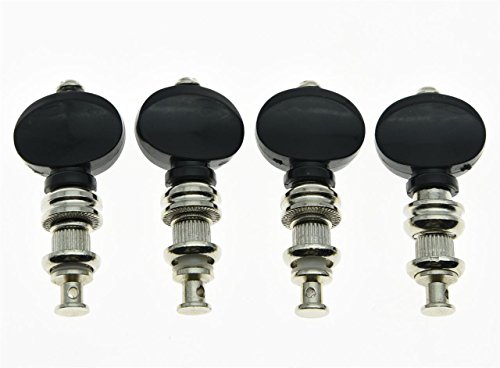
Best for: Dulcimer owners whose tuner holes measure 8 mm and whose headstock can accommodate this style of geared machine head. The listing says the set has nickel tuners with black buttons and fits most models with 8 mm, or 5/16-inch, tuner holes. It also notes use on similar instruments with the same hole size.
This is one of the more straightforward options to evaluate because the listing provides a specific hole measurement. Before buying, compare the mounting arrangement, tuner post length, and clearance against the dulcimer’s existing hardware. An 8 mm hole alone does not confirm a complete fit.
Limitation: These are sold as ukulele tuners, and the product information does not confirm mountain dulcimer compatibility. Avoid choosing them based only on the hole diameter.
FLEOR White Ukulele Tuning Pegs
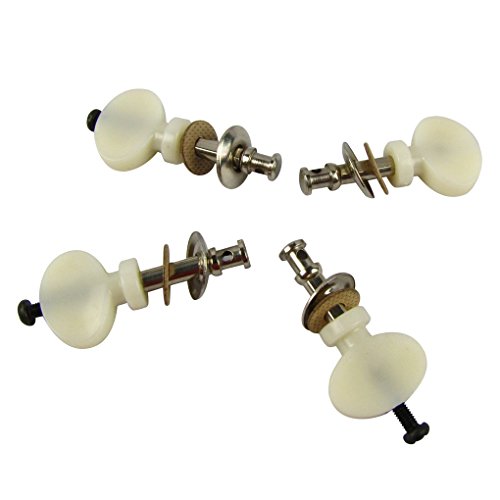
Best for: Buyers checking a small replacement tuner against a dulcimer with matching dimensions and a compatible mounting style. This four-piece set is described as replacement pegs for a ukulele. The listed features include a steel central peg, a small top screw for adjusting pressure, and a shaft end approximately 6 mm in diameter.
The 6 mm measurement gives buyers a useful starting point for comparing hardware, but it is not a stated headstock-hole measurement. Measure the shaft and the hole separately, and check whether the dulcimer requires a different tuner orientation or mounting screw position. The pressure screw may be relevant when adjusting tuner feel, but it does not establish fit.
Limitation: The set is intended for ukulele replacement. Its product information does not specify mountain dulcimer use or provide all dimensions needed to confirm compatibility.
harpfeas 3L3R Guitar Tuners

Best for: A dulcimer headstock that has 10 mm tuner holes and can accommodate a three-left, three-right arrangement. The listing describes semi-closed tuners for acoustic or electric guitars, made from alloy metal, with a 15:1 gear ratio and chrome finish.
These are a better candidate than smaller-hole tuners only when the dulcimer’s measurements and layout match. The stated gear ratio is a useful comparison point: it describes the relationship between button rotation and post rotation, rather than confirming fit. Check how many tuners are needed and whether the headstock has room for the tuner bodies and buttons.
Limitation: This is a six-piece guitar set with a 3L3R layout, not a mountain dulcimer-specific set. Do not assume the arrangement suits a dulcimer headstock.
Yibuy Five-String Banjo Machine Heads

Best for: Dulcimer owners comparing a geared tuner set with existing hardware, particularly when a five-piece set is useful. The product information describes zinc-alloy tuners with pearl buttons and a 4:1 gear ratio. It says the set fits most five-string banjos.
Compared with the harpfeas guitar set, this option has a lower listed gear ratio and is packaged for a five-string instrument. That distinction may help narrow a comparison, but it does not show that the tuners will fit a dulcimer. Verify the hole size, tuner post dimensions, mounting requirements, and the number and position of tuners before considering it.
Limitation: The stated fit is for most five-string banjos. The listing does not provide mountain dulcimer compatibility or the hole measurements needed to establish it.
CashBeat Jujube Wood Violin Pegs

Best for: A buyer whose dulcimer is specifically designed to use compatible friction-style wooden pegs and who can confirm the required dimensions with a repair professional. The listing describes a four-piece set of jujube wood pegs for 4/4 violins, with a mahogany-colored appearance.
These differ from geared machine heads: they are wooden violin pegs, so the fitting method and headstock requirements are not interchangeable with those of geared tuners. Their listed violin size is important; do not infer that a peg will fit a dulcimer simply because both instruments use strings and tuning pegs.
Limitation: The product is specifically described for 4/4 violins, and no dulcimer dimensions or compatibility are provided. Avoid this option unless the peg style and measurements match exactly.
Buying Guide: How To Choose Mountain Dulcimer Tuning Pegs
What measurements should you take first?
Remove a tuner only if you can do so safely, then measure the headstock hole diameter with an appropriate measuring tool. Also record the post diameter, post length, mounting-screw position, and the distance between neighboring tuners. A listing’s hole measurement may refer to the headstock opening, while a shaft measurement refers to a different part; do not treat the two as interchangeable.
Take clear photos of the front and back of the headstock and note whether the tuners are arranged on one side or both sides. Compare the number of tuners required with the package contents. These checks can prevent ordering a set with the right hole size but the wrong layout, spacing, or hardware.
Do you need geared tuners or friction pegs?
Identify the type already installed. Geared machine heads use a gear mechanism, while friction pegs hold position through pressure and a close fit. They require different fitting considerations, and one type is not automatically a substitute for the other. The CashBeat violin pegs in this list are wooden pegs; the ukulele, banjo, and guitar products are machine-head-style replacements.
If you are unsure which type your dulcimer uses, consult the instrument maker, a dulcimer repair shop, or a qualified instrument technician before ordering. A change in tuner type can require work beyond simply inserting a replacement.
How should gear ratio affect your choice?
A gear ratio describes how much the tuning post turns in relation to the button. The harpfeas listing gives a 15:1 ratio, while the Yibuy listing gives a 4:1 ratio. These figures can help compare the listed mechanisms, but they do not by themselves establish tuning quality, smoothness, or compatibility with a particular dulcimer.
Choose based on the tuner style and dimensions your instrument requires. Do not select a tuner solely because its ratio sounds higher or lower; confirm the mounting and post specifications first.
What else should you compare?
- Set quantity: Check how many individual tuners are included and how many your dulcimer needs.
- Layout: Confirm left/right orientation and whether the headstock supports the stated arrangement.
- Mounting: Compare screw locations and any bushings or other hardware required. The supplied product details may not list every installation dimension.
- Materials and appearance: Match metal, button, or wooden-peg styles to your instrument only after confirming mechanical fit.
- Installation: If a replacement requires enlarging holes, reshaping pegs, or altering the headstock, ask a repair professional before proceeding.
Among these listings, KAISH gives an 8 mm hole specification, FLEOR gives an approximately 6 mm shaft-end measurement, and harpfeas specifies 10 mm holes. Those are different measurements and product types. Treat each as a measurement to compare—not as proof that the part fits your mountain dulcimer.
Frequently Asked Questions
Are these products made specifically for mountain dulcimers?
No. The listed products are described as ukulele, guitar, banjo, or violin tuners. None of the supplied product details confirms mountain dulcimer compatibility.
Which listed tuner has an 8 mm hole specification?
The KAISH nickel ukulele tuners are listed for tuner holes measuring 8 mm, or 5/16 inch. Confirm all other dimensions and mounting details before considering them for a dulcimer.
Is the FLEOR 6 mm measurement the headstock-hole size?
The supplied feature describes the end of the shaft as about 6 mm in diameter. It does not identify that measurement as the headstock-hole size, so measure both parts separately.
Can violin pegs replace geared dulcimer tuners?
Not automatically. Wooden friction pegs and geared machine heads use different mechanisms and fitting requirements. Use violin pegs only if the dulcimer is designed for a compatible friction-peg style.
What should I do if the dimensions are not listed?
Ask the seller or an instrument repair professional for the missing measurements. If you cannot confirm the hole size, post dimensions, layout, and mounting method, do not assume the tuner will fit.