
The best six-and-a-half-inch subwoofer depends on your amplifier’s wiring needs, available space, and desired power handling. The Pyle PLPW6D is best for buyers seeking a dual-voice-coil model with a stated 300-watt RMS rating, while the Skar Audio EVL-65 D4 and D2 offer different dual-coil impedance options. The Dayton Audio DCS165-4 is a 4-ohm choice with construction details for comparison, and the Pyle Lanzar MAXP64 is a straightforward 4-ohm option.
| Product | Best For | Key Detail |
|---|---|---|
| Pyle PLPW6D | Buyers comparing dual-coil wiring options | 300 watts RMS; dual 4-ohm coils |
| Pyle Lanzar MAXP64 | Buyers seeking a 4-ohm model | 600 watts peak; foam edge suspension |
| Dayton Audio DCS165-4 | Buyers prioritizing driver construction details | 4-layer voice coil; vented pole piece |
| Skar Audio EVL-65 D4 | Buyers needing a dual 4-ohm model | 200 watts RMS; 400 watts peak |
| Skar Audio EVL-65 D2 | Buyers needing a dual 2-ohm model | 200 watts RMS; 400 watts peak |
Pyle PLPW6D Dual Voice Coil Subwoofer

The Pyle PLPW6D is a six-and-a-half-inch car subwoofer with a non-pressed paper cone, foam surround, and dual voice coil. Its listed power handling is 300 watts RMS and 600 watts peak. The product information also specifies a 30-ounce magnet, 89 dB sensitivity, and spring-loaded push-down terminals.
Best for: Buyers who want a dual-coil subwoofer and need to compare wiring options with their amplifier. The listed description says the dual 4-ohm design can be wired as 4 or 8 ohms; confirm the wiring configuration and amplifier requirements before installation.
Why it stands out: Its RMS rating is provided alongside its peak rating, making power comparisons more informative than peak power alone. The listed sensitivity and terminal style also give buyers specific details to weigh against other models.
Limitation: The dual-coil wiring options require careful matching to the amplifier and intended system impedance. Do not select it based on the 600-watt peak figure alone.
Pyle Lanzar MAXP64 4-Ohm Subwoofer
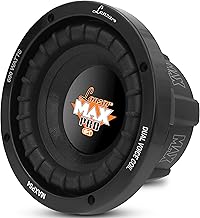
The Pyle Lanzar MAXP64 combines a six-and-a-half-inch non-pressed paper cone with a treated foam edge suspension. Its listed specifications include 600 watts peak power, 4-ohm impedance, and an 80 Hz frequency figure. The product description also mentions a bumped and vented motor structure.
Best for: Buyers looking for a 4-ohm subwoofer with a foam surround and a simple cone-and-suspension specification. It may suit a comparison shortlist when the amplifier is intended for a 4-ohm load, subject to checking the complete system requirements.
Why it stands out: The listed material and motor details offer useful points of comparison for shoppers considering basic car-audio subwoofer construction. Its 4-ohm impedance is stated directly.
Limitation: The provided information lists peak power but does not state an RMS rating. The 80 Hz figure is not presented as a full frequency-response range, so it should not be treated as one.
Dayton Audio DCS165-4 Classic Subwoofer

The Dayton Audio DCS165-4 is a six-and-a-half-inch, 4-ohm classic subwoofer. Its listed construction features include a four-layer voice coil with a polyimide former, a vented pole piece, and a bumped back plate. The product information says these latter features provide voice-coil travel with minimal compression. A copper pole piece cap is also specified as a way to minimize inductance.
Best for: Buyers who want to compare detailed motor and voice-coil construction, or who are specifically looking for a 4-ohm model. The construction details make it distinct from listings that primarily emphasize peak power and cone material.
Why it stands out: The four-layer voice coil, vented pole piece, and copper cap are concrete design features to consider when evaluating a driver for a custom audio project.
Limitation: The supplied product details do not state RMS or peak power, sensitivity, or mounting dimensions. Check those specifications and the available installation space before choosing it.
Skar Audio EVL-65 D4 Dual 4-Ohm Subwoofer

The Skar Audio EVL-65 D4 is a six-and-a-half-inch dual 4-ohm car subwoofer. Its listed power handling is 200 watts RMS and 400 watts peak. It also has a 2-inch copper voice coil and a stated sensitivity of 82.8 dB.
Best for: Buyers whose amplifier and wiring plan call for a dual 4-ohm voice-coil model. Compare its RMS rating with the amplifier’s output at the final wired impedance rather than using the 400-watt peak figure as the main matching number.
Why it stands out: The listing provides RMS and peak power, coil size, impedance, and sensitivity. Those figures support a more direct comparison with the dual 2-ohm version and other subwoofers.
Limitation: Its 82.8 dB sensitivity is lower than the 83.1 dB figure listed for the D2 version. This small specification difference alone does not determine how a complete system will sound.
Skar Audio EVL-65 D2 Dual 2-Ohm Subwoofer
The Skar Audio EVL-65 D2 is a six-and-a-half-inch subwoofer with dual 2-ohm voice coils. It is rated at 200 watts RMS and 400 watts peak, and the listing specifies a 2-inch copper voice coil and 83.1 dB sensitivity.
Best for: Buyers whose amplifier and wiring design require a dual 2-ohm model. The D2 version is the better match than the D4 when the planned final load and amplifier specifications call for its lower coil impedance option.
Why it stands out: It shares the stated power handling and voice-coil size of the D4 model, allowing the main comparison to focus on impedance and the listed sensitivity difference.
Limitation: A dual 2-ohm coil arrangement is not automatically suitable for every amplifier. Confirm the final wired impedance is supported by the amplifier before purchasing or connecting the subwoofer.
Buying Guide: How To Choose A Six-And-A-Half-Inch Subwoofer
What does a 6.5-inch subwoofer size tell you?
The size identifies the speaker class, but it does not establish whether the subwoofer will fit a particular vehicle or enclosure. Before buying, check the mounting opening, available depth, enclosure design, and any vehicle-specific installation constraints. The product details provided here do not include complete mounting dimensions for every model, so consult the full specification information for the selected driver.
A small-format subwoofer can be useful when installation space is limited, but size alone does not predict bass output. Enclosure volume, installation, amplifier power, and the rest of the audio system all affect the result. Compare the complete setup rather than choosing solely by diameter or a headline wattage.
Should you compare RMS or peak power?
Use RMS power as the more useful starting point when comparing continuous power handling with an amplifier. Peak ratings describe a different measure and should not be treated as equivalent to RMS. For example, the Pyle PLPW6D lists 300 watts RMS and 600 watts peak, while both Skar Audio models list 200 watts RMS and 400 watts peak.
The Pyle Lanzar MAXP64 product information supplied here lists 600 watts peak but does not state RMS power. That missing figure makes a direct continuous-power comparison harder. The Dayton Audio listing also does not provide power handling in the supplied details, so buyers should verify it before matching the subwoofer to an amplifier.
Amplifier output should be evaluated at the impedance the subwoofer will present after wiring. Avoid choosing an amplifier based only on a maximum or peak number. If the manufacturer provides recommended power ranges, use those figures along with the amplifier’s output specifications.
How do dual voice coils affect the choice?
A dual voice-coil subwoofer has two coils that can be connected in different configurations. The resulting system impedance depends on how the coils are wired. That makes coil impedance a central compatibility detail, not just a secondary specification.
The Skar EVL-65 D4 has dual 4-ohm coils, while the EVL-65 D2 has dual 2-ohm coils. The Pyle PLPW6D is also described as dual 4-ohm, with its product information listing 4- or 8-ohm wiring options. Confirm the manufacturer’s wiring diagram and your amplifier’s supported load before selecting a configuration.
A single impedance figure can be misleading if the subwoofer has multiple coils. Check whether a listing describes each coil’s impedance or the final wired load. When uncertain, have the wiring plan checked by a qualified installer.
Does sensitivity matter when comparing models?
Sensitivity is a specification that can help compare how efficiently speakers convert input into sound under the stated measurement conditions. The Pyle PLPW6D lists 89 dB, while the Skar EVL-65 D4 and D2 list 82.8 dB and 83.1 dB, respectively. These figures should be compared cautiously because measurement methods and test conditions can differ.
Sensitivity alone does not establish sound quality, maximum output, or suitability for a specific enclosure. It is one part of a broader comparison that should also include impedance, RMS power handling, enclosure requirements, and installation fit.
Which construction details are worth checking?
Cone, surround, and voice-coil details can help distinguish products, but no single material is automatically the right choice for every installation. The Pyle models list non-pressed paper cones and foam suspension or surrounds. The Dayton Audio DCS165-4 specifies a four-layer voice coil with a polyimide former, vented pole piece, bumped back plate, and copper pole piece cap.
Look for specifications that matter to the project and compare them consistently. If the listing does not state a particular measurement, such as mounting depth or RMS power, do not assume it from the product name or appearance. Verify missing details before ordering.
What should you check before installation?
- Mounting fit: Confirm the cutout, mounting depth, and available space against the product’s complete specifications.
- Enclosure: Check whether the intended enclosure type and internal volume suit the specific driver. Do not assume every subwoofer uses the same enclosure requirements.
- Amplifier load: Match the final wired impedance to an amplifier load it supports.
- Power handling: Compare amplifier output with the subwoofer’s stated RMS rating where available.
- System wiring: Use the manufacturer’s coil-wiring diagram and appropriate installation practices.
- Missing specifications: Seek clarification on measurements or ratings that are not included in the product details.
These checks can prevent a physically incompatible purchase or an amplifier mismatch. They are particularly important when comparing dual-coil models, because the final impedance depends on wiring choices.
Frequently Asked Questions
Are all six-and-a-half-inch subwoofers the same size for installation?
No. The nominal speaker size does not guarantee that the mounting opening, depth, or enclosure requirements are identical. Check the exact installation dimensions for the selected model and vehicle or enclosure.
Is 600 watts peak the same as 600 watts RMS?
No. Peak and RMS power are different ratings. Use an RMS figure when comparing continuous power handling, and verify the amplifier’s output at the intended impedance.
Which Skar Audio EVL-65 model should I choose, D2 or D4?
Choose based on the impedance your amplifier and planned wiring support. The D2 has dual 2-ohm coils; the D4 has dual 4-ohm coils. Confirm the final wired load before connecting either model.
Is the Dayton Audio DCS165-4 a 4-ohm subwoofer?
Yes. Its product name identifies it as a 4-ohm subwoofer. The supplied product details do not state its RMS or peak power handling, so verify those specifications when matching it to an amplifier.
Can I compare sensitivity figures directly across brands?
Sensitivity figures can be useful, but comparisons may be affected by different measurement methods and conditions. Treat sensitivity as one specification among several, not as a complete prediction of real-world sound.