
The best MP3 jack for a car depends on which inputs the stereo has. Choose the Syncwire cable for a car with a working 3.5mm AUX port, the COMSOON receiver for wireless Bluetooth playback through AUX, or the LENCENT transmitter for a stereo that receives audio over FM. The iPhone cable and cassette adapter offer options for particular phone connectors and older cassette-equipped cars.
| Product | Best For | Connection Type |
|---|---|---|
| Syncwire 3.5mm AUX Cable | Phones and players with a headphone output | Wired AUX |
| COMSOON Bluetooth Receiver | Wireless playback through an AUX input | Bluetooth to AUX |
| LENCENT FM Transmitter | Cars without AUX or Bluetooth audio input | Bluetooth or media storage to FM |
| iPhone Lightning AUX Cable | Compatible Lightning-equipped iPhones | Lightning to 3.5mm |
| arsvita Cassette Adapter | Cars with a working cassette player | Cassette to AUX |
Syncwire 3.5mm AUX Cable

Best for: Drivers whose car stereo has a 3.5mm AUX input and whose audio device has a matching headphone jack. This is the most direct option in the list: connect one end to the device and the other to the car’s AUX input, then select AUX as the stereo source.
The Syncwire cable is a 3.3-foot, male-to-male 3.5mm audio cable with a nylon-braided exterior. Its listed uses include car stereos, headphones, home stereos, speakers, and several audio devices. It is selected for buyers who want a simple wired connection without pairing a Bluetooth adapter or tuning an FM frequency.
Limitation: It does not convert Bluetooth or a different phone connector. Check both devices for a compatible 3.5mm jack before choosing it.
COMSOON Bluetooth AUX Receiver

Best for: A car with an AUX input when you want to stream from a Bluetooth-enabled phone instead of connecting it with a headphone cable. The receiver plugs into the 3.5mm AUX connection and pairs with the phone, making it a practical middle ground between wired AUX and an FM transmitter.
COMSOON lists Bluetooth 5.0, CVC8.0 noise cancellation, and digital signal processing for calls. The receiver is rated for up to 16 hours of use for music or calls, takes about 2.5 hours to charge using the included Type-C cable, and can be used while charging. The same 3.5mm adapter can also connect to listed devices such as home stereos, speakers, and wired headphones.
Limitation: This is a receiver, not a built-in car stereo upgrade. It needs an AUX input and requires charging; it is not the right choice if the car has no AUX connection.
LENCENT Bluetooth FM Transmitter
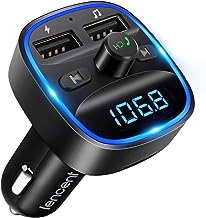
Best for: Drivers whose stereo lacks an AUX input but can tune to an FM radio frequency. The transmitter sends audio to the car stereo over FM, so it provides an alternative to a direct 3.5mm cable. It can receive music over Bluetooth and also supports USB flash drives and microSD cards, according to the listed features.
The LENCENT unit supports MP3, WMA, WAV, APE, and FLAC formats from USB or microSD storage, with each storage option listed as supporting up to 32GB. It also has two USB ports, specified as 5V/2.4A and 5V/1A, and lists protection features for charging. CVC noise suppression and echo cancellation are included for hands-free calls and voice navigation.
Limitation: FM audio requires choosing a usable frequency on both the transmitter and car radio. This is less direct than a wired AUX connection, and the listed USB charging ports have different output ratings.
Lightning-to-AUX iPhone Cable

Best for: Buyers with an iPhone that uses a Lightning connector and a car stereo with a 3.5mm AUX input. This 3.3-foot cable combines the phone-side Lightning connection and the car-side 3.5mm audio plug in one cable, avoiding a separate AUX cable and adapter.
The product title describes it as an Apple MFi Certified Lightning-to-1/8-inch audio cable and lists compatibility with iPhone 14, 13, 12, 11, XR, X, 8, and 7. It is selected for people who need a wired route from a Lightning-equipped phone to an AUX stereo. Confirm the phone’s connector and the car’s input before ordering.
Limitation: It is not a universal cable for phones with other connectors, and it still requires a 3.5mm AUX input in the car. The supplied listing does not provide further feature details beyond the product title.
arsvita Cassette-to-AUX Adapter

Best for: Drivers with an older car stereo that has a functioning cassette player but no convenient AUX or Bluetooth audio input. The product is identified as a cassette-to-AUX adapter with a 3.5mm auxiliary cable, so it offers a way to play audio from an external device through the cassette deck.
This option is selected because it addresses a different car setup from the other products: the audio connection begins at the cassette player rather than an AUX jack, Bluetooth receiver, or FM radio. It may suit a driver who wants to retain the existing stereo instead of replacing it, provided the player works and the audio device can connect to the adapter’s 3.5mm plug.
Limitation: It depends on having a cassette deck that accepts and plays tapes. The product information supplied does not specify cable length or additional functions, so check the listing details if those matter.
Buying Guide: How to Choose a Car MP3 Jack
What audio input does the car have?
Start by checking the stereo rather than the phone. Look for a 3.5mm AUX port, a cassette slot, Bluetooth audio support, or a radio tuner. The right accessory depends on how the car can receive sound. A basic AUX cable cannot connect to an FM-only stereo, while a cassette adapter is useful only if the car has a working cassette player.
- AUX input: Choose a 3.5mm cable for a device with a headphone jack, or a Bluetooth AUX receiver for wireless playback.
- Cassette player: Consider a cassette-to-AUX adapter for a compatible audio device.
- FM radio but no AUX: Consider an FM transmitter, such as the LENCENT, and tune the stereo to its selected frequency.
- Bluetooth audio already built into the stereo: Check the stereo’s pairing instructions before buying another receiver.
Should you choose wired or wireless playback?
A wired AUX cable provides a direct connection and does not require pairing or a separately charged receiver. It does require a suitable jack at both ends, or a purpose-made cable such as the Lightning-to-AUX option for a compatible iPhone. A Bluetooth receiver reduces the need to plug the phone into the car, but the COMSOON receiver has its own battery and must connect to the car through AUX.
An FM transmitter can serve cars without AUX, but it relies on radio tuning rather than a direct audio input. If convenience is more important than avoiding cables, Bluetooth may be preferable when the stereo supports it. If the car has a clear AUX port and the phone has a matching output, a simple cable is usually the most straightforward setup.
How do phone connectors affect the choice?
Identify the audio output on the phone or music player. A standard 3.5mm headphone jack can connect to a male-to-male AUX cable. The listed iPhone cable is specifically a Lightning-to-3.5mm cable and names several Lightning-equipped iPhone models. Devices with a different connector need a compatible audio solution; do not assume that a cable listed for Lightning will fit another phone.
Do you need hands-free calls or charging?
For calling features, compare the listed claims rather than assuming every audio cable includes a microphone or call controls. COMSOON lists noise reduction for calls, and LENCENT lists hands-free calling and voice navigation. The LENCENT model also specifies two USB charging ports. The basic cables in this selection are presented as audio connections, not as car chargers.
What should you check before buying?
- Confirm the car’s actual input and whether it works.
- Check the phone’s connector and whether it has a 3.5mm audio output.
- For Bluetooth receivers, verify that the car has AUX and consider charging needs.
- For an FM transmitter, make sure you are comfortable selecting a radio frequency.
- For a cassette adapter, confirm that the stereo has a usable cassette player.
- Review cable length and the placement of the car’s ports, especially if the cable must reach a dashboard or console.
Frequently Asked Questions
What is an MP3 jack for a car?
It usually means a connection or adapter that lets a phone or MP3 player send audio to a car stereo. A 3.5mm AUX cable is the simplest example when both the device and stereo have compatible audio jacks.
Can I play music through AUX without Bluetooth?
Yes. Connect a compatible device to the car’s 3.5mm AUX input with a suitable cable, then select AUX as the stereo’s audio source. The device needs a matching headphone jack or an appropriate wired audio cable.
How can I play music if my car has no AUX port?
Options depend on the stereo. A cassette adapter can work with a functional cassette player, while an FM transmitter can send audio to a car radio. Check the car’s available inputs before selecting either option.
Does a Bluetooth AUX receiver need an AUX port?
Yes. The COMSOON receiver sends Bluetooth audio from a paired device to a stereo through its 3.5mm AUX connection. It is not designed to provide an AUX connection to a car that lacks one.
Is an FM transmitter the same as an AUX cable?
No. An AUX cable sends audio through a direct wired connection. An FM transmitter sends audio to the car radio over an FM frequency, so the stereo must tune to that frequency.