
The best home stereo system for bass depends on whether you want a strong bass boost, higher output, or a dedicated subwoofer. The Philips FX10 is best for a one-touch bass boost, while the Acoustic Audio AA5170 is better for listeners who want a powered subwoofer and surround speakers. For a compact stereo with adjustable bass and treble, consider the Panasonic SC-PM700PP-K.
| System | Best For | Bass-Related Feature |
|---|---|---|
| Philips FX10 | Quick bass boost | MAX Sound and bass-reflex speakers |
| Philips 100W Wi-Fi system | Music and radio sources | 5.25-inch woofers and bass-reflex ports |
| Philips 80W Bluetooth system | Larger-room stereo listening | 4-inch woofers and bass-reflex ports |
| Panasonic SC-PM700PP-K | Adjustable sound in a compact system | Bass control and bass-reflex port |
| Acoustic Audio AA5170 | Subwoofer-based surround sound | Powered subwoofer |
Philips FX10 Stereo System
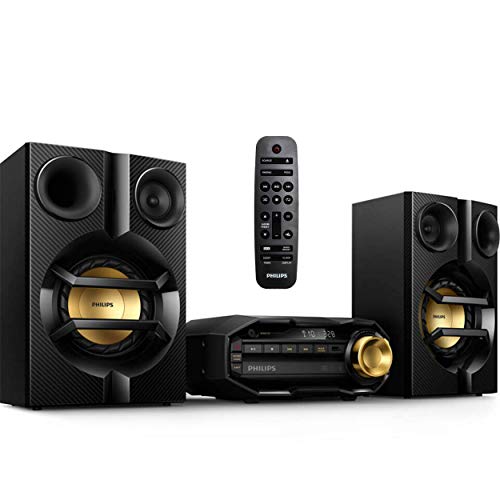
The Philips FX10 is best for buyers who want bass to be prominent without adding a separate subwoofer. Its feature list describes a dual-amplifier design, bass-reflex speakers, and MAX Sound, which is intended to provide an instant boost to bass and volume. The system is rated at 230 watts in its product name.
It also supports Bluetooth streaming, CD playback, MP3, USB, and FM radio, so it can serve as a central system for several common music sources. The included remote adds another way to control playback and sound settings.
- Best for: Listeners who want a quick bass and volume boost for music.
- Why it stands out: MAX Sound is specifically described as boosting bass, while the dual-amplifier design separates woofer and tweeter amplification.
- Consider: The provided details do not identify a separate powered subwoofer, so buyers seeking a dedicated sub should compare it with the Acoustic Audio system.
Choose this Philips if convenience and a bass-forward listening option matter more than having a separate subwoofer enclosure.
Philips 100W Wi-Fi Stereo System

This Philips system is best for buyers who want bass-capable stereo speakers alongside a broad range of listening sources. Its listed 100-watt output works with 5.25-inch woofers and bass-reflex ports. Philips describes the sound as having powerful bass, with output suited to a lounge or open-plan home.
Source options include Wi-Fi streaming with Spotify Connect, Bluetooth, CDs, USB playback, internet radio, and FM radio. It also includes an aux-in connection and a headphone jack. The combination is useful for households that switch between streaming, radio, and physical media.
- Best for: Buyers who want a multi-source system with larger woofers and bass-reflex speaker design.
- Why it stands out: It pairs 100W output with 5.25-inch woofers and offers both internet and FM radio.
- Consider: The listed features do not mention a separate subwoofer or a dedicated bass adjustment control.
Choose this model if streaming flexibility and a fuller stereo-speaker setup are priorities. Buyers who want manual bass adjustment may prefer a system with a stated bass control knob.
Philips 80W Bluetooth Stereo System

This Philips stereo is best for listeners who want a higher-output bookshelf system for music, movies, and multiple everyday sources. Its listed 80W RMS output is paired with two-way speakers, 4-inch woofers, 0.75-inch tweeters, and bass-reflex ports. Those speaker details make it a relevant option for buyers comparing bass response in a traditional stereo system.
Bluetooth 5.4 supports wireless music streaming, and Auracast is listed for sharing or broadcasting audio to compatible speakers. Other playback options include CDs, FM radio, USB files in MP3, WAV, WMA, and FLAC formats, and a 3.5mm audio input.
- Best for: Buyers who want stereo speakers with a stated RMS output and bass-reflex ports.
- Why it stands out: The two-way bookshelf speakers combine dedicated woofers and tweeters rather than relying on a single full-range driver.
- Consider: No separate subwoofer or dedicated bass control is listed in the supplied features.
Choose this model if stereo separation, file-format options, and a range of wired and wireless sources matter. For stronger low-frequency emphasis from a separate speaker, consider a subwoofer-based system instead.
Panasonic SC-PM700PP-K Stereo System

The Panasonic SC-PM700PP-K is best for buyers who want to adjust bass and treble directly rather than rely only on a preset boost. It provides 80W RMS output, with a 10cm woofer, a 6cm tweeter, and a bass-reflex port. A bass and treble knob and “My Sound” presets let listeners tailor the system’s sound.
This compact system combines a CD player, FM radio, Bluetooth playback, and USB playback from a flash drive. It includes a remote, which makes it easier to change settings or playback from across the room.
- Best for: People who want a compact system with stated bass adjustment.
- Why it stands out: Its manual bass and treble controls offer a straightforward way to change tonal balance.
- Consider: The supplied information lists a bass-reflex speaker, but does not describe a separate subwoofer.
Choose the Panasonic if having control over bass level is more important than adding a dedicated low-frequency speaker. It is also a practical fit for buyers who want CDs and radio in one compact system.
Acoustic Audio AA5170 5.1 System

The Acoustic Audio AA5170 is best for buyers who want a home theater-style setup with a dedicated powered subwoofer. The listed system includes a subwoofer, five wired satellite speakers, and an integrated amplifier. Its features state 700 watts of system power and describe a frequency range of 20Hz–20kHz.
Bluetooth, FM radio, USB, SD card, RCA, AUX, and digital/optical inputs are listed. The system supports stereo and 5.1 connections, and its Pro Surround function can convert stereo to 5.1 sound. The feature list also gives cable lengths for the satellite speakers, a useful detail when planning speaker placement.
- Best for: Buyers seeking a separate subwoofer and multi-speaker surround arrangement.
- Why it stands out: Unlike the compact stereo systems above, it specifically includes a powered subwoofer and five satellites.
- Consider: The satellite speakers are wired, so placement depends on the included RCA cable lengths and access to suitable connections.
Choose this system if a dedicated subwoofer and surround layout matter more than having a compact two-speaker stereo. Check room layout and cable routes before deciding where its wired speakers will go.
Buying Guide: How To Choose A Home Stereo For Bass
Do you want bass boost or a separate subwoofer?
A bass boost changes how the stereo presents low frequencies, while a separate subwoofer provides a dedicated speaker for bass. The Philips FX10 lists MAX Sound for an instant bass and volume boost. The Acoustic Audio AA5170 includes a powered subwoofer. These approaches suit different priorities: a conventional stereo setup or a multi-speaker system with a distinct subwoofer.
Look for precise descriptions in product specifications. Terms such as “bass-reflex port” describe a speaker enclosure feature, not the same thing as a separate subwoofer. If a subwoofer is essential, confirm that the product explicitly includes one rather than assuming it from a bass-related label.
How much output do you need?
Compare the type of power figure as well as the number. The product information lists 80W RMS for the Philips and Panasonic systems, 100W for the Wi-Fi Philips, and 700 watts of system power for the Acoustic Audio. The Bobtot listing elsewhere in the supplied product set specifies 1200 watts peak power, which is a different measure from RMS. Do not treat peak and RMS figures as directly equivalent.
Room size, speaker placement, and listening distance also affect how a system works in a home. A compact stereo may suit a desk or smaller room, while a multi-speaker system requires space for its subwoofer and satellites. The listed power alone does not establish how much bass a particular room will have.
Do speaker size and design matter?
Check the speaker configuration when comparing systems. The Philips 100W model lists 5.25-inch woofers, and the Philips 80W system lists 4-inch woofers with separate tweeters. The Panasonic SC-PM700PP-K lists a 10cm woofer and bass-reflex port. These specifications help explain the design, but they do not guarantee a particular sound in every room.
Bass-reflex ports appear on several of the stereo systems in this guide. They are a design feature intended to support the speaker’s low-frequency output. They should not be confused with a separate powered subwoofer, which the Acoustic Audio system lists explicitly.
Which sound controls are useful?
Choose a system with controls that match how much adjustment you want. The Panasonic SC-PM700PP-K lists a bass and treble knob plus sound presets. The Philips FX10 describes MAX Sound as a one-touch boost. These are different forms of control: one allows bass level adjustment, while the other is a quick boost mode.
If you regularly listen to different genres or use the system for spoken-word audio, a bass and treble control may be useful for changing the balance. If you prefer a simple option, a named boost feature may be easier to operate. Review the listed controls rather than assuming that every system includes an equalizer.
Which sources and connections should you check?
List the sources you actually use before choosing a stereo. The models in this guide include combinations of Bluetooth, CD, USB, FM radio, and wired inputs. The Philips Wi-Fi system adds Spotify Connect and internet radio. The Acoustic Audio system lists RCA and digital/optical inputs, along with USB and SD card playback.
Also consider whether a remote, headphone jack, or external input matters for your setup. Confirm that the product’s listed inputs match the devices you want to connect. A system with many features is not automatically the best choice if it lacks the source or control you use most.
Will the system fit your room and setup?
Measure the space available for the main unit, speakers, and any subwoofer. A two-speaker stereo generally involves fewer speaker locations than a 5.1 arrangement. With wired satellites, check where cables can run and whether the listed lengths suit your room. Speaker placement can affect the listening experience, so leave room to position components sensibly.
For an open-plan room, compare the systems’ stated output and speaker configuration, but avoid choosing by wattage alone. For a desk or smaller space, a compact system may be easier to place. A dedicated subwoofer system is a better fit when you have room for an additional speaker and want that component included.
Frequently Asked Questions
Which type of home stereo is best for strong bass?
A system with a dedicated powered subwoofer is a clear option for buyers seeking a separate bass speaker. In this selection, the Acoustic Audio AA5170 lists a powered subwoofer. For a traditional stereo system, compare woofer size, bass-reflex design, and any stated bass controls or boost features.
Does a bass-reflex port mean a stereo has a subwoofer?
No. A bass-reflex port is part of a speaker enclosure design. A separate subwoofer is an additional speaker component and should be listed explicitly in the product details.
Is a higher wattage number always better for bass?
No. Power figures can use different measures, including RMS and peak power, and they do not independently describe bass quality. Compare like-for-like specifications and consider speaker design, room size, and whether a subwoofer is included.
Which system offers manual bass adjustment?
The Panasonic SC-PM700PP-K lists a bass and treble knob, along with “My Sound” presets. The Philips FX10 instead lists MAX Sound as an instant bass and volume boost.
Can a home stereo play music from a phone?
Several systems in this guide list Bluetooth playback, including the Philips and Panasonic stereos. The Philips Wi-Fi system also lists Spotify Connect. Check the specific model’s features to confirm the connection method you need.