
A 3.5mm jack wireless receiver adds Bluetooth audio to a car stereo, speaker, or other device with an AUX input. The UGREEN Aux to Bluetooth 6.0 Adapter is best for straightforward car use and hands-free calls; COMSOON is a strong fit for buyers who prioritize long stated battery life; and 1Mii adds physical volume controls. For travel or sending audio to wireless headphones, consider a two-way transmitter-receiver instead.
| Product | Best For | Standout Feature |
|---|---|---|
| UGREEN Aux to Bluetooth 6.0 Adapter | Car AUX use and calls | Built-in microphone |
| COMSOON Bluetooth Receiver | Long listening sessions | Up to 16 hours of use |
| 1Mii Bluetooth 6.0 Receiver | On-device adjustments | Volume buttons and call controls |
| UGREEN Transmitter Receiver | Travel and two-way Bluetooth audio | TX and RX modes; dual pairing |
| GMCELL C28 Transmitter Receiver | Simple use with varied AUX devices | One-button mode switching |
UGREEN Aux to Bluetooth 6.0 Adapter

This UGREEN receiver is designed to bring Bluetooth audio and hands-free calling to car audio systems, home audio equipment, and speakers with an AUX input. Connect the receiver to the 3.5mm jack, then pair a phone or other Bluetooth source to stream audio through the connected sound system.
The listed features include Bluetooth 6.0, SBC codec support, a stated connection range of up to 10 meters, and a built-in microphone. The microphone supports hands-free calls through the connected speakers. Its focus is receiving audio over Bluetooth, rather than transmitting sound from a wired source to wireless headphones.
- Best for: Drivers who want a compact AUX receiver for music streaming and hands-free calls.
- Why it stands out: It combines a 3.5mm connection, built-in microphone, and stated 10-meter connection range.
- Consider: The supplied features do not state a battery runtime or battery capacity. Check the product details for its power requirements before choosing it for a setup without convenient USB power.
COMSOON Bluetooth Receiver With Noise Reduction

The COMSOON receiver connects a Bluetooth source to non-Bluetooth car stereos, home stereos, speakers, or wired headphones through a 3.5mm AUX connection. Its Bluetooth 5.0 chip is described as supporting stable connections and fast transmission. The product also lists CVC 8.0 noise cancellation and digital signal processing for reducing echo and background noise during calls.
COMSOON states that the receiver can operate for up to 16 hours during music playback or calls. It charges through USB-C, with a stated full charging time of 2.5 hours, and can be used while charging. That combination can suit buyers who want a rechargeable receiver for extended listening sessions.
- Best for: People who want a rechargeable AUX receiver with a stated long operating time and call-focused noise reduction features.
- Why it stands out: It lists up to 16 hours of use and supports operation while charging.
- Consider: Its stated Bluetooth version is 5.0, while some other options listed here specify Bluetooth 6.0. Choose based on the features you need rather than version number alone.
1Mii Bluetooth 6.0 Receiver

The 1Mii receiver adds Bluetooth audio to car stereos, home audio systems, speakers, and wired headphones with a 3.5mm AUX connection. Its listed Bluetooth 6.0 technology is intended to support faster pairing, a more stable connection, and wider wireless range. Physical volume-up and volume-down buttons provide a way to adjust sound at the receiver.
For calls, the built-in microphone and one-touch controls support answering, rejecting, hanging up, and redialing. The listed controls also include a two-second button press to activate a voice assistant. These controls make this model a practical option for someone who wants more than basic audio reception.
- Best for: Buyers who want a receiver with on-device volume adjustment and call controls.
- Why it stands out: Its listed controls cover volume, several call actions, and voice-assistant activation.
- Consider: The provided product information does not specify battery life or charging details. Confirm those details if you need a particular runtime or charging method.
UGREEN Two-Way Bluetooth Transmitter Receiver
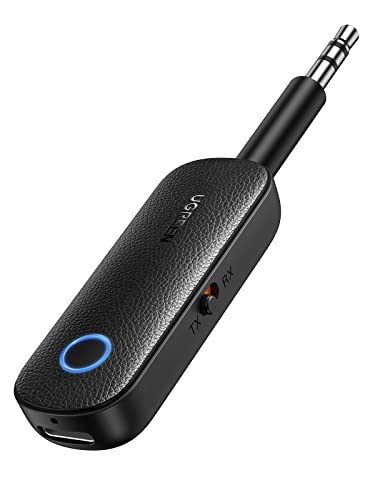
Unlike a receiver-only adapter, this UGREEN model has both transmitter (TX) and receiver (RX) modes. In transmitter mode, it sends audio from a compatible wired audio source to Bluetooth devices. In receiver mode, it brings Bluetooth audio to a device connected through its 3.5mm jack. The listed use cases include cars, home audio, and airplane audio systems.
The product supports pairing with two devices at once. UGREEN lists up to eight hours of use in TX mode and up to 5.5 hours in RX mode. A built-in microphone supports answering and ending calls, but the product information specifies that calls are supported only in RX mode. After initial pairing, it is described as automatically reconnecting when used again.
- Best for: Travelers and households that want one adapter for sending and receiving Bluetooth audio.
- Why it stands out: It has two modes, dual-device pairing, and separate stated runtimes for TX and RX.
- Consider: Calls are supported only in RX mode, and the stated runtime is shorter in RX mode than TX mode.
GMCELL C28 Bluetooth Transmitter Receiver

The GMCELL C28 is a two-way adapter for devices with a 3.5mm headphone or AUX jack. Its listed compatible device types include stereos, turntables, older TVs, car AUX inputs, CD players, treadmills, projectors, and airplane seats. One button switches between transmitter mode, which sends audio out to Bluetooth headphones, and receiver mode, which brings Bluetooth audio into a wired sound system.
The product description emphasizes plug-and-play operation without an app or pairing codes. It states up to six hours of use per charge, a two-hour recharge time using the included USB cable, and the ability to charge while operating. A red-and-blue LED indicates battery level.
- Best for: Buyers who want a two-way adapter for different AUX-equipped devices and a simple mode switch.
- Why it stands out: Its listed use cases extend beyond cars, and it can charge while in use.
- Consider: The stated runtime is up to six hours, so plan to recharge it for longer sessions or keep a suitable power source available.
Buying Guide: How To Choose A 3.5mm Jack Wireless Receiver
A 3.5mm jack wireless receiver is useful when a speaker, stereo, or car audio system has an AUX input but does not receive Bluetooth directly. A phone sends audio wirelessly to the receiver, and the receiver passes that audio through the 3.5mm connection. For a simple music setup, a receiver-only model may be enough. Choose a transmitter-receiver if you also need to send sound from a wired source to Bluetooth headphones.
Do You Need A Receiver Or A Transmitter-Receiver?
Choose a receiver-only adapter when the main goal is playing audio from a phone through an older car stereo or home system. This is the most direct choice when the audio system has a 3.5mm AUX input and the source device supports Bluetooth. A receiver may also support hands-free calls if it has a built-in microphone and call controls.
Choose a two-way transmitter-receiver when you want both functions. TX mode sends audio from a wired source, such as an airplane seat’s audio jack, to Bluetooth headphones. RX mode receives Bluetooth audio from a phone and sends it through a connected AUX device. Check the model’s mode-specific limits, including whether calls work in both modes.
Does The Device Have A 3.5mm AUX Input?
Check the input on the speaker, stereo, or car system before buying. A receiver must connect to a suitable 3.5mm input to play Bluetooth audio through that equipment. A device with a 3.5mm output is a different use case: it may need a Bluetooth transmitter to send audio to wireless headphones.
Also consider the physical layout around the jack. An adapter may need room to connect without being bent or obstructed. If the device’s jack is difficult to reach, check product images and dimensions in the listing before deciding.
How Important Are Battery Life And Charging?
Battery life matters when the receiver will be used away from a convenient power source. The products in this list have different stated runtimes: COMSOON lists up to 16 hours, UGREEN’s two-way model lists up to eight hours in TX mode and 5.5 hours in RX mode, and the GMCELL C28 lists up to six hours. These figures are manufacturer-provided claims, and actual use can vary.
Some listings do not provide a runtime in the supplied features. If you plan to use a receiver for long drives or extended listening, verify its power source, charging connection, and operating time in the complete product details. A model that can run while charging may be useful when a suitable USB power source is available.
Do You Need Hands-Free Calling?
For calls through a car stereo, look for a built-in microphone and clearly stated call controls. A microphone can capture your voice while the connected speakers play the other caller’s voice. Some models include buttons for answering, rejecting, or ending a call. Controls can differ between receiver and transmitter modes, so read the mode-specific details before buying.
Noise reduction features may be relevant if calls will take place in a noisy environment. COMSOON lists CVC 8.0 noise cancellation and digital signal processing. These are product specifications, not a guarantee that every call will sound the same in every vehicle or room.
Which Controls Make Daily Use Easier?
Physical buttons can make common actions easier without reaching for a phone. The 1Mii receiver lists volume buttons, one-touch call controls, and a voice-assistant shortcut. UGREEN’s two-way adapter describes a press-and-hold action for power and pairing. Compare the available controls with how you expect to use the receiver, especially if it will be installed in a car.
Simple setup can also be important. Product descriptions may mention automatic reconnection or plug-and-play pairing, but initial pairing is still required for Bluetooth devices. Check the instructions for your chosen model and test the connection while parked or at home before using it during a drive.
What Bluetooth Version Or Codec Should You Compare?
Bluetooth version and supported codecs are useful specifications, but they do not tell the whole story. The products listed here include Bluetooth 5.0, 5.1, and 6.0 models. UGREEN’s standard receiver lists SBC support, while another UGREEN model lists LDAC support. Confirm that the source device and the intended use support the feature you want; otherwise, a newer version or codec may not provide a practical benefit in your setup.
For everyday use, connection stability, control layout, microphone needs, charging, and the correct operating mode may matter more than a version number alone. Compare the listed features against your actual audio source and destination.
Frequently Asked Questions
What Does A 3.5mm Bluetooth Receiver Do?
It receives audio wirelessly from a Bluetooth source, such as a phone, and sends that audio through a 3.5mm connection to a compatible stereo, speaker, or wired headphones.
Can I Use A 3.5mm Receiver In A Car?
Yes, if the car audio system has a compatible 3.5mm AUX input. Connect the receiver to the input and pair it with a Bluetooth source. Follow the product’s power and setup instructions.
Can A Bluetooth Receiver Send Audio To Wireless Headphones?
A receiver-only adapter generally receives Bluetooth audio rather than transmitting audio to headphones. For wireless headphones connected to a wired source, choose a model with transmitter mode.
Can I Make Hands-Free Calls Through An AUX Receiver?
Some receivers support calls through a built-in microphone and compatible call controls. Check the product details carefully; for two-way adapters, call support may be limited to one mode.
How Do I Know Whether I Need A Receiver Or Transmitter?
Choose receiver mode to send phone audio to a wired AUX sound system. Choose transmitter mode to send audio from a wired source to Bluetooth headphones or speakers.
Will Every Receiver Work With Every 3.5mm Jack?
No. Check the product’s connection type and the audio device’s jack function. A 3.5mm AUX input is typically used for receiving audio, while a headphone output is commonly used as an audio source for a transmitter.