
The best rack mount power amplifier depends on the speakers, signal sources, and installation. The Rockville RCS650-6 is best for multi-zone commercial sound, while the MUSYSIC MU-D8500 is aimed at high-output two-channel applications. For DJ and event setups, the Pyle PTA1000BT adds Bluetooth and USB playback; the Rockville RPA5 is a more modest 2U option, and the RPA12 lists higher RMS output with bridging and crossover features.
| Amplifier | Best For | Standout Features |
|---|---|---|
| Rockville RCS650-6 | Commercial multi-zone audio | Six zones, 70V/100V and low-impedance operation |
| MUSYSIC MU-D8500 | High-output two-channel systems | Class D, stereo or bridge mode |
| Pyle PTA1000BT | DJ and playback setups | Bluetooth, USB MP3 playback, bridge mode |
| Rockville RPA5 | Compact DJ or home rack systems | Built-in crossover, multiple input types |
| Rockville RPA12 | Higher-output rack systems | 1400W RMS listed, LCD, crossover |
Rockville RCS650-6 For Six-Zone Commercial Audio
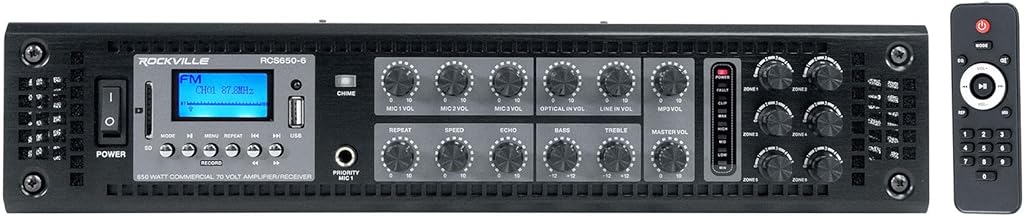
The Rockville RCS650-6 is best for businesses that need to distribute audio across multiple areas. Its listed 650W output and six zone controls make it a better fit for separately managed commercial spaces than for a basic two-channel DJ rig.
- Supports 70V, 100V, and 4–8 ohm speaker systems.
- Includes Bluetooth, USB/SD playback, optical input, and three microphone inputs.
- Zone volume controls and a chime function support paging and announcements.
Choose this model if centralized source connections and per-zone volume adjustment are priorities. The mix of speaker formats may also suit installations that need either distributed-line or conventional low-impedance output. Its multiple inputs provide flexibility for music and microphone sources.
Limitation: This is a zone-oriented commercial amplifier, not the most straightforward choice for a conventional two-channel passive-speaker setup. Confirm that its output modes and zone layout match the intended wiring before buying.
MUSYSIC MU-D8500 For High-Output Two-Channel Systems

The MUSYSIC MU-D8500 is best for users seeking a two-channel Class D amplifier with stereo and bridge operating modes. Its product name lists 8500W peak output; that peak figure should not be treated as continuous RMS output when comparing it with other amplifiers.
- Two channels and Class D amplifier design.
- Stereo and bridge modes.
- XLR inputs, Speakon outputs, and rack-mount construction.
Choose this amplifier if balanced XLR connections and Speakon speaker connections suit the rest of the system, and if you need the option of stereo or bridged operation. The Class D design is a listed feature for buyers comparing amplifier types and system requirements.
Limitation: The supplied product details do not state an RMS power rating or supported speaker impedance. Check the full specifications against your speakers and power needs rather than relying on the peak figure alone.
Pyle PTA1000BT For Bluetooth And USB Playback

The Pyle PTA1000BT is best for a DJ, rehearsal, or event setup where built-in playback options are useful. The listed 2000W bridgeable output is a product rating; compare it carefully with the system’s RMS requirements and the amplifier’s detailed specifications.
- Two-channel rack-mount amplifier with bridge mode.
- Bluetooth and USB-A input with an MP3 player.
- TRS and XLR inputs, Speakon outputs, cooling fan, and LED level meters.
Choose this model if you want playback from compatible Bluetooth sources or USB media without relying exclusively on an external player. TRS and XLR inputs give it connection options for source equipment, while the level meters provide a visible indication of signal level.
Limitation: Bluetooth and USB playback may not be needed in an installation built around a mixer or dedicated source system. The supplied details do not specify RMS output or speaker impedance, so confirm both before matching it to speakers.
Rockville RPA5 For Compact DJ Rack Systems

The Rockville RPA5 is best for a smaller professional or DJ rack where moderate listed output and broad connection choices are more important than a multi-zone layout. Its specifications list 1000W peak and 400W RMS, giving buyers both figures for comparison.
- Two channels with stereo and bridged modes.
- Built-in crossover.
- XLR, 1/4-inch, and RCA inputs; Speakon and banana outputs.
- 2U rack-mount format.
Choose this model if your sources use different input formats or if a built-in crossover is relevant to your setup. The stated 400W RMS is a more useful starting point for output comparisons than the 1000W peak figure.
Limitation: The RPA5 is the lower-output choice among the two Rockville professional/DJ amplifiers listed here. It may not be the right match for a system that requires more continuous power; confirm the speaker load and required output first.
Rockville RPA12 For Higher Listed RMS Output
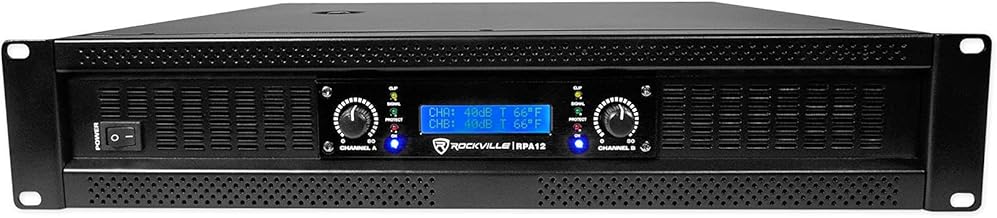
The Rockville RPA12 is best for buyers comparing higher-output two-channel rack amplifiers. Its listing specifies 1400W RMS and 5000W peak, plus a 2U rack format. The RMS specification makes it easier to compare with the RPA5’s stated 400W RMS, while the peak rating should be considered separately.
- Two channels with bridgeable operation.
- LCD display and cooling fans.
- XLR and 1/4-inch inputs; Speakon and banana outputs.
- Built-in crossover and 2U rack-mount design.
Choose this model if you need the listed RMS figure to be higher than the RPA5’s and want bridging, a crossover, and a display in the same amplifier. It is a better candidate for a system whose power requirements exceed what a lower-rated option can provide, provided the speaker load is supported.
Limitation: A higher output rating does not automatically make an amplifier suitable for every speaker. Check the full output-by-impedance specifications and ventilation requirements before installation.
Buying Guide: How To Choose A Rack Mount Power Amplifier
What will the amplifier power?
Start with the speakers and the job they need to do. A commercial paging system, distributed background-music system, DJ rig, and home rack can require different amplifier features. For multi-room or commercial sound, the RCS650-6’s six zones and 70V/100V support distinguish it from the two-channel models. For conventional stereo amplification, focus on channel count, speaker load, and the amplifier’s continuous output specifications.
How should you compare amplifier wattage?
Do not compare peak output with RMS output as if they were equivalent measurements. Peak figures appear in several product names, while the RPA5 and RPA12 listings also state RMS output. Use the manufacturer’s detailed specifications to compare output at the impedance you plan to use. The available product information does not provide every model’s RMS output or impedance-specific ratings.
Do you need stereo, bridge mode, or multiple zones?
Stereo mode supplies separate left and right channels. Bridge mode combines amplifier channels according to the manufacturer’s instructions and is useful only when the amplifier and speaker load support that configuration. A six-zone amplifier serves a different purpose: it provides separate zone controls for distributing audio. Do not assume zone outputs, stereo channels, and bridged operation are interchangeable.
Which inputs and outputs should you check?
Match input connectors to your mixer, player, or other source. XLR, TRS, 1/4-inch, RCA, optical, Bluetooth, and USB are not universal substitutes for one another. On the speaker side, check whether the amplifier’s Speakon, banana, or other connections match your cables. Also verify that the output type suits the speaker system, especially when choosing between 70V/100V distribution and low-impedance speakers.
How important are rack size and cooling?
Check the rack unit height, available rack depth, cable clearance, and the rack’s ventilation plan. The RPA5 and RPA12 are listed as 2U models, but buyers should confirm their complete physical dimensions and installation requirements. Cooling fans are specifically listed for the Pyle PTA1000BT and Rockville RPA12. Leave appropriate airflow around equipment and follow the product’s installation guidance.
Should you choose built-in playback?
Bluetooth and USB playback can reduce the need for separate playback equipment in some setups. The Pyle PTA1000BT lists Bluetooth and USB-A MP3 playback, while the RCS650-6 lists Bluetooth and USB/SD inputs. If the system already uses a mixer or central source, prioritize power, connections, and speaker compatibility instead of paying attention only to playback features.
Frequently Asked Questions
What is a rack mount power amplifier?
A rack mount power amplifier is an amplifier designed to install in an equipment rack. It receives an audio signal and supplies amplified output to passive speakers. Its channels, output ratings, connectors, and supported speaker loads determine which systems it can serve.
Is peak wattage the same as RMS wattage?
No. Peak and RMS ratings are different specifications and should not be treated as equal measures of continuous output. Compare amplifiers using consistent ratings and check the detailed manufacturer specifications for the intended speaker impedance.
Which listed amplifier is best for a multi-zone business?
The Rockville RCS650-6 is the clearest fit for multi-zone commercial audio in this selection because it lists six zones, individual zone volume controls, and 70V/100V as well as 4–8 ohm operation.
Which model has Bluetooth and USB playback?
The Pyle PTA1000BT lists Bluetooth and USB-A MP3 playback. The Rockville RCS650-6 also lists Bluetooth and USB/SD playback, along with commercial zone controls and microphone inputs.
Can any rack amplifier run any passive speaker?
No. Confirm that the amplifier’s supported impedance, output configuration, and power ratings match the speaker specifications. Also verify that bridge mode, if used, is supported at the connected load.
What does bridge mode do?
Bridge mode combines two amplifier channels into a bridged output according to the unit’s instructions. It can change the available output and the load requirements, so check the amplifier manual and speaker compatibility before using it.