
A 133 microfarad bass blocker is a speaker capacitor intended to reduce low-frequency signals reaching a speaker. The Audiopipe options are the closest matches for shoppers seeking a 133 µF unit, while the RonDexy pair is a near-value alternative listed at 132 µF. The DS18 products are much smaller capacitors for filtering high frequencies to tweeters or drivers, so they are not substitutes for a 133 µF bass blocker.
| Product | Best For | Listed Capacitance |
|---|---|---|
| Audiopipe 133 UF Bass Blockers | Buyers seeking the specified value | 133 µF |
| Audiopipe 133 UF 4 Pack | Buyers needing multiple blockers | 133 µF |
| RonDexy RDBB-300 | Buyers considering a close alternative | 132 µF |
| DS18 BB2.2UF/50V-10PK | High-frequency tweeter filtering | 2.2 µF |
| DS18 BB4.7UF/50V-10PK | High-frequency driver filtering | 4.7 µF |
Audiopipe 133 UF Bass Blockers

The Audiopipe 133 UF blockers are the most direct match for a search for a 133 microfarad bass blocker. The product name lists crossover points of 300 Hz for 4-ohm speakers and 150 Hz for 8-ohm speakers. It also names 6-by-9-inch, 6-by-8-inch, and 5-by-7-inch speaker sizes.
Best for: Buyers who specifically want the listed 133 µF value and are matching the stated impedance and speaker-size details. The value and frequency information make it easier to compare with an existing passive speaker setup.
Limitation: The supplied product details do not specify power handling or package quantity. Confirm those details on the product listing before ordering, particularly if you need blockers for multiple speakers.
Audiopipe 133 UF Bass Blockers, Four Pack
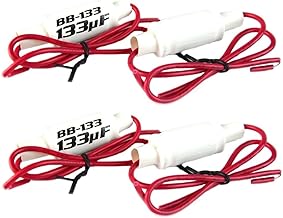
This Audiopipe listing names a four-pack of 133 UF bass blockers and gives the same listed crossover points as the other Audiopipe option: 300 Hz at 4 ohms and 150 Hz at 8 ohms. The pack format may suit an installation that requires several blockers or a buyer who wants spare units.
Best for: Buyers who need multiple 133 µF blockers while seeking the listed frequency and impedance information. It is a better fit than the single-quantity-style listing when the project calls for several units.
Limitation: The provided feature text includes claims about dynamic drivers, RCA cables, and speaker dimensions that do not clearly describe a bass-blocker component. Treat the product name as the clearest specification and verify the exact contents and details in the listing before purchase.
RonDexy RDBB-300 Bass Blocks

The RonDexy RDBB-300 is listed at 132 µF, one microfarad below the requested 133 µF value. Its product information says it blocks frequencies from 0 to 300 Hz at 4 ohms and from 0 to 150 Hz at 8 ohms. The listing specifies a pair, up to 50 watts of power handling, and color-coded leads: white positive and black negative.
Best for: Buyers who can consider a near-value alternative and want a pair with stated lead polarity and power handling. The listed frequency ranges make it straightforward to compare against the Audiopipe 133 UF products.
Limitation: This is a 132 µF product, not 133 µF. Choose it only if that difference is suitable for your system requirements, and check that the stated 50-watt handling meets the intended application.
DS18 BB2.2UF/50V-10PK Capacitors

This ten-piece DS18 pack contains 2.2 µF non-polar electrolytic capacitors. The listing gives a filtering point of 18 kHz at 4 ohms or 9 kHz at 8 ohms, with a 6 dB-per-octave slope. It describes the components as suitable for car audio and pro audio systems and intended to filter low-frequency signals from tweeters or other high-frequency speakers.
Best for: Buyers who need small-value capacitors for high-frequency filtering across several speakers. The ten-piece quantity may be useful for multiple installations or spares.
Limitation: At 2.2 µF, this is not a substitute for a 133 µF car-speaker bass blocker. Avoid it if your target is the lower-frequency blocking associated with the Audiopipe or RonDexy products.
DS18 BB4.7UF/50V-10PK Capacitors

The DS18 BB4.7UF/50V-10PK includes ten 4.7 µF non-polar electrolytic capacitors. Its listed filtering points are 8.5 kHz at 4 ohms and 4.2 kHz at 8 ohms, with a 6 dB-per-octave slope. The product description presents the capacitors for filtering low frequencies from drivers in car audio or pro audio systems.
Best for: Buyers seeking a small-value capacitor for high-frequency driver filtering and needing several pieces. Compared with the 2.2 µF DS18 option, this product has a higher capacitance and lower listed filtering frequencies.
Limitation: The 4.7 µF value is far below 133 µF. This product belongs to a different filtering application and should not be selected as a direct replacement for a 133 microfarad bass blocker.
Buying Guide: Choosing a 133 Microfarad Bass Blocker
What does a 133 µF bass blocker do?
A bass blocker is a capacitor placed in series with a speaker to reduce the low-frequency signal reaching that speaker. In this context, “133 microfarad” refers to the capacitor’s capacitance, written as 133 µF. It does not, by itself, describe every detail of the resulting filter. Speaker impedance and the rest of the audio circuit affect the crossover behavior.
Does speaker impedance change the listed frequency?
Yes. The Audiopipe listing gives 300 Hz at 4 ohms and 150 Hz at 8 ohms. RonDexy lists the same frequency ranges for its 132 µF product. These are the manufacturers’ stated figures; compare the value that corresponds to your speaker’s impedance rather than assuming one frequency applies to every speaker.
Should you choose 133 µF or 132 µF?
Choose a 133 µF Audiopipe option if matching the requested capacitance is important. Consider the 132 µF RonDexy pair only if a one-microfarad difference is acceptable for the project. The RonDexy listing also states a pair quantity, 50-watt handling, and lead polarity, while the supplied details for the Audiopipe products do not provide those same specifications.
How many blockers do you need?
Count the speakers that need filtering and check how the selected product is packaged. The Audiopipe four-pack is named as a four-pack, and the RonDexy product is described as a pair. The quantity for the other Audiopipe listing is not clear from the supplied details. Confirm package contents before ordering so the quantity matches your installation.
How do you compare a 133 µF blocker with a small capacitor?
Do not treat all products called bass blockers as interchangeable. The DS18 capacitors are listed at 2.2 µF and 4.7 µF, with high-frequency filtering points in kilohertz. The Audiopipe 133 µF products and RonDexy 132 µF option are listed for much lower frequencies. Select by capacitance and stated application, not by the general product label alone.
What details should you verify before installation?
Match the listed impedance to the speaker, check the intended frequency range, and confirm package quantity and power handling where those specifications matter. Review the product’s wiring instructions before connecting it. For the RonDexy blocker, the supplied details identify white as positive and black as negative; do not assume that lead-color information applies to another product.
Frequently Asked Questions
Is 133 µF the same as 133 UF?
Yes. “UF” is commonly used in product titles to represent microfarads, while µF is the standard symbol. A 133 UF listing refers to a 133-microfarad capacitance.
Which listed product is closest to exactly 133 µF?
The Audiopipe options are listed as 133 UF. The RonDexy RDBB-300 is listed as 132 UF, so it is a near-value alternative rather than an exact match.
What frequency does a 133 µF bass blocker provide?
The Audiopipe listing states 300 Hz for 4-ohm speakers and 150 Hz for 8-ohm speakers. Use the figure that corresponds to the speaker impedance, and treat it as the product’s stated specification.
Can a 2.2 µF or 4.7 µF capacitor replace a 133 µF blocker?
No. The DS18 products are much lower in capacitance and are listed for high-frequency filtering. They are not direct substitutes for the 133 µF Audiopipe blockers.
Are these products suitable for every car speaker?
The listed frequency behavior depends on speaker impedance, and the Audiopipe name also identifies particular speaker sizes. Check the speaker’s impedance, the product specifications, and the intended installation before choosing a blocker.