
The best high gain overdrive pedal depends on whether you need extra saturation, detailed tone shaping, or a flexible boost for an already driven amp. The MXR EVH Modern High Gain is best for players seeking adjustable high-gain tone; the BOSS MT-2 offers extensive distortion shaping; and the JOYO JF-04 is a high-gain distortion option with a full-range EQ. The BOSS SD-1 and JOYO King of Kings are better suited to boosting or stacking overdrive than to providing the most extreme gain on their own.
| Pedal | Best suited for | Key feature |
|---|---|---|
| MXR EVH Modern High Gain | Adjustable high-gain tones | Gain, output, and three-band EQ controls |
| BOSS MT-2 Metal Zone | Detailed distortion shaping | Dual-stage gain circuit and advanced tone controls |
| JOYO JF-04 | High-gain distortion on a budget-conscious board | Analog circuit and full-range EQ |
| JOYO King of Kings R-20 | Stacked overdrive and multiple drive voices | Two independent channels |
| BOSS SD-1 Super Overdrive | Adding a focused overdrive or boost | Tube-like response from its clipping circuitry |
MXR EVH Modern High Gain

The MXR EVH Modern High Gain is the most direct match for guitarists looking specifically for a high-gain pedal with controls for shaping the sound. Its listed features include raw EVH high-gain tone, separate Output and Gain knobs, and Bass, Mid, and Treble controls. That control set makes it possible to adjust saturation and overall EQ separately rather than relying on a single tone knob.
Best for: Players who want high-gain saturation with hands-on control over the low, middle, and high frequencies. It is also a practical choice when balancing gain against clarity is a priority.
Why it stands out: The dedicated three-band EQ offers more explicit frequency shaping than a basic overdrive control. Output and Gain provide separate level and saturation adjustments.
Keep in mind: The product is described as delivering a specific EVH high-gain tone. Players seeking a mild, transparent boost or a broad range of low-gain overdrive may prefer a more versatile overdrive design.
BOSS MT-2 Metal Zone

The BOSS MT-2 Metal Zone is a high-gain distortion pedal designed for guitar, bass, and other instruments. Its dual-stage gain circuit is intended to produce thick, tight distortion and smooth, singing sustain. The advanced tone-shaping system can cover contrasting sounds, from mid-scooped rhythm tones to more prominent, cutting sounds.
Best for: Players who want substantial distortion and a wide range of EQ choices, particularly when they need to adjust how the guitar sits in a mix. Its listed compatibility with guitar and bass also makes it relevant to players seeking a distortion pedal for either instrument.
Why it stands out: The MT-2 combines high gain with more extensive tone shaping than many basic analog drive pedals. That makes it a stronger fit for users who want to experiment with different frequency profiles rather than set one fixed distortion sound.
Keep in mind: Its broad EQ options can take more adjustment than a simple overdrive pedal. Choose another model if minimal controls and quick, straightforward tone changes are more important than shaping flexibility.
JOYO JF-04 High Gain Distortion
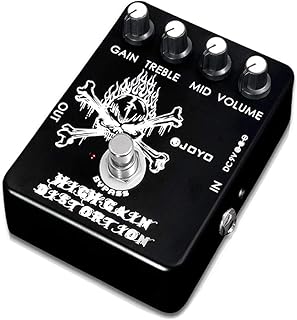
The JOYO JF-04 is a high-gain distortion pedal with an analog circuit, full-range EQ, and true bypass, according to its product name. It is described as covering tones from classic rock to heavy metal. The full-range EQ is useful for players who want to adjust the pedal’s tonal character instead of relying on a fixed distortion voice.
Best for: Guitarists looking for a dedicated high-gain distortion option that also advertises a broad EQ range. It is a relevant choice for players moving between classic-rock and heavier styles.
Why it stands out: The combination of high-gain distortion and full-range EQ directly addresses two common needs: strong drive and the ability to shape the resulting tone. Its true-bypass design is also a stated feature for players comparing bypass types.
Keep in mind: The available product details do not specify the exact control layout or how much gain range is available. Check the listing details if particular knobs or a specific style of EQ control are essential to your setup.
JOYO King of Kings R-20

The JOYO King of Kings R-20 is a dual-channel analog overdrive with separate Volume, Gain, and Tone controls for each channel. The channels can operate independently or stack in A-to-B order. Its clipping switches offer hard clipping, soft clipping, both styles together, or neither, creating distinct drive and boost options.
Best for: Players who want to combine more than one overdrive sound, such as a lower-gain rhythm setting and a second channel for boosting or adding saturation. It is also suited to guitarists who prefer separate controls for each drive stage.
Why it stands out: The two channels and selectable clipping styles provide more ways to configure overdrive than a single-channel pedal. The product description identifies its natural range as low- to mid-gain, while stacking the channels can add cascading saturation.
Keep in mind: This is not the clearest choice for players who need one standalone, extreme high-gain distortion sound. Its strongest stated use is flexible low- to mid-gain overdrive and channel stacking.
BOSS SD-1 Super Overdrive

The BOSS SD-1 Super Overdrive is a compact overdrive pedal whose listed description highlights a distinctive clipping circuit designed to produce tube-like characteristics. It is not presented as a dedicated high-gain distortion pedal, but it can be relevant to a high-gain setup when the goal is to add overdrive character or push a driven sound rather than generate all the distortion alone.
Best for: Players who want a compact, conventional overdrive sound or a pedal to use alongside another source of gain. It is a better match for adding drive and feel than for choosing a standalone metal distortion unit.
Why it stands out: The product description specifically calls out its clipping circuitry and tube-like characteristics. That makes it a useful comparison point for players who want an overdrive response rather than only maximum distortion.
Keep in mind: The listed product information does not describe it as a high-gain pedal. Avoid choosing it as your only pedal if you need pronounced heavy-metal distortion without another gain source.
Buying Guide: How To Choose A High Gain Overdrive Pedal
Do you need overdrive, distortion, or a boost?
These terms describe related but different roles on a guitar pedalboard. Overdrive generally adds drive and can be used to shape or push an existing amp sound. Distortion pedals are often selected when the pedal itself needs to supply a more pronounced distorted tone. A boost emphasizes signal level or helps push another gain stage. The products here span these roles, so match the pedal to the sound you need rather than relying on the word “gain” alone.
For a dedicated high-gain sound, compare the MXR EVH Modern High Gain, BOSS MT-2, and JOYO JF-04. The MXR emphasizes high-gain tone with separate gain, output, and three-band EQ controls. The MT-2 pairs a dual-stage gain circuit with advanced tone shaping. The JOYO JF-04 is described as high-gain distortion with a full-range EQ.
How much EQ control do you want?
EQ controls influence how much bass, midrange, and treble the pedal adds or emphasizes. More frequency controls give you more ways to shape the sound, but they may also require more time to adjust. The MXR provides Bass, Mid, and Treble controls, while the MT-2 is described as offering advanced tone shaping. The JOYO JF-04 is listed with a full-range EQ, though the provided product information does not detail its specific controls.
If you prefer simple adjustments, prioritize a pedal with a control layout you understand and can set quickly. If you need to change between a scooped rhythm sound and a more cutting lead tone, a broader EQ range may be more useful.
Will you use one pedal or stack gain stages?
A single high-gain pedal can provide a direct route to a distorted tone. Stacking pedals means sending one gain stage into another, which can add saturation or create separate rhythm and lead sounds. The JOYO King of Kings is specifically designed with two independent channels that can stack in A-to-B order. The BOSS SD-1 may suit players who want an overdrive alongside another gain source, but its listed description does not position it as a high-gain unit.
Before choosing a stackable pedal, consider whether you need two independently controlled channels or simply one main distortion sound. A dual-channel design offers more configuration options, while a dedicated distortion pedal may be easier to use when one main high-gain tone is the priority.
Should you prioritize gain range or tone flexibility?
Gain controls adjust saturation, but a high setting does not automatically produce the right sound for every guitar, amp, or musical style. Look at the controls and stated design as well as the gain label. The MXR separates Gain from Output and includes three-band EQ. The MT-2 emphasizes thick distortion, sustain, and extensive tone shaping. The JF-04 is described as covering classic rock through heavy metal.
For a wider range of drive levels, the King of Kings offers separate gain controls and clipping choices per channel. Its stated low- to mid-gain focus makes it better for layered overdrive than for a single extreme-gain tone.
What should you check before buying?
- Primary role: Decide whether the pedal must generate distortion, add overdrive, or support another gain stage.
- Control layout: Compare available gain, level, tone, and EQ adjustments. Do not assume a control is present when it is not listed.
- Channel setup: Choose a dual-channel pedal if you want two separately adjustable sounds or a specified stacking option.
- Bypass information: The JF-04 is listed as true bypass. Check the product listing for bypass details on other models if this is a deciding factor.
- Instrument use: The MT-2 is listed for guitar, bass, and other instruments. Confirm the product details for any other pedal you are considering.
Frequently Asked Questions
What is the best pedal here for a dedicated high-gain tone?
The MXR EVH Modern High Gain, BOSS MT-2, and JOYO JF-04 are the most directly described as high-gain or distortion options. The MXR offers separate gain and output controls with three-band EQ; the MT-2 adds a dual-stage gain circuit and extensive tone shaping; and the JF-04 is listed as high-gain distortion with full-range EQ.
Is an overdrive pedal the same as a high-gain distortion pedal?
No. Overdrive and distortion are different types of drive, and individual pedals are designed for different amounts and styles of saturation. The SD-1 and King of Kings are described as overdrive pedals, while the MT-2 and JF-04 are described as distortion options.
Which option has two independent overdrive channels?
The JOYO King of Kings R-20 has two independent channels, each with its own Volume, Gain, and Tone controls. Its channels can also stack in A-to-B order.
Which pedal offers the most clearly specified EQ controls?
The MXR EVH Modern High Gain lists Bass, Mid, and Treble controls. The BOSS MT-2 is described as offering advanced tone shaping, while the JOYO JF-04 is listed with a full-range EQ.
Can the BOSS SD-1 be used in a high-gain setup?
The SD-1 can be considered as an overdrive alongside another gain source, but its product description identifies it as a compact overdrive rather than a dedicated high-gain distortion pedal. Choose a pedal such as the MT-2 or JF-04 if you need a listed distortion option.