
The right six-string set depends on whether you play a full-scale six-string bass or a shorter-scale Bass VI. For a conventional six-string bass, Ernie Ball and D’Addario offer 32–130 sets. For Bass VI instruments, Stringjoy and Fender list lighter, Bass VI-oriented gauges. Check your instrument’s scale length, tuning, and current string gauges before choosing; these sets are not interchangeable by default.
| Product | Listed Gauge | Best For |
|---|---|---|
| Ernie Ball Long Scale Slinky | 32–130 | Long-scale six-string basses |
| D’Addario XL Nickel | 32–130 | Bright tone and consistent feel |
| Ernie Ball Short Scale Slinky | 20w–90 | Short-scale instruments using its specified format |
| Fender Super 250 Bass VI | .024–.084 in listed features | Bass VI-style setup |
| Stringjoy Signatures Bass VI | 24–90 | Bass VI players seeking balanced tension |
Ernie Ball Long Scale Slinky 32–130

This set is best for players who need a conventional long-scale six-string bass set in a 32–130 gauge range. Ernie Ball describes the strings as nickel-wound, made with tin-plated high-carbon steel core wire and nickel-plated steel winding. The listed features identify a rich, balanced tone.
Choose this set if your bass uses long-scale strings and the 32–130 range matches your instrument and preferred feel. The heavier low string and lighter high strings provide a broad gauge spread for a six-string bass arrangement. The listed construction and tone description make it a straightforward option for players seeking a familiar nickel-wound setup.
Limitation: The product is specifically listed as long scale. It may not suit short-scale basses or Bass VI instruments. Confirm the scale and required gauges before ordering.
D’Addario XL Nickel 32–130

D’Addario XL Nickel is best for six-string bass players who want a 32–130 set with a bright, tight sound and a consistent feel. The listed features specify nickel-plated steel wrap wire and a proprietary Hex-Core construction. D’Addario also describes the set as providing clear fundamentals, tight low notes, reliable intonation, and tuning stability.
Choose this set if you want a clearly specified long-range gauge set and value the manufacturer’s emphasis on consistent feel and durability. Its bright, tight tone is presented as suitable for a variety of musical styles, making it a useful comparison against the Ernie Ball 32–130 set.
Limitation: The supplied product details do not identify this as a Bass VI set. Do not assume that a 32–130 full-scale bass set will fit or feel appropriate on a Bass VI or short-scale instrument.
Ernie Ball Short Scale Slinky 20w–90
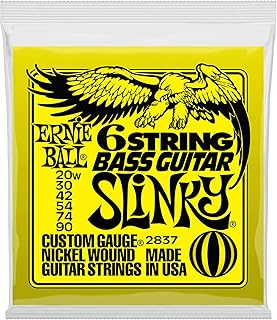
This Ernie Ball set is best for players looking specifically for a short-scale six-string string set with a listed 20w–90 gauge. Its strings use nickel-plated steel wire wrapped around a tin-plated, hex-shaped steel core. The features also describe small ball ends, similar to guitar strings rather than the larger ends used on traditional electric bass strings.
Choose this set only after checking the string-end format and scale requirements of your instrument. Its lighter listed gauge range differs substantially from the 32–130 long-scale sets above, so it is not a direct substitute for a conventional six-string bass set. The product’s specified construction and small ball ends are important selection details.
Limitation: The provided details do not give an exact scale length or individual gauge breakdown. Confirm fit and ball-end compatibility with the instrument manufacturer before buying.
Fender Super 250 Bass VI Strings

Fender Super 250 strings are best for Bass VI players who want a nickel-plated steel set identified for Bass VI use. The product features list gauges of .024–.084 and describes the strings as combining steel’s output and dynamic sound with nickel’s smoother feel. Fender also notes that the set is suited to rock and other styles where the instrument needs to cut through.
Choose this option when the Bass VI designation and listed gauge range correspond to your instrument’s requirements. That makes it a more targeted choice than a standard bass set when shopping for a Bass VI. The stated material and tonal description help distinguish it from the heavier 32–130 sets intended for conventional six-string basses.
Limitation: The product name and supplied features do not present the gauge range consistently. The features specify .024–.084, so verify the package details and exact set before purchase.
Stringjoy Signatures Bass VI 24–90

Stringjoy Signatures are best for Bass VI players seeking a 24–90 nickel-wound set described as balanced medium gauge. The listed features say the strings are designed to balance tension across the fretboard for comfortable, even playability. Stringjoy also highlights consistent tone, tuning stability, and quality-control checks for resonance and intonation.
Choose this set if you want a Bass VI-specific option and value the stated focus on balanced tension and smooth playability. Its 24–90 range is lighter than the 32–130 sets listed for conventional six-string basses, so it belongs in a different comparison group. The Nashville, Tennessee manufacturing detail is also included in the product description.
Limitation: The features do not specify the instrument’s scale length or a complete individual-gauge breakdown. Confirm that the set matches your Bass VI’s setup and tuning.
Buying Guide: How to Choose Six-String Bass Gauges
Is your instrument a six-string bass or a Bass VI?
This is the first question to answer. A conventional six-string bass commonly uses a much heavier string set than a Bass VI. In this selection, the conventional long-scale options are listed as 32–130, while the Bass VI sets are in lighter ranges such as 24–90 or .024–.084. These numbers show why “six strings” alone is not enough information to choose a set.
Check the instrument’s model documentation or current string packaging. Confirm the instrument type, scale length, tuning, and recommended string gauges. A Bass VI may use a guitar-style string format and different ball ends from a traditional bass. Do not choose by the product title alone when the listing details are inconsistent.
What does the gauge range tell you?
Gauge refers to string thickness, usually expressed in thousandths of an inch. A set described as 32–130 has a broad span between its thinnest and thickest strings. That notation does not, by itself, show the gauge of every string in the set, so check the manufacturer’s complete string-by-string specifications if you need an exact match.
Heavier strings generally feel firmer under the fingers than lighter strings, but the final feel also depends on scale length, tuning, setup, and string construction. A change in gauge can affect tension and may require setup adjustments. If you move well beyond your instrument’s existing gauges, consult a qualified technician or the instrument maker’s guidance.
How should scale length affect your choice?
Scale length affects how a string fits and feels when installed. The Ernie Ball 32–130 product is explicitly described as long scale, while the other listings identify short-scale or Bass VI use in their names or features. Treat those labels as meaningful selection criteria, not just marketing language.
Measure or verify your instrument’s scale specification rather than estimating from its overall body size. Also check whether the string has enough winding length for the tuning post and whether its end construction suits the bridge. If a listing does not provide these details, confirm them before ordering.
Which winding material and tone description matter?
Ernie Ball’s long-scale set uses nickel-plated steel winding around a steel core and is described as rich and balanced. D’Addario’s XL Nickel strings use nickel-plated steel wrap wire and are described as bright and tight. Stringjoy also lists nickel winding and emphasizes a full, powerful tone. These descriptions can guide a shortlist, but they do not replace checking fit and gauge.
Fender’s Bass VI set is described as combining steel output and dynamics with a smoother nickel feel. Consider whether you prioritize a bright attack, a balanced tone, or a particular playing feel. The product descriptions provide general tonal guidance, not a guarantee of how strings will sound on every instrument, amplifier, or setup.
Are ball ends and string format compatible?
Check the bridge and string-end style before choosing a set. The Ernie Ball short-scale listing specifically notes small ball ends similar to guitar strings, rather than the larger ends used on traditional electric bass strings. That distinction can matter for instruments designed around a particular string format.
Look for the instrument maker’s requirements and compare them with the listing. If the product information does not clearly identify ball-end size or compatibility, do not assume it will fit. This check is especially useful when comparing Bass VI strings with standard bass strings.
Should you choose the same gauges as your current strings?
Matching the current set is a practical starting point when you are satisfied with the instrument’s feel and setup. Record each string’s gauge if available, along with the tuning and string type. A new set with a substantially different gauge may change tension and playability, even when it physically fits.
If you intentionally want a lighter or heavier feel, compare the full gauge breakdown rather than only the thickest string. Make changes with attention to tuning and setup, and seek professional help if the instrument develops setup or intonation problems.
Frequently Asked Questions
What gauge are six-string bass strings?
There is no single standard gauge for every six-string instrument. The products here include conventional bass sets listed as 32–130 and Bass VI sets around 24–90. Choose based on your instrument type, scale length, tuning, and manufacturer recommendations.
Can I use 32–130 strings on a Bass VI?
Do not assume so. The 32–130 sets in this selection are presented as conventional six-string bass strings, while the Bass VI sets have lighter listed gauges. Check your Bass VI maker’s specifications before using a different string format or gauge.
Are 24–90 strings the same as 32–130 strings?
No. They represent different gauge ranges and are listed for different instrument categories in these products. Verify the full set specification and intended use before comparing them.
Do heavier strings always sound better?
No. Gauge alone does not determine sound quality. Tone and feel also depend on the instrument, tuning, playing technique, string construction, and setup. Choose a gauge that fits the instrument and your playing needs.
Do new gauges require a setup?
They may. A meaningful change in string gauge can alter tension and affect feel or setup. Follow the instrument manufacturer’s guidance and consult a technician if you are unsure.