
A high-to-low RCA converter lets you connect an aftermarket amplifier or subwoofer to a car stereo that has speaker-wire outputs but no RCA preamp outputs. The NuIth is best for buyers who want an adjustable level control, while PNGKNYOCN and Yeebline specify support for inputs up to 50 watts. AICARS is supplied as a two-pack, and Autokemat offers a single-dial adjustment feature. Check the input rating and adjustment needs against your system before choosing.
| Product | Best suited for | Standout listed feature |
|---|---|---|
| NuIth | Adjustable output level | Gain adjustment |
| PNGKNYOCN | Specified input limit | Up to 50 watts |
| AICARS | Buyers wanting two converters | Two-pack |
| Yeebline | Noise-reduction focus | Built-in noise-reduction circuitry |
| Autokemat | Simple level matching | Single adjustment dial |
NuIth Adjustable 2-Channel Converter

The NuIth converts speaker-level output from a factory or aftermarket car stereo into RCA output for an amplifier or subwoofer. Its listed features include two-channel operation and a level-gain adjustment intended to let the user adjust bass level without changing the amplifier setting.
Best for: Drivers adding an amplifier or subwoofer who want an adjustment control on the converter. It is a relevant choice when the stereo lacks RCA outputs and the installation needs speaker-wire-to-RCA signal conversion.
Why it was selected: The adjustable gain feature distinguishes it from basic converters in this group. The listing says it can be used with a two-channel or mono amplifier or subwoofer.
Limitation: The provided product information does not state a maximum input wattage. Check the stereo’s speaker output and the converter’s current specifications before installation.
PNGKNYOCN 50-Watt Converter
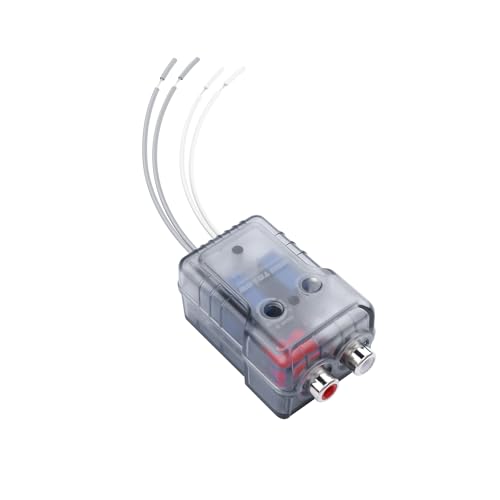
This two-channel converter is designed to connect factory speaker-level outputs to an aftermarket amplifier by converting them to RCA line-level signals. Its listed input limit is up to 50 watts, and the product description says it works with standard radios and most smart radios.
Best for: Buyers who want a stated input limit to compare with their stereo’s output. It may suit a system where the head unit has speaker outputs but no RCA preamp connections.
Why it was selected: The listing clearly identifies the high-to-low conversion purpose and gives a maximum input figure, which helps shoppers screen for basic system suitability.
Limitation: The 50-watt rating should be treated as a limit, not a recommended target. Confirm how the manufacturer defines that rating and avoid using the converter if your source output exceeds its supported input.
AICARS Two-Pack RCA Converters

AICARS describes these converters as a two-pack for converting speaker output to low-level RCA signal. The intended application is connecting an amplifier or subwoofer when the original car stereo has no RCA audio output. The listing also describes a compact design for plug-and-play installation.
Best for: Buyers who prefer to have two converters available, such as for separate installation needs or a spare. Its basic signal-conversion function may be suitable for older audio sources that lack low-frequency RCA outputs.
Why it was selected: It directly addresses the common use case of adding RCA signal connections to a stereo without them, and the pack quantity is clearly stated.
Limitation: The supplied product details do not specify an input power rating, adjustment control, or noise-filtering feature. Check those requirements if your setup needs them.
Yeebline Converter With Noise Reduction

Yeebline converts high-level speaker output into low-level RCA output for adding an aftermarket amplifier or subwoofer to a stereo without preamp outputs. The listing describes built-in noise-reduction circuitry and states an input limit of up to 50 watts. It also names standard, smart, and vintage radio types among its intended sources.
Best for: Buyers prioritizing a converter with listed noise-suppression features and a stated input limit. It is also a candidate for older head units, provided their output is within the specified rating.
Why it was selected: Its product details combine the core speaker-to-RCA function with both a maximum input figure and a noise-reduction claim.
Limitation: Noise reduction is a feature claim, not a guarantee that every installation will be free of noise. Wiring, grounding, and other components can also affect the result.
Autokemat Converter With Level Dial
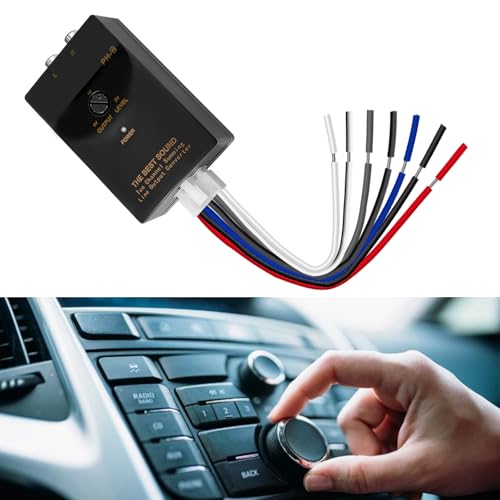
Autokemat is a two-channel speaker-level converter for adding an amplifier or subwoofer to an existing factory or aftermarket car stereo. Its listed features include a single adjustment dial for matching the stereo level and an adjustment function for lowering bass output.
Best for: Buyers who want a straightforward control for adjusting the signal level. The converter is intended for systems where speaker-wire output needs to feed an RCA-equipped amplifier or subwoofer.
Why it was selected: Its single-dial adjustment gives it a clear point of comparison with the NuIth model, which also lists an adjustable gain feature.
Limitation: The provided specifications do not include a maximum input wattage or detailed noise-reduction information. Verify compatibility with your source before buying.
Buying Guide: Choosing a High-to-Low RCA Converter
What does a high-to-low converter do?
A high-to-low converter, also called a line output converter or LOC, changes a speaker-level audio signal into a lower-level signal carried through RCA connections. This lets a compatible aftermarket amplifier or subwoofer receive audio from a car stereo that offers speaker-wire outputs but lacks RCA preamp outputs.
The converter does not replace the amplifier, supply power to a subwoofer, or create a speaker output. It changes the signal connection type and level. The amplifier still needs its own appropriate power and signal wiring.
Does your stereo need a converter?
First, check the back of the stereo or its documentation for RCA preamp outputs. If the stereo has a suitable RCA output for the amplifier or subwoofer, a high-to-low converter may not be necessary for that connection. If it only provides speaker-wire outputs, an LOC may be an option.
Confirm what the amplifier accepts as an input. Some equipment may offer speaker-level inputs directly, while other equipment may require RCA input. Use the amplifier and stereo manuals to verify the connection method rather than assuming every system needs a separate converter.
How should you compare input ratings?
Compare the converter’s supported input with the stereo’s speaker output. PNGKNYOCN and Yeebline list support for input signals up to 50 watts; the provided details for the other selected models do not give a maximum figure. Do not assume an unstated rating is equivalent to 50 watts.
When a rating is unclear, consult the product’s current specifications or ask the manufacturer. A converter that is not suited to the source signal can produce poor results or fail to work as intended.
Do you need an adjustable level control?
An adjustment dial can help match the converter output to the connected amplifier’s input. NuIth and Autokemat list adjustment features, while the product information for the other selected models does not specify a level control. Choose an adjustable model if you expect to need signal matching, but follow the instructions for both the converter and amplifier.
Level adjustment is not the same as adjusting the amplifier’s gain or changing the stereo’s volume. Make changes gradually and avoid treating a converter control as a substitute for correct amplifier setup.
How important is noise reduction?
Noise can come from multiple parts of an installation, including signal wiring, grounding, or electrical interference. Yeebline specifically lists noise-reduction circuitry, and PNGKNYOCN describes minimizing interference. These claims may be useful comparison points, but no converter can guarantee silence in every vehicle.
If you hear hum, static, or a whine after installation, inspect the wiring and grounding and consult the equipment instructions. A noise-related problem may not be solved by replacing the converter alone.
What should you check before installation?
- Confirm that the stereo provides speaker-level outputs and note the relevant channels.
- Check whether the amplifier or subwoofer accepts RCA input or speaker-level input.
- Compare the stereo’s output with the converter’s stated input limit.
- Review wiring diagrams and channel polarity in the manuals for all connected equipment.
- Plan a secure installation that keeps signal wiring organized and follows vehicle safety guidance.
- Disconnect power as directed by the vehicle and equipment instructions before wiring.
Two-channel or mono amplifier: which matters?
A two-channel converter handles a left and right audio signal. Several products here are described as two-channel, and some are specifically marketed for connecting a mono amplifier or subwoofer. Check the signal routing and input requirements of the equipment you plan to connect; a product’s channel count alone does not confirm every possible wiring arrangement.
Frequently Asked Questions
Can I connect a subwoofer to a factory stereo with no RCA outputs?
A high-to-low converter can provide an RCA-level signal from speaker-wire output for a compatible amplifier or subwoofer. Confirm that the amplifier accepts RCA input and that the converter supports the stereo’s output.
Is a high-to-low converter the same as an amplifier?
No. A converter changes a speaker-level signal to a lower-level RCA signal. It does not provide the power amplification needed to drive a subwoofer.
Will every converter work with every car stereo?
No. Compatibility depends on the stereo’s output, the converter’s input limits, the amplifier’s input requirements, and the wiring. Check the specifications for each component before connecting them.
Does a converter with noise reduction eliminate all audio noise?
No. Noise-reduction features may help, but results depend on the complete installation. Wiring, grounding, and other electrical or audio components can also contribute to noise.
Should I choose a converter with an adjustment dial?
Choose an adjustable converter if you want a control for matching or adjusting the signal level. NuIth and Autokemat list adjustment features; follow their instructions and those of the connected amplifier when setting levels.