
If you want a compact keyboard around the size of two octaves, compare the number and size of its keys, sound options, and practice features. The five models below have 32 or 37 mini keys rather than exactly two octaves, so they offer more physical keys than a basic 24-key range. The POGOLAB MK-2 is best for sound variety and octave-shifting features; the Casio SA-51 suits young beginners seeking simple tone selection; and the Alesis Melody 32 offers many sounds and rhythms in a compact format.
| Keyboard | Key Count | Best For |
|---|---|---|
| POGOLAB MK-2, Black | 37 mini keys | Portable play with octave and transpose functions |
| Casio Casiotone SA-51 | 32 mini keys | Young beginners and simple tone changes |
| M SANMERSEN Kids Keyboard | 37 keys | Beginners who want a microphone and demos |
| POGOLAB MK-2, White | 37 mini keys | Same feature set as the black model in another color |
| Alesis Melody 32 | 32 mini keys | Beginners who want varied sounds and rhythms |
POGOLAB MK-2 37-Key Keyboard, Black
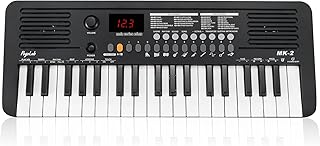
The black POGOLAB MK-2 is a portable 37-mini-key keyboard with 200 sounds, 200 rhythms, and 40 built-in songs. Its listed octave and transpose functions let players shift the notes the keyboard produces, extending the usable musical range without adding physical keys.
Best for: Kids, teens, or beginners who want a compact keyboard with a broad selection of built-in sounds and practice functions. It was selected because its octave and transpose features are especially relevant to shoppers comparing small keyboards by musical range.
- Includes a LED display, volume control, chord, sustain, and metronome functions.
- Has dual speakers and a 3.5 mm headphone jack for quieter practice.
- Its small mini keys are intended for smaller hands.
Limitation: This is not a full-size piano keyboard, and its 37 physical keys may not suit players who need a wider, conventional range without shifting octaves.
Casio Casiotone SA-51 32-Key Keyboard

The Casio Casiotone SA-51 has 32 mini keys and 100 built-in tones, including piano, strings, and percussion. Dedicated buttons provide direct access to selected tones, making it straightforward to switch sounds during casual play.
Best for: Young beginners who need a simple, compact instrument for exploring different sounds. It was selected for its small-hand-friendly keys and direct tone controls, which make basic sound changes easy to understand.
- Provides 100 built-in tones for creative play.
- Uses one-touch tone selection for quick changes, including piano, trumpet, and drum set tones.
- Has 32 mini keys rather than a standard full-size keyboard layout.
Limitation: The listed features do not include the extensive rhythm, recording, or octave-shift details found on some other models here. Choose it for simplicity rather than a long feature list.
M SANMERSEN 37-Key Beginner Keyboard

This 37-key beginner keyboard includes 200 rhythms, 200 tones, and 50 demo songs. Its listed features also include dual speakers, an LED screen, recording and playback, a headphone mode, and a microphone for singing while playing.
Best for: Beginners who want an activity-focused keyboard with demos, recording, and a microphone. It was selected because its combination of built-in music features and headphone use offers several ways to practice and play.
- The LED screen displays the active function.
- Plugging in headphones mutes the built-in speakers, according to the product details.
- The microphone supports singing while playing.
Limitation: The headphones are not included. Buyers seeking a straightforward piano-style instrument without singing or accompaniment features may not need its extra functions.
POGOLAB MK-2 37-Key Keyboard, White

The white POGOLAB MK-2 has the same listed core features as the black version: 37 mini keys, 200 sounds, 200 rhythms, and 40 built-in songs. It also has octave and transpose functions, an LED display, chord and sustain options, a metronome, dual speakers, and a headphone jack.
Best for: Buyers who want the POGOLAB feature set in a white finish. Its octave and transpose functions make it a relevant option for shoppers who want to shift notes on a compact keyboard.
- Portable design is described as suitable for travel or playing on a sofa.
- Headphone connection supports quieter practice.
- Mini keys are designed for children or teens with smaller fingers.
Limitation: The white version has 37 physical keys, not a full-size piano layout. Its listed feature set is essentially the same as the black model, so the main distinction in the supplied product information is color.
Alesis Melody 32 Mini Keyboard

The Alesis Melody 32 is a compact keyboard with 32 mini piano-style keys and 300 voices, including acoustic piano, electric piano, strings, organ, synth, and drums. It also provides 300 built-in rhythms, 40 demo songs, accompaniment mode, a recording feature, and built-in speakers.
Best for: Beginners who want a wide range of sounds and accompaniment options in a small keyboard. It was selected because its stated voice and rhythm counts are the highest among the listed products, and it includes a recording feature.
- Can be powered by USB or four AA batteries; the batteries are not included.
- A 1/8-inch stereo headphone output mutes the built-in speakers.
- Accompaniment mode uses the built-in rhythms.
Limitation: Its 32 keys are mini-size, and the four AA batteries must be supplied separately if using battery power.
Buying Guide: How To Choose A Compact Piano Keyboard
What Does “Two-Octave Keyboard” Mean?
An octave spans 12 semitones. A keyboard covering two full octaves from one note to the same note two octaves higher typically needs 25 keys because the starting and ending notes are both included. A 24-key span covers 24 semitones, but its endpoint is not an additional repeated note.
Key count alone does not always tell you the exact note range. The products in this comparison have 32 or 37 physical keys, but the supplied details do not specify the starting and ending notes for every model. Check the instrument’s key layout if you need a particular range for a song, lesson, or arrangement.
Should You Choose 32 Or 37 Keys?
A 32-key keyboard is a compact option for basic play, sound exploration, and beginners with limited space. A 37-key model provides five additional physical keys, which can reduce the need to move between notes for some short melodies. Neither key count matches a standard full-size piano keyboard.
For a child or casual player, mini keys can make a small instrument easier to handle and transport. For formal piano study, consider whether mini keys and a limited physical range will support the learner’s lessons. A compact keyboard can introduce notes and rhythm, but it is not the same playing experience as a full-size piano.
Do Octave And Transpose Controls Matter?
Octave and transpose functions change the notes produced without increasing the number of physical keys. They can help a player reach notes outside the keyboard’s immediate range or change the pitch of a passage. The POGOLAB MK-2 listings specifically mention both functions; do not assume another model includes them unless its product details say so.
These controls are useful for flexibility, but they do not add keys or expand the instrument’s physical layout. If you need to play a broad passage with both hands at once, a keyboard with more physical keys may be more appropriate than relying only on shifting.
How Many Sounds And Rhythms Do You Need?
Built-in tones let beginners try instrument sounds beyond piano, while rhythms and accompaniment can make practice more interactive. The Alesis Melody 32 lists 300 voices and 300 rhythms. Both POGOLAB versions list 200 sounds and 200 rhythms, while the M SANMERSEN lists the same counts plus demo songs and recording.
More options are not automatically better for every player. A young learner focused on piano basics may prefer the Casio SA-51’s direct tone-selection buttons over a larger selection of modes. Consider whether the intended user will benefit from experimenting or would rather have a simpler control panel.
What Practice Features Should You Check?
Headphone output is useful when practice needs to be quieter. The POGOLAB models list a 3.5 mm headphone jack, while the Alesis and M SANMERSEN product details also describe headphone use. The M SANMERSEN listing says its speakers mute when headphones are connected; the Alesis listing also says its built-in speakers mute through the headphone output.
A metronome can help players keep a steady beat, and recording or playback can let beginners listen to a performance. The POGOLAB models list a metronome, while the M SANMERSEN and Alesis list recording features. Check the specific feature list for the model you are considering rather than assuming all compact keyboards offer the same practice tools.
Do You Need Battery Or USB Power?
Power requirements affect where a keyboard can be used. The Alesis Melody 32 listing specifies USB power or four AA batteries, with batteries not included. The supplied details for other models do not provide the same power information, so confirm the product listing if portability without a nearby outlet is important.
Also consider whether the keyboard will be used mainly at home, in a classroom, or while traveling. A compact body can be convenient to carry, but portability depends on the complete setup, including its power source and any accessories you plan to use.
Frequently Asked Questions
Is a 32-key keyboard two octaves?
No. A typical two-octave range from a note to the same note two octaves higher uses 25 keys, counting both endpoint notes. A 32-key keyboard has more physical keys, though its exact note range depends on its layout.
Is a 37-key keyboard better than a 32-key keyboard?
A 37-key keyboard has five more physical keys, which can provide a wider immediate playing area. A 32-key model may still be a better choice when compact size, simple controls, or a particular feature set matters more than extra keys.
Can a small keyboard teach piano?
A compact keyboard can help beginners explore notes, melodies, rhythm, and basic playing. Mini keys and a limited range may differ from the full-size keyboard used in many piano lessons, so check whether the instrument matches the learner’s instructional needs.
Does octave shifting add more keys?
No. Octave shifting changes the pitch range produced by the existing keys; it does not increase the number or width of the physical keys. The POGOLAB MK-2 listings include octave and transpose functions.
Which option is best for quiet practice?
Look for a headphone output and check whether connecting headphones mutes the speakers. The POGOLAB models list a 3.5 mm headphone jack, and the Alesis and M SANMERSEN listings describe speaker muting when headphones are connected.
Which keyboard is simplest for a young beginner?
The Casio Casiotone SA-51 is a straightforward option in this comparison because it has 32 mini keys and dedicated tone-selection buttons. The best fit still depends on the child’s hand size, desired sounds, and preferred features.