
The best audio interface for a smartphone depends on what you want to record: the JOYO MOMIX CAB is best for quick guitar capture with direct monitoring, while the KYXAIN pocket interface is a simple choice for phone or laptop recording. The iRig 2 is designed for iPhone and iPad instrument connections. The Pyle PMUX9 and Universal Audio Volt 1 offer broader recording-interface formats, but confirm phone connection and power requirements before choosing them.
| Product | Best suited for | Key point |
|---|---|---|
| JOYO MOMIX CAB | Portable guitar recording | Direct monitoring and USB-C/Lightning connections |
| IK Multimedia iRig 2 | iPhone or iPad instrument input | Instrument input and headphone/amplifier outputs |
| KYXAIN Pocket Interface | Basic phone or laptop guitar recording | 24-bit/48 kHz recording and headphone monitoring |
| Pyle PMUX9 | Multi-input recording setups | Mic, line, guitar, AUX, and RCA inputs |
| Universal Audio Volt 1 | Users considering a USB interface | Verify smartphone connection needs before buying |
JOYO MOMIX CAB for Portable Guitar Recording

The JOYO MOMIX CAB is a compact guitar-to-phone interface for recording practice, capturing ideas, or streaming playing. It connects a guitar through a 6.35 mm input and provides a 3.5 mm headphone output. The included USB-C cable and Lightning adapter are intended to connect it to phones with either port type.
Its direct-monitoring design sends the clean guitar signal to the headphones while also sending audio to the phone. The manufacturer describes the headphone signal as zero-latency. The device is plug-and-play, requires no charging or driver installation, and includes a signal indicator that turns red when the input is too hot.
- Best for: Guitarists who want a pocket-size recording connection with direct monitoring.
- Why it stands out: Its clip design, included connection options, and headphone output are useful for mobile practice and capture.
- Limitation: The dry guitar signal cannot be muted, so it is not designed for hearing software amp simulations or effects as the monitored guitar sound.
Choose this if you want a simple guitar signal path and can monitor the clean instrument sound. Avoid it if you need the phone app’s processed guitar tone in your headphones while playing.
IK Multimedia iRig 2 for iPhone and iPad

The IK Multimedia iRig 2 is a portable instrument audio adapter identified for use with iPhone and iPad. Its listed connections include an instrument input plus headphone and amplifier outputs. That configuration makes it relevant to musicians who want to connect an instrument to a mobile device while retaining options for listening or routing audio to an amplifier.
The provided product information does not specify recording resolution, included cables, power requirements, or detailed app support. Check the connection requirements for your particular iPhone or iPad before purchasing, especially if the device uses a port that requires an adapter. Also verify that the recording app you plan to use accepts the intended input.
- Best for: iPhone or iPad users seeking a portable instrument input with headphone and amplifier outputs.
- Why it was selected: The product is specifically described as a lightweight guitar audio interface for Apple mobile devices.
- Limitation: The supplied details do not establish Android compatibility or describe included adapters.
Choose this if your priority is connecting an instrument to an iPhone or iPad and you have confirmed the required device connection. Compare its output arrangement with the JOYO and KYXAIN options if you specifically need a documented 3.5 mm headphone jack or USB-C/Lightning accessories.
KYXAIN Pocket Interface for Phone and Laptop

The KYXAIN pocket interface is a compact recording adapter for electric guitar or bass. Its listed recording specification is 24-bit/48 kHz. The interface connects through USB-C for Android phones or laptops and includes a Lightning-to-USB-C adapter for iPhone and iPad. A 6.35 mm instrument input and 3.5 mm headphone output support instrument connection and monitoring.
The product description says its low-latency digital audio processing is intended to keep audio synchronized with video. It is described as plug-and-play, does not require batteries, and supports recording through compatible live-streaming apps. The stated function is recording rather than editing or mixing, so plan to use an app if you need to edit or process the captured audio.
- Best for: Beginners who want a straightforward guitar or bass recording connection for a phone or laptop.
- Why it was selected: It lists specific mobile connections, an instrument input, headphone monitoring, and a recording format.
- Limitation: It does not provide editing or mixing functions, and app compatibility should be checked for the intended workflow.
Choose this if you need documented USB-C and Lightning connection options and basic recording. Compared with the JOYO, it lists a recording resolution and does not describe a dry-signal-only monitoring limitation; confirm the monitoring behavior you need before buying.
Pyle PMUX9 for Multi-Input Recording
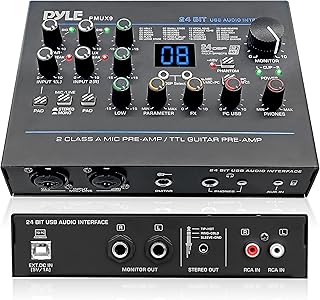
The Pyle PMUX9 is presented as a USB audio interface with multiple input types and monitoring outputs. Its listed connections include mic/line, guitar, AUX stereo, and RCA inputs. The product title also lists preset digital effects, phantom power, and phone, stereo, monitor, and headphone outputs.
This range of connections may suit a user who wants to connect more than a single guitar or instrument. However, the supplied details do not explain how the PMUX9 connects to a specific smartphone, whether it needs additional power, or which mobile operating systems and apps it supports. A USB connection by itself does not confirm smartphone compatibility.
- Best for: Buyers seeking a multi-input interface that may serve a wider recording setup than a pocket guitar adapter.
- Why it was selected: Its stated inputs and outputs make it relevant to users recording different source types.
- Limitation: Phone connection and power requirements are not specified in the provided product details.
Choose this if its input variety matches your equipment and you can verify the mobile connection path. It is less clearly suited to grab-and-go phone recording than the JOYO or KYXAIN, whose product details explicitly describe mobile-device connections.
Universal Audio Volt 1 USB Interface

The Universal Audio Volt 1 is identified in the supplied listing as a USB audio interface. The available product information does not specify its inputs, outputs, recording format, power arrangement, included cables, or smartphone compatibility. Those details matter when the intended recording device is a phone rather than a computer.
For smartphone buyers, treat this as an option to investigate rather than assuming it will connect directly. Check the current product documentation for your phone’s port, supported mobile operating system, required adapters, and power needs. Also confirm that your recording app can receive audio from the interface.
- Best for: Buyers already considering a USB interface who are willing to verify mobile-device requirements before purchase.
- Why it was selected: It is a named USB audio interface in the supplied selection and may be relevant to users comparing phone and computer recording paths.
- Limitation: The provided product details are not enough to confirm direct smartphone use or describe the interface’s recording connections.
Choose this only after checking the manufacturer’s documentation against your specific phone and workflow. If confirmed mobile compatibility is your priority, the JOYO and KYXAIN listings provide more explicit phone-connection details.
Buying Guide: How to Choose a Smartphone Audio Interface
What are you recording?
Start with the source. A guitarist or bassist usually needs an instrument input, while a vocal or multi-source setup may call for microphone, line, or other inputs. The JOYO, iRig 2, and KYXAIN are described around instrument recording. The Pyle listing identifies mic/line, guitar, AUX stereo, and RCA inputs, making it a different kind of option. Do not assume that an interface has a particular input unless its product information lists it.
Does it connect to your phone?
Match the interface connection to the smartphone’s port and operating system. USB-C, Lightning, and USB are not interchangeable without the right connection path. The JOYO lists a USB-C cable and Lightning adapter, and the KYXAIN lists USB-C plus a Lightning-to-USB-C adapter. For the iRig 2, Pyle PMUX9, and Volt 1, confirm the precise cable or adapter needed for your phone before ordering.
Do you need direct headphone monitoring?
A headphone output lets you listen while recording, but monitoring behavior varies. The JOYO sends a clean guitar signal directly to headphones and cannot mute that dry signal; it is therefore a poor match if you need to hear software effects as your monitored guitar sound. The KYXAIN lists a headphone output, but its supplied details do not explain whether it monitors the input directly or how effects are handled. Check that distinction if latency or app processing matters.
Will you record, edit, or mix on the phone?
An interface captures or passes audio; editing and mixing are usually handled by an app or other software. The KYXAIN description explicitly says it is for recording and does not have editing or mixing functions. Before buying, identify the app you plan to use and confirm that it can accept the interface’s audio input. App compatibility can affect the entire workflow, even when the physical connection fits.
Do you need a pocket setup or more inputs?
For portable guitar capture, a compact adapter can reduce cable and setup demands. The JOYO is described as pocket-sized with a clip, while the KYXAIN is described as a mini interface. A multi-input product such as the Pyle may suit a setup involving several source types, but its size and mobile power requirements are not established in the supplied details. Compare the number and type of inputs with the equipment you actually plan to connect.
What recording specifications matter?
Consider the stated recording resolution when it is available, but do not use one specification alone to judge suitability. The KYXAIN lists 24-bit/48 kHz recording. The supplied details for the other products do not provide comparable resolution figures. For each option, also check supported apps, connection requirements, monitoring, and the kinds of sources it accepts.
Frequently Asked Questions
Can I connect any audio interface to a smartphone?
No. Compatibility depends on the interface, phone port, operating system, adapter, power needs, and recording app. Confirm all of these before buying.
Which listed interface is best for portable guitar recording?
The JOYO MOMIX CAB is a strong fit for portable guitar capture because its listing describes a pocket-size design, instrument input, headphone output, and USB-C and Lightning connection options.
Which option lists a recording resolution?
The KYXAIN pocket interface lists 24-bit/48 kHz recording. The provided descriptions for the other products do not state a comparable resolution.
Can the JOYO MOMIX CAB monitor software guitar effects?
It is not designed for that use. Its dry guitar signal cannot be muted, so the direct headphone signal remains unprocessed according to the product description.
Is the Pyle PMUX9 confirmed to work directly with a phone?
The supplied product details do not confirm direct smartphone compatibility. Verify phone connection, adapter, power, and app requirements with the product documentation.