
The best acoustic guitar FX pedal depends on whether you need a natural preamp and feedback control, acoustic-style effects, or a flexible multi-effects setup. The SONICAKE is best suited to players who want an acoustic-focused preamp with a balanced XLR output. The LEKATO offers amp models and impulse responses, while the MOOER Acoustikar is designed to give an electric guitar an acoustic-like character. The MOOER GE100 and Zoom G1X Four offer broader effects and practice features.
| Pedal | Best For | Key Feature |
|---|---|---|
| SONICAKE Acoustic Effects Pedal | Acoustic players seeking preamp and feedback control | Notch filter and XLR output |
| LEKATO Multi Effects Pedal | Players who want acoustic amp and cabinet simulations | 9 amp models and 8 IR cabinets |
| MOOER Acoustikar | Electric guitarists seeking an acoustic-style tone | Piezo, Standard, and Jumbo modes |
| MOOER GE100 | Players wanting a broad effects library | 66 effect types and user presets |
| Zoom G1X Four | Practice and songwriting with multiple effects | Rhythm patterns and a looper |
SONICAKE Acoustic Effects Pedal
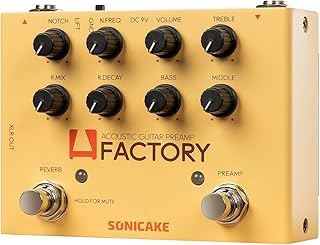
The SONICAKE is the most directly acoustic-focused choice in this group. It combines an analog preamp with digital reverb, providing basic tone shaping and ambience in one pedal. Its high-impedance input and balanced XLR output are useful features for setups that send a signal to a mixer or other audio equipment.
A built-in notch filter is designed to help address whistling or feedback, with adjustable gain and frequency range. The pedal also includes a mute function, which can be useful when silencing the signal during a guitar change or between songs.
- Best for: Acoustic guitarists who need preamp controls, reverb, and feedback management.
- Why it stands out: Its XLR output and notch filter target common live acoustic-guitar needs.
- Limitation: The listed features focus on preamp and reverb functions rather than a large selection of effects.
Choose this if your priority is a straightforward acoustic signal path with an XLR output. It is less suited to players seeking extensive effect libraries, amp models, or user-programmable patches.
LEKATO Acoustic Multi Effects Pedal

The LEKATO is a flexible option for players who want to shape an acoustic signal with amp and cabinet simulations. Its listed features include nine amp preamp models and eight impulse-response cabinet models. It also offers chorus, tremolo, delay, and reverb, so players can build a broader sound palette than a simple preamp-and-reverb pedal provides.
The pedal supports third-party IR files, which can be imported over USB using the company’s Cube-Suite software. Preset, Edit, and Live modes provide ways to create, save, and switch between sounds. The listed features also include Bluetooth 5.0, recording, and a built-in battery.
- Best for: Players who want multiple sound-shaping options and the ability to load IR files.
- Why it stands out: It combines effects, amp models, cabinet simulations, and preset editing.
- Limitation: Importing third-party IR files involves using a computer, USB cable, and the specified software.
Choose this if you want more than basic acoustic tone correction and are comfortable managing presets or IR files. It may be more feature-rich than necessary for someone seeking only a simple acoustic preamp.
MOOER Acoustikar Simulator Pedal

The MOOER Acoustikar has a different purpose from the acoustic preamp pedals in this list. It is an acoustic simulator intended to help an electric guitar produce an acoustic-guitar-like sound. The listed modes are Piezo, Standard, and Jumbo, giving players three character options to try.
This compact feature set makes it a focused choice for guitarists who want an acoustic-style part without switching to a separate acoustic guitar. It may also suit arrangements that call for a change in tonal character during a song. The supplied information describes its purpose as restoring acoustic-guitar sound texture, but does not specify additional output or recording features.
- Best for: Electric guitarists who want to add an acoustic-like sound to their playing.
- Why it stands out: Three modes provide distinct starting points for shaping the simulated tone.
- Limitation: It is a focused simulator, not a broad multi-effects processor or acoustic preamp.
Choose this if your main goal is an acoustic-style sound from an electric guitar. Avoid choosing it as a substitute for a full acoustic signal chain if you need features such as a balanced XLR output or a listed feedback-control filter.
MOOER GE100 Multi-Effects Pedal

The MOOER GE100 is a general-purpose multi-effects pedal rather than an acoustic-specific processor. It offers eight effect modules with 66 effect types, plus 80 preset patches and 80 user patches. Players can save preferred tones and organize a range of sounds for different songs or playing situations.
Its assignable expression pedal parameters provide hands-on control over selected tone settings. The listed features also include an adjustable output mode, which is described as allowing line-out use without an amp, along with a looper, drum rhythms, tap tempo, a tuner, and a headphone output.
- Best for: Players who want many effects, saved patches, and expression control in one unit.
- Why it stands out: Its user-patch capacity and effect selection support a wide range of sound setups.
- Limitation: The listed effects are not presented as a dedicated acoustic-guitar processing system.
Choose this if you need a broad effects library for acoustic or other guitar sounds and value saved presets. For a simpler acoustic rig focused on feedback management and XLR connection, the SONICAKE is a more directly targeted option.
Zoom G1X Four Effects Processor

The Zoom G1X Four is another general guitar effects processor that can appeal to players seeking practice and songwriting tools alongside effects. Its listed features include 71 effects, 13 amp models, a 30-second looper, and 68 rhythm patterns. It also includes an expression pedal and is described as battery powered.
The looper can support layered practice or songwriting, while the rhythm patterns provide accompaniment for timing practice. The effects and amp models offer a broader sound-selection approach than a single-purpose acoustic preamp. The product information does not identify it as an acoustic-specific processor, so acoustic players should confirm that its available sounds suit their instrument and intended signal chain.
- Best for: Players who want effects, rhythm accompaniment, and a looper for practice or songwriting.
- Why it stands out: Its large selection of rhythm patterns and built-in looper add practice functions.
- Limitation: It is a general guitar processor, not a dedicated acoustic preamp with a listed XLR output.
Choose this if practice features are as important as tone effects. For live acoustic use where balanced output and feedback control are priorities, compare its role with the acoustic-focused SONICAKE.
Buying Guide: How To Choose An Acoustic Guitar FX Pedal
Do you need an acoustic preamp or an acoustic simulator?
Start by identifying what instrument and sound you want to process. An acoustic preamp is intended to shape an acoustic guitar’s signal. The SONICAKE fits this category, with an analog preamp, digital reverb, notch filter, mute, and XLR output. An acoustic simulator has a different job: the MOOER Acoustikar is designed to give an electric guitar an acoustic-like character.
These types of pedals are not interchangeable. If you play an acoustic guitar and want output and feedback-related controls, look at the preamp’s listed connections and tone features. If you play electric guitar and want an acoustic-style sound, look at the simulator’s modes instead.
Would a dedicated acoustic pedal or multi-effects unit suit you better?
A dedicated acoustic pedal can be easier to match to a specific need. The SONICAKE focuses on preamp shaping, reverb, feedback management, and balanced output. A multi-effects unit such as the LEKATO, MOOER GE100, or Zoom G1X Four offers a wider range of processing and practice options, but may include many features that are not necessary for a simple acoustic setup.
Choose a multi-effects unit if you want to save and switch sounds, explore different effects, or use built-in practice tools. Choose a more focused pedal if you already know which functions your acoustic signal chain needs.
When does an XLR output matter?
An XLR output can be useful when your setup calls for a balanced connection to audio equipment. The SONICAKE specifically lists a balanced XLR output. The other products’ supplied feature descriptions do not list an XLR output, so compare the connection requirements of your mixer, recording setup, or performance rig before buying.
Do not assume that every multi-effects pedal includes the same connection options. Check the product’s current specifications for the exact inputs and outputs you need.
How important are feedback controls?
Feedback can be a concern when an amplified acoustic guitar is used at performance volume. The SONICAKE lists a notch filter with adjustable gain and frequency range, as well as a mute function. Those features make it a relevant choice for players who specifically want feedback-related controls.
Other pedals in this selection offer different strengths, such as amp models, IR cabinets, or a wide range of effects. If feedback management is essential, prioritize a product that explicitly lists that function rather than assuming a general-purpose pedal provides it.
Do you want presets, IR loading, or hands-on expression control?
Presets are useful when you want to recall sounds without rebuilding settings each time. The LEKATO supports preset editing and third-party IR loading, while the MOOER GE100 lists 80 user patches and assignable expression pedal parameters. The Zoom G1X Four emphasizes effects, amp models, rhythm patterns, and looping in its feature description.
IR loading can add flexibility, but it can also add setup steps. The LEKATO’s listed process uses a USB cable and Cube-Suite software. If you prefer a simpler setup, consider whether that extra customization is worth learning and maintaining.
Which features matter most for practice?
For practice, built-in rhythms and looping can help players work on timing, repetition, and song ideas. The Zoom G1X Four lists 68 rhythm patterns and a 30-second looper. The MOOER GE100 also lists a looper and drum rhythms, while its headphone output can be relevant for private practice.
Choose based on the specific practice tools you will use. A player who mainly needs reverb and feedback control may not benefit from a larger effects processor. A songwriter who layers parts or practices with a rhythmic backing may value those built-in functions more.
Frequently Asked Questions
What is the best acoustic guitar effects pedal for live use?
The SONICAKE is the most directly live-oriented option in this selection based on its listed balanced XLR output, mute function, and notch filter. The right choice still depends on the connections and controls your live setup requires.
Can an acoustic simulator turn an electric guitar into an acoustic guitar?
An acoustic simulator can create an acoustic-style tone from an electric guitar, but the MOOER Acoustikar is described as simulating acoustic sound rather than replacing a separate acoustic guitar. It offers Piezo, Standard, and Jumbo modes.
Which pedal has the most listed effects?
The Zoom G1X Four lists 71 effects, while the MOOER GE100 lists 66 effect types. The number of effects alone does not determine which pedal is better for an acoustic setup; consider the specific effects and connections you need.
Which pedal supports third-party IR files?
The LEKATO supports third-party IR files and allows users to import them using a USB cable and Cube-Suite software. Its listed features also include eight IR cabinet models and nine amp preamp models.
Which option is best for a player who only needs feedback control?
The SONICAKE is the most relevant option in this group because its listed features include a notch filter with adjustable gain and frequency range. The other products’ supplied descriptions do not specifically list a feedback-control feature.
Should I choose a multi-effects pedal for acoustic guitar?
A multi-effects pedal can be a good choice if you want several effects, presets, or practice tools in one unit. If you mainly need acoustic preamp functions, reverb, feedback control, or balanced output, compare those specific requirements with the features of an acoustic-focused pedal.