
A monoblock amplifier has one output channel, so it is not a two-channel amplifier. For a system with two subwoofers, one mono amp may work if the combined speaker load matches the amp’s supported impedance and power; otherwise, two monoblock amps or a two-channel model may be more suitable. These five Class D monoblock amps are options for bass-focused systems, with the Skar RP-1200.1D best for a lower stated power level and the CT Sounds CT-2000.1D best for compact installation.
| Product | Best For | Listed RMS Output |
|---|---|---|
| AUDIOZERONE ZE1000.1 | Several listed impedance options | 400–1,000 watts, depending on load |
| ORION CBA2000.1D | 1-ohm subwoofer loads | Not specified in supplied details |
| Skar Audio RP-1200.1D | Moderate power with bass EQ | 1,200 watts at 1 ohm |
| CT Sounds CT-2000.1D | Compact installation | 650–2,000 watts, depending on load |
| Skar Audio RP-2000.1D | Higher stated RMS output | 2,000 watts at 1 ohm |
AUDIOZERONE ZE1000.1
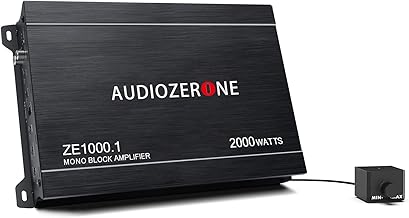
The AUDIOZERONE ZE1000.1 is a Class D monoblock amplifier with stated RMS output at 1-, 2-, and 4-ohm loads. Its listed output is 1,000 watts RMS at 1 ohm, 650 watts at 2 ohms, and 400 watts at 4 ohms. It is specified as stable at 1 ohm and includes a low-pass crossover.
- Best for: Buyers comparing output across multiple supported impedance loads.
- Why it was selected: Its feature list gives RMS figures at three loads, making it easier to compare against a subwoofer’s impedance and power needs.
- Consider: The 2,000-watt figure is maximum power; the listed RMS output at 1 ohm is 1,000 watts.
For a two-subwoofer setup, check the final combined impedance before choosing this amp. The product is one-channel, so it does not provide independent left- and right-channel outputs.
ORION CBA2000.1D Cobalt Mono Amp

The ORION CBA2000.1D is a Class D, one-channel subwoofer amplifier with a MOSFET power supply. Its supplied features describe continuous 1-ohm operation, a crossover network, and low-level RCA inputs for receiving a signal from a receiver.
- Best for: Buyers seeking a mono subwoofer amp with low-level RCA input and stated 1-ohm capability.
- Why it was selected: The listed input and load details are useful when matching an amplifier to a receiver-based car audio installation.
- Consider: The supplied product details do not state RMS output at specific impedance loads, so compare the complete manufacturer specifications with the subwoofer before purchase.
The listing name includes 2,000 watts maximum, but the provided information does not give a corresponding RMS figure. Do not treat the maximum rating as a confirmed continuous output. This model is also not a two-channel amplifier.
Skar Audio RP-1200.1D

The Skar Audio RP-1200.1D is a Class D MOSFET monoblock amplifier rated at 1,200 watts RMS at 1 ohm and 1,600 watts peak at 1 ohm. Its listed frequency response is 20 Hz to 250 Hz. An onboard bass EQ switch provides +6 or +12 dB of boost at 45 Hz.
- Best for: Buyers whose subwoofer system calls for a lower stated 1-ohm RMS output than the 2,000-watt models in this selection.
- Why it was selected: The RMS rating, frequency response, and switchable bass EQ are specified in the supplied features.
- Consider: The listed output figures are at 1 ohm. Confirm the amp’s full impedance specifications and use the bass boost carefully when matching the system.
This is a single-channel amplifier intended for a mono subwoofer signal. It is not a two-channel option for separately powering left and right full-range speakers.
CT Sounds CT-2000.1D

The CT Sounds CT-2000.1D is a compact Class D monoblock amplifier. The listed RMS output is 2,000 watts at 1 ohm, 1,200 watts at 2 ohms, and 650 watts at 4 ohms, specified at 14.4 volts. Its features also list a 0-to-320-Hz frequency response and an included bass knob.
- Best for: Buyers who need a compact mono amp and want stated output figures at three impedance levels.
- Why it was selected: The chassis is described as small, while the power figures make load matching more straightforward.
- Consider: The listed RMS figures are tied to a 14.4-volt supply condition. Check installation requirements and vehicle electrical capacity rather than assuming every system will deliver those conditions.
The CT-2000.1D can suit a subwoofer system when its final load and power requirements align with the amplifier. Its compact format does not change the fact that it has one channel.
Skar Audio RP-2000.1D

The Skar Audio RP-2000.1D is a Class D MOSFET monoblock amplifier with a listed 2,000 watts RMS and 2,800 watts peak at 1 ohm. It has a stated frequency response of 20 Hz to 250 Hz and an onboard bass EQ switch offering +6 or +12 dB at 45 Hz.
- Best for: Buyers whose subwoofer system is designed for a high 1-ohm RMS output.
- Why it was selected: Its stated 1-ohm RMS rating is higher than the RP-1200.1D’s, and both share a listed frequency response and bass EQ options.
- Consider: The 2,000-watt RMS figure is specified at 1 ohm. Do not assume the same output at another load; check the manufacturer’s full specifications.
Choose this model only when the subwoofer wiring produces a supported load and the system is intended for this output level. It remains a mono amplifier, not a two-channel amp.
Buying Guide: How to Choose a Monoblock Amp for Two Subwoofers
Can a monoblock amplifier power two subwoofers?
Yes, a single monoblock amp can power two subwoofers if the speakers can be wired to a final impedance supported by the amplifier and the combined power demand is appropriate. A monoblock has one amplified output channel, but that output can feed multiple subwoofers wired together. The speakers do not become separate channels simply because there are two drivers.
Before buying, identify each subwoofer’s impedance and voice-coil configuration. Calculate the final load for the proposed series or parallel wiring, then compare it with the amplifier’s stated stable impedance. If the resulting load is not supported, do not use that wiring arrangement.
What if “two channels” means left and right speakers?
If the goal is to power a left and right pair of full-range speakers separately, select a two-channel amplifier rather than a monoblock. A monoblock is designed around one output channel, commonly for a subwoofer signal. Another option is to use two mono amplifiers, but that requires appropriate equipment, wiring, and system planning.
How should RMS power and maximum power be compared?
Use RMS output as the main continuous-power comparison when it is available. Maximum or peak figures are not interchangeable with RMS ratings. For example, the AUDIOZERONE listing gives both a 2,000-watt maximum figure and a 1,000-watt RMS figure at 1 ohm. The ORION product details supplied here give a 2,000-watt maximum figure but do not provide a specific RMS output.
Compare the amplifier’s RMS output at the intended impedance with the subwoofer system’s power-handling specifications. Avoid choosing by the largest number in a product name or headline alone.
Why does impedance affect amplifier output?
Impedance is the electrical load presented by the connected speaker system. An amplifier may deliver different power at different loads, as shown by the CT Sounds and AUDIOZERONE output listings. A lower impedance can correspond to higher stated output, but the amplifier must be rated to handle that load. Never infer 1-ohm stability unless the product specifications state it.
What installation details should buyers check?
- Speaker wiring: Confirm the final impedance of the connected subwoofer or subwoofers.
- Power needs: Compare RMS output at that impedance with the subwoofer system’s requirements.
- Signal input: Check whether the receiver provides the input type the amplifier accepts. The ORION feature list specifically mentions low-level RCA inputs.
- Space: Consider the amplifier’s dimensions and available mounting area. The CT Sounds model is described as compact, but verify its physical measurements for the installation.
- Controls: Decide whether onboard EQ or a remote bass control matters. The Skar models list bass EQ switches, while the CT Sounds listing mentions an included bass knob.
- Electrical system: Review the installation and power requirements in the full product documentation, especially for high-output amplifiers.
Frequently Asked Questions
Is a monoblock amp the same as a two-channel amp?
No. A monoblock amplifier has one output channel. A two-channel amplifier has separate left and right output channels.
Can one monoblock amp run two subwoofers?
Yes, if the subwoofers can be wired to a load supported by the amp and the amp’s output is appropriate for the combined system.
Does a 2,000-watt maximum rating mean 2,000 watts RMS?
No. Maximum and RMS ratings are different specifications. Use the RMS figure at the intended impedance when the manufacturer provides one.
Which product here lists 2,000 watts RMS at 1 ohm?
The CT Sounds CT-2000.1D and Skar Audio RP-2000.1D list 2,000 watts RMS at 1 ohm in the supplied product details.
Which listed amp gives RMS output at several impedance loads?
The AUDIOZERONE ZE1000.1 and CT Sounds CT-2000.1D provide listed RMS output at 1, 2, and 4 ohms.