
A record weight or clamp can help hold an LP against the platter and reduce movement, but the right choice depends on your turntable’s spindle, dust-cover clearance, and tolerance for added weight. The Preffair is best for buyers seeking a lightweight spindle clamp; the Feir is a heavier option, while the Dufray and FEMELI models offer lighter puck-style weights. The Pancosmy is a low-profile choice for listeners who want a weight designed to fit under a closed dust cover.
| Product | Best for | Listed weight |
|---|---|---|
| Preffair POM Clamp | Lightweight clamping | 75 g |
| Feir Aluminum Clamp | Heavier stabilization | 14 oz |
| Dufray Aluminum Weight | Lower added load | 6 oz |
| Pancosmy Low-Profile Weight | Use under a closed dust cover | 11 oz |
| FEMELI 10.8oz Weight | Centered weighting with low profile | 306 g |
Preffair POM Record Clamp

The Preffair is a lightweight clamp-style stabilizer made from POM, or polyformaldehyde. At 75 grams, it adds less weight than the heavier puck-style options in this list. Its collet is designed to clamp tightly to most turntable spindles, while the product description says it holds the record firmly against the platter.
Best for: Buyers who want a clamp with modest weight and a spindle-gripping design. It is a relevant choice when reducing LP slippage and unwanted resonance is the goal, without selecting a 14-ounce weight.
Consider: “Most turntable spindles” does not mean every spindle. Check your turntable’s spindle and the clamp’s fit before use. The listing does not specify a dust-cover clearance measurement.
Feir 14-Ounce Aluminum Clamp

The Feir is a 14-ounce aluminum record weight clamp intended to stabilize an LP, reduce vibration, and keep the record centered on the platter. Its product description also says it can help clamp warped records flat and couple the vinyl more tightly to the platter. Those are the listed purposes, not a guarantee that every warped record will become flat.
Best for: Buyers who want a heavier stabilizer and whose turntable can accommodate the added load. Choose this over a lightweight clamp if mass is a priority and the turntable’s operating guidance allows a weight of this size.
Consider: At 14 ounces, it is the heaviest option in this group. The added load may not suit every turntable, and the listing does not give a height for checking dust-cover clearance.
Dufray 6-Ounce Aluminum Weight

The Dufray is a 6-ounce, 172-gram aluminum puck-style stabilizer. The brand says its centered weight distribution keeps the record label safe, and its shape is designed to avoid contact with the cartridge as it reaches the center dead space. The listed purpose is to improve record-to-platter contact while reducing resonance and vibration.
Best for: Buyers who want a lighter option than the 11- and 14-ounce weights listed here. Its stated 6-ounce weight may make it a practical comparison point for turntable owners who want to avoid a heavier stabilizer.
Consider: The listing does not state its height or confirm dust-cover clearance. Check the available space above the platter, and confirm that the center opening fits your turntable’s spindle.
Pancosmy 11-Ounce Low-Profile Weight

The Pancosmy is an 11-ounce record weight with a soft base pad and a low-profile design. Its listing says it is made to fit beneath most turntable dust covers and has a sized spindle hole intended to center on the turntable. The product description also says it is designed to flatten warped records and reduce vibration interference.
Best for: Buyers who want to keep the dust cover closed during playback or storage. The low-profile design is its key distinction among the products here.
Consider: “Most” dust covers does not guarantee clearance on a specific model. Measure the space between the platter and closed cover, and verify spindle fit. Its 11-ounce mass is also more than the Preffair and Dufray options.
FEMELI 10.8-Ounce Record Weight
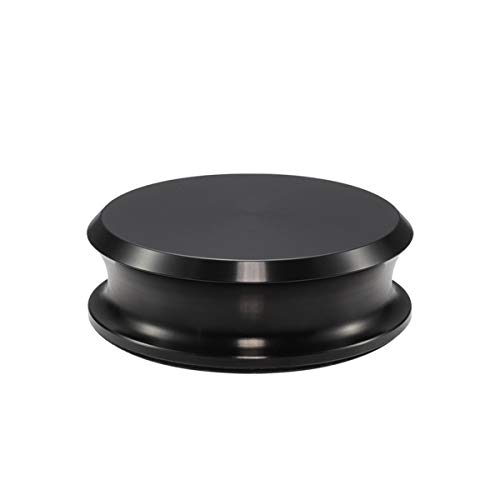
The FEMELI weighs 306 grams, or about 10.8 ounces, and has a low-profile shape. The listing says it can fit under a turntable lid, protects the record label, and distributes weight centrally. Its center shape is designed to avoid cartridge contact when the stylus reaches the record’s inner dead space.
Best for: Buyers looking for a centered weight with stated lid clearance and a shape intended to keep clear of the cartridge near the record’s center. It is a middle-weight option between the 6-ounce Dufray and 14-ounce Feir.
Consider: The listing describes the weight as suitable for damping vibration without overloading bearings, but turntable designs vary. Check your manufacturer’s guidance and confirm the lid closes freely on your setup.
Buying Guide: How To Choose A Record Clamp Or Weight
What is the difference between a record clamp and a record weight?
A record weight rests on the LP and uses its mass to hold the record against the platter. A clamp typically grips or tightens around the spindle to secure the record, and some clamp products also add weight. Product names are not always consistent: “clamp,” “weight,” and “stabilizer” may describe overlapping designs. Compare how the specific model attaches, how much it weighs, and whether its spindle opening suits your turntable.
A clamp can be appealing if you want the record held at the spindle without relying only on a heavy puck. A weight is straightforward to place over the center, but it adds load to the platter and bearing. Neither type is automatically better for every record player.
How much weight should you choose?
Start with the turntable maker’s instructions. Added mass can affect the load on the platter and bearing, so do not assume that a heavier stabilizer is suitable just because it is marketed for turntables. In this group, the Preffair is the lightest at 75 grams, the Dufray is 6 ounces, the FEMELI is about 10.8 ounces, the Pancosmy is 11 ounces, and the Feir is 14 ounces.
If you are uncertain about your turntable’s weight limits, a lighter product is the more conservative comparison point. A heavier model may be preferable only when the manufacturer’s guidance and the turntable’s design support it. Weight alone does not establish sound quality or guarantee that a record will play without skipping.
Will it fit beneath a closed dust cover?
Check both the stabilizer’s height and the available clearance above the record. A cover that touches the weight could interfere with playback or prevent the cover from closing properly. The FEMELI and Pancosmy listings specifically describe low-profile designs; the FEMELI says it fits under a lid, while Pancosmy says it fits under most dust covers. Those descriptions are not a substitute for measuring your own setup.
Also consider how you prefer to use the cover. If you play records with the lid open, clearance may be less important. If you want to keep it closed, confirm that the weight does not touch the cover, spindle, or other parts during rotation.
What should you check about the spindle and cartridge?
For a clamp, the center opening or collet must fit the spindle. The Preffair listing says its collet clamps tightly to most spindles, but it does not establish universal fit. For any weight, verify that the center hole sits securely and does not wobble excessively.
Check cartridge clearance near the end of a record, too. The FEMELI and Dufray descriptions say their shapes are designed to avoid contact with the cartridge in the center dead space. Even so, inspect the setup with the stylus raised and follow the turntable’s operating instructions before playback.
Is a stabilizer a fix for warped or skipping records?
A stabilizer may hold a record more firmly against the platter, and some product listings describe helping flatten warped LPs or reducing movement. That does not mean it will correct every warp or prevent every skip. Skipping can have other causes, and a heavy weight may be unsuitable for some turntables. Treat these products as accessories for record-to-platter contact, not as guaranteed repairs.
If a record is significantly warped, damaged, or still skips, check the record and turntable according to their manufacturers’ guidance rather than adding more weight automatically. Do not use a stabilizer to force a record flat if the setup appears unsafe or the platter does not rotate normally.
Which material and design should you compare?
The Preffair is made from POM, while the Feir and Dufray are described as aluminum. The FEMELI listing emphasizes low profile and centered weight distribution; Pancosmy highlights a soft base pad. These differences can help narrow the selection, but the product details do not establish that one material will sound better than another.
Compare the features that affect your setup first: attachment style, total weight, spindle fit, cover clearance, and cartridge clearance. Then consider the features that matter to your handling preferences, such as a soft base pad or a clamp mechanism.
Frequently Asked Questions
Do record weights improve sound quality?
Product listings describe reducing vibration, slippage, or resonance as intended benefits. Results depend on the record, turntable, and setup, so a weight should not be treated as a guaranteed sound-quality upgrade.
Can I use a record weight on any turntable?
Not necessarily. Check the turntable manufacturer’s guidance for added weight, and verify that the spindle, platter, bearing, and dust-cover clearance suit the accessory.
Is a lighter record clamp safer for my turntable?
A lighter model adds less mass, but suitability depends on the turntable. Confirm the model’s fit and follow the turntable maker’s instructions rather than relying on weight alone.
Can a record weight flatten a warped LP?
Some product descriptions say their stabilizers can help flatten warped records. They are not guaranteed to correct every warp, and a weight should not be used as a substitute for safe record handling.
Should I leave the stabilizer on when the turntable is not playing?
Follow the product and turntable instructions. If you want to close the dust cover or store the turntable with the stabilizer in place, confirm that it clears the cover and does not put an unsupported load on the platter.