
If you want a portable way to practice bass-guitar finger placement, the products below can help with quiet fretting drills—but they are six-string guitar practice necks, not bass-specific trainers. The Moreup digital model is best for learners who want chord diagrams and a metronome; the simpler pocket necks are better for basic finger-placement practice. Because their string count and layout differ from a standard bass, use them as supplemental practice tools rather than substitutes for a bass neck.
| Product | Best suited for | Key distinction |
|---|---|---|
| Moreup Rotatable Chord Trainer | Chord-reference practice | Displays chord diagrams; silent and not tunable |
| Pocket Guitar Practice Neck | Simple portable drills | Six frets, real strings, no listed electronics |
| Moreup Digital Trainer Model B | Guided practice routines | Chord display and adjustable metronome |
| Pocket Guitar Practice Neck, B09NDL66CJ | Basic finger-placement repetition | Compact design with wood and real strings |
| Six-String Practice Tool With Bag | Quiet chord and scale drills | Includes a tuning wrench and velvet bag |
Moreup Rotatable Chord Trainer

This six-string, six-fret trainer is best for beginners who want a visual chord reference alongside finger-placement repetition. Its rotatable screen displays common chord positions, and the product description states that its internal library contains more than 400 chord patterns. Genuine steel strings are intended to provide a string feel closer to a guitar than a fully electronic fingerboard.
For bass learners, it may help with general finger coordination, but it does not reproduce a standard bass’s four-string layout or bass-specific spacing. It is designed for silent practice and is not tunable, so choose another option if you need to hear notes or practice bass tuning.
Pocket Guitar Practice Neck

This compact practice neck is best for learners who want a straightforward tool for repeating finger positions away from a full instrument. The listed features include six frets, real strings, a wood fingerboard, and a sliding ABS case. Its simple design keeps the focus on fretting-hand movement rather than screens or built-in practice functions.
It may suit basic coordination exercises for a bass player, but it is still a six-string guitar trainer, not a bass neck replica. The product information does not list a chord display, metronome, or sound output, so avoid this model if you need those features.
Moreup Digital Trainer Model B

Model B is best for learners who want prompts while practicing. It has a rotatable display with more than 400 chord fingerings and a built-in metronome with customizable tempo. Six frets provide room for practicing chord shapes and note combinations, while the genuine steel strings offer a physical fretting surface.
The product description says string tension can be adjusted with the included tool. That feature may be useful for changing the feel, but it does not make this a bass trainer: the device remains a six-string guitar practice neck. Choose it for guided, silent finger practice, not for hearing bass notes or matching a bass’s string layout.
Pocket Guitar Practice Neck With Wood Fingerboard
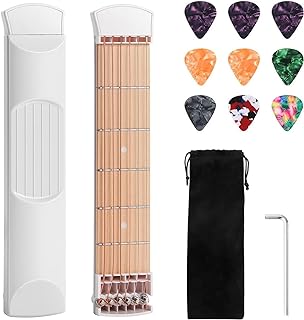
This version is best for someone seeking a portable, uncomplicated tool for building repeated fingering habits. Its listed construction includes a wooden fingerboard, real strings, and a sliding ABS case. The six-fret layout gives learners a small area for repeating chord shapes and practicing finger placement without carrying a full guitar.
As with the other pocket necks, the listed layout is for guitar rather than bass. Product details do not specify a metronome, electronic chord chart, or audible output. Choose it for basic physical practice; avoid it if your goal requires bass-specific spacing, bass note range, or sound.
Six-String Practice Tool With Velvet Bag
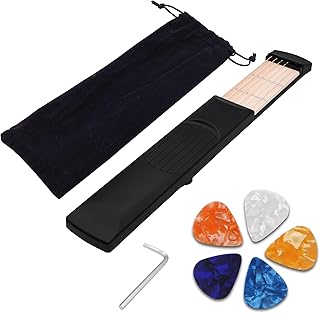
This practice tool is best for learners who want a portable surface for silent chord, plucking, and scale drills. The product description lists six strings and six fret columns, a wooden fingerboard, metal strings, a tuning wrench, and a velvet bag. It is presented as a way to work on finger placement and transitions without making noise.
For bassists, its value is limited to general hand coordination because the product is described as a six-string guitar tool. The listing does not provide bass-specific string spacing or a bass neck layout. It is a reasonable choice for quiet supplemental practice, but not a replacement for practicing on a bass.
Buying Guide: Choosing a Practice Neck for Bass Guitar Skills
Start by deciding which skill you want to practice. A pocket trainer can make it easier to repeat finger placements in a quiet setting, but the five products here are guitar practice necks. If accurate bass technique is the priority, compare any trainer’s string count, fret spacing, and scale length with the bass you play before relying on it for instrument-specific practice.
Is a guitar practice neck suitable for bass practice?
It can be used for general fretting-hand exercises, such as placing fingers deliberately and moving between positions. However, a six-string guitar layout does not reproduce the feel or spacing of a standard bass. The listed product information also does not establish that these tools reproduce bass scale length, string tension, or bass notes. Treat them as supplementary finger-placement aids, not bass substitutes.
Do you need a screen or metronome?
A screen can make a trainer more useful if you are learning chord shapes and want a visual reminder. The Moreup models include chord-display features, and Model B also lists an adjustable metronome. A simpler practice neck may be a better fit if you already know what to practice and only need a portable fretting surface.
A metronome can support steady timing during repetitions, but a silent neck does not let you check whether a note sounds clean. Pair silent drills with practice on a real bass when you need to assess tone, timing, and note accuracy.
What should you check about strings and feel?
Look for clear product details about string material and adjustment. Several listings describe real or steel strings, while Model B specifically says its string tension can be adjusted with an included tool. These details can influence the physical practice experience, but they do not establish that the feel matches a bass. Verify the instrument layout and purpose before buying for bass-specific technique.
Which practice features matter most?
- For visual guidance: Choose a model with a displayed chord chart if you benefit from seeing finger positions.
- For timing drills: Consider the digital model that lists a customizable metronome.
- For simple portability: A basic pocket neck may be sufficient if you only need a small surface for finger exercises.
- For quiet settings: These products are described as silent practice tools, but confirm whether you need audible output before purchase.
- For bass accuracy: Seek a trainer specifically described as a bass practice neck, with details that match your bass’s string layout and dimensions.
How can you use a pocket trainer effectively?
Set a short, repeatable goal, such as placing one finger at a time or moving between two familiar positions. Keep the movement controlled and avoid pressing harder than necessary. Use a metronome when available, then repeat the exercise on your bass to check that the technique transfers. A trainer can encourage repetition, but practice on the real instrument remains important for bass-specific spacing and sound.
Frequently Asked Questions
Are these products bass guitar practice necks?
No. The listed products are described as six-string guitar practice tools. They may support general finger-placement exercises, but their specifications do not identify them as bass-specific trainers.
Can I use a pocket guitar neck to build bass finger strength?
You can use one for general fretting-hand movement and repetition. However, it may not recreate bass string spacing or tension, so it should not be your only tool for bass technique.
Do these practice tools produce sound?
The first Moreup model is explicitly described as silent and not tunable. The other listings emphasize quiet or silent practice, but the supplied product details do not establish that they produce playable notes.
Which option includes a metronome?
The Moreup Digital Guitar Chords Trainer, Model B, lists a built-in metronome with customizable tempo. The other supplied product descriptions do not list that feature.
Which product is best for learning chord shapes?
The Moreup models are the clearest choices for visual chord guidance because their product descriptions list built-in chord displays. These are guitar chord references, so bass learners should use them only when that kind of general finger-placement practice is relevant.
What should bass players buy for accurate neck practice?
Look for a tool explicitly made for bass that describes its string count and neck layout. Compare those details with your bass, and use the instrument itself to practice bass-specific fretting, note accuracy, and sound.