
The best FM transmitter for a PA system depends on the area you need to cover and the transmitter’s input and power options. The 7W/1W model is suited to buyers seeking selectable output power, while the 0.5W/0.1W model is a lower-power option. For a compact setup, consider the transmitter listed for up to 1,000 feet; for adjustable output up to 25W, consider the CZE-T251. Check the PA system’s audio output, antenna requirements, local rules, and intended coverage before choosing.
| Product | Best suited for | Listed highlights |
|---|---|---|
| 7W/1W LCD FM Transmitter | Events needing two power settings | LCD and 3.5mm audio cable in product name |
| AZWang 1W/7W FM Transmitter | Buyers comparing selectable power and LCD controls | BH1415 chip, triple amplifier, LCD |
| 0.5W/0.1W LCD FM Transmitter | Lower-power setups | Two power modes and stereo circuitry |
| AZWang 1000FT FM Transmitter | Small setups with a stated 1,000-foot range | Compact design and multiple listed audio sources |
| CZE-T251 25W FM Transmitter | Buyers who need adjustable output up to 25W | Selectable channel modes and standing-wave protection |
7W/1W Long-Range LCD FM Transmitter
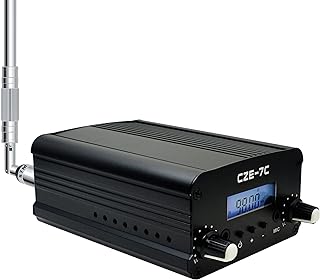
This model is a candidate for a PA setup that needs a choice between two output-power levels. Its product name identifies 7W and 1W settings, an LCD, and a 3.5mm audio cable. The listing describes it for drive-in churches, schools, supermarkets, light shows, and fireworks displays.
Best for: Buyers who want selectable power and a listed 3.5mm audio connection. It was selected because those details align with common event-broadcast needs and make it straightforward to compare against fixed- or lower-power models.
Limitation: The supplied product information does not specify range, FCC identification, or detailed audio-input options beyond the cable named in the title. Confirm that the PA output can connect appropriately before purchase.
AZWang 1W/7W FM Transmitter

The AZWang transmitter lists 1W and 7W power modes, an LCD frequency display, and a BH1415 chip. Its features also describe a triple-amplifier arrangement and stereo audio. The listing claims a 1,000-meter range, but actual reception depends on the installation and conditions; treat that figure as a manufacturer claim rather than a guaranteed coverage radius.
Best for: Buyers comparing an LCD-controlled model with two power settings and stated stereo circuitry. The range claim may make it worth considering for a larger outdoor event, provided the buyer verifies requirements and tests coverage at the intended site.
Limitation: The listing does not provide the supplied input cable or detailed PA connection instructions in the provided features. Confirm the audio interface and antenna setup before ordering.
0.5W/0.1W LCD FM Transmitter

This transmitter offers 0.5W and 0.1W modes and identifies an FCC ID in its listing. Its described circuitry includes a BH1415 transmitter chip, PLL modulation, audio pre-emphasis, a limiter, a low-pass filter, and three power amplifiers. These details distinguish it from the 1W/7W choices when lower listed output settings are the priority.
Best for: Buyers seeking a lower-power transmitter for a relatively contained setup and wanting the listed stereo-processing features. It is selected as the lower-output comparison in this group.
Limitation: The provided features do not state a coverage distance or identify the included audio cable. An FCC ID alone does not establish that every use, power setting, or installation meets applicable rules; check current requirements for the planned operation.
AZWang Compact 1000FT FM Transmitter

The AZWang model is described as a compact FM transmitter with a stated range of up to 1,000 feet. Its listing names mobile phones, laptops, PCs, MP3/MP4 players, TVs, and external microphones as possible audio sources. It also provides an FCC ID and notes that obstacles can affect signal distance.
Best for: Buyers seeking a compact unit for a smaller event area or a setup using one of the listed audio sources. It is a useful comparison against the 1,000-meter model because the stated distance is shorter and more clearly framed around a local area.
Limitation: The stated range is not a guarantee, and the listing says concrete walls can reduce coverage. The provided information does not specify selectable power modes or an LCD display.
CZE-T251 Adjustable 25W FM Transmitter

The CZE-T251 is the highest-output model in this selection. Its listed output adjusts continuously from 0W to 25W. The product information also identifies selectable single- or dual-channel mode, standing-wave protection, and a package that includes a 12V power adapter, transmitter, antenna, and audio cable.
Best for: Buyers who specifically need adjustable output and want the antenna and audio cable listed as included items. It was selected to represent a more configurable broadcast-style option than the lower-output units.
Limitation: The provided features do not state a coverage distance or FCC ID. Higher output does not automatically mean the transmitter is appropriate for every PA installation or location; verify operating rules, antenna setup, and coverage needs before use.
Buying Guide: How To Choose An FM Transmitter For A PA System
What does an FM transmitter add to a PA system?
An FM transmitter sends an audio feed over an FM radio signal so listeners with compatible FM receivers can hear the program. In a PA installation, the transmitter generally receives an audio feed from the sound system and broadcasts it to nearby radios. This can be useful when an audience is spread across a parking lot or outdoor area, or when people need to listen inside vehicles.
The transmitter does not replace the PA system’s microphones, mixer, or speakers. It adds a radio-broadcast path. Before purchasing, identify where the transmitter will connect in the audio chain and whether the sound system offers an output that matches the transmitter’s input.
How much transmitter power do you need?
Start with the size and layout of the listening area, not just the largest wattage listed. This selection ranges from 0.1W/0.5W and 1W/7W modes to a model adjustable up to 25W. Higher listed power can be relevant to coverage planning, but it does not guarantee a particular distance or make a device suitable for unrestricted use.
Buildings, vehicles, terrain, antenna placement, and interference can affect reception. A clear outdoor path may perform differently from a site with concrete walls or other obstructions. Choose a model whose power options fit the intended application, and test reception at the farthest listening points before relying on it for an event.
Should you choose an LCD or adjustable power controls?
An LCD frequency display can make it easier to see the selected frequency while setting up. Two power modes provide a choice between the listed output levels, while a continuously adjustable model offers a broader output range. These controls matter most when the event location, audience area, or operating needs change from one setup to another.
If a transmitter will remain in one fixed location, simple controls may be enough. For recurring events at different sites, a display and flexible output can make setup easier to manage. Confirm the unit’s actual controls and included accessories in the product listing.
Will the transmitter connect to your PA system?
Check the PA system’s available audio outputs and the transmitter’s documented inputs. The first product title identifies a 3.5mm audio cable, and the CZE-T251 listing says an audio cable is included. The AZWang compact model names several possible audio sources, including a TV, computer, phone, and external microphone.
Those descriptions do not confirm compatibility with every mixer or PA system. If the PA output uses a different connector or signal level, you may need an appropriate connection solution, but the provided product data does not establish which adapters will work. Check the manuals or ask the manufacturer before buying.
What should you know about range claims?
Range figures in product listings are claims, not universal guarantees. One selected model states up to 1,000 feet, while another claims 1,000 meters. Do not compare these numbers without considering how each listing describes its test conditions and without checking local rules for intended use.
For a dependable event plan, test the signal at the site using the intended transmitter placement and receiver locations. Check for dead spots and interference. If the audience moves between indoor and outdoor areas, test each area separately rather than assuming one range figure will apply everywhere.
How do certifications and operating rules affect the choice?
Some product listings provide an FCC ID or describe a transmitter as FCC certified. Treat that information as a starting point for verification, not as a complete determination that every installation or use is allowed. Regulations can depend on the device, power, antenna, frequency, and operating circumstances.
Before broadcasting, review current Federal Communications Commission requirements for the device and use case. Follow the manufacturer’s instructions, use the specified antenna arrangement, and avoid assuming that a product’s marketing language authorizes any power level or coverage area.
Which model type fits common PA applications?
- For two selectable power levels: Compare the 1W/7W models and review their input and frequency controls.
- For lower listed power: Consider the 0.1W/0.5W model, while confirming that its coverage meets the need.
- For a compact unit with named audio sources: Review the AZWang model listed for up to 1,000 feet.
- For continuously adjustable output: Compare the CZE-T251, which lists adjustment up to 25W, and verify that its operation is appropriate for the site.
- For a PA with an uncertain connector: Check the exact input and cable details before choosing any model.
Frequently Asked Questions
Can an FM transmitter work with any PA system?
Not necessarily. The PA system must provide an audio output that can connect to the transmitter’s input. Check the connector and signal requirements for both devices before purchasing.
Does a higher-wattage FM transmitter always cover a larger area?
No. Output power is only one factor. Antenna placement, obstructions, terrain, interference, and applicable operating limits also affect practical coverage.
Do I need FM radios for listeners?
Listeners need an FM receiver tuned to the transmitter’s frequency. The product information supplied here does not specify that radios are included with these transmitters.
Is a listed FCC ID proof that any use is legal?
No. An FCC ID or certification claim should be verified, and it does not by itself establish that every power setting, antenna configuration, or use complies with current requirements.
Which listed transmitter has the most adjustable output?
The CZE-T251 listing says its output adjusts continuously from 0W to 25W. Confirm the device’s operating requirements and suitability before using that range.
What should I test before an event?
Test the connection from the PA system, tune a receiver to the selected frequency, and check audio clarity and reception throughout the intended listening area. Also confirm the transmitter’s setup and operation follow applicable rules.