
The best surge protector for a subwoofer depends on how many home theater components you need to protect, how much outlet space you have, and whether you want a power strip or a single wall-mounted outlet. The ECHOGEAR is best for a multi-device setup with higher listed surge capacity; the Belkin is better for many plugs and a long cord; and the Cable Matters and Woods options suit a single-device connection.
| Product | Best for | Listed surge rating | Format |
|---|---|---|---|
| ECHOGEAR ShockBlocker | Home theater systems | 3,420 joules | Eight-outlet strip |
| Belkin 12-Outlet Strip | Many plugs and bulky adapters | 4,320 joules | 12-outlet strip |
| CyberPower CSP604UC | Compact media setups with USB charging | 1,500 joules | Six-outlet strip |
| Cable Matters Single Outlet | Protecting one device at the wall | 490 joules | Single-outlet plug |
| Woods Single Outlet | Simple plug-in protection with status alert | 1,080 joules | Single-outlet plug |
ECHOGEAR ShockBlocker 8-Outlet Surge Protector

The ECHOGEAR ShockBlocker is best for a subwoofer used as part of a larger home theater or gaming setup. It provides eight outlets and a listed surge rating of 3,420 joules, so a user can connect multiple components to one strip rather than relying on a single protected outlet.
Its slim design is intended to fit behind or under furniture. Built-in outlet safety covers help shield unused sockets, and the product description says its MOV components filter harmful signals from the power supply. Those details make it a practical choice when the strip will sit near a media cabinet or in a shared room.
- Best for: A subwoofer, TV, receiver, and other nearby equipment that need multiple outlets.
- Why it was selected: It combines a home-theater-oriented use case, eight outlets, and a comparatively high listed joule rating.
- Limitation: The supplied product information does not state the cord length or include a status indicator, so check those details if placement or protection-status monitoring matters.
Belkin 12-Outlet Surge Protector Power Strip

The Belkin strip is best for a home theater with many connected devices or plugs that need extra room. It has 12 AC outlets, including eight rotating outlets and four standard outlets, plus an eight-foot extension cord and a flat pivot plug. Its listed surge protection is 4,320 joules.
Rotating outlets can help accommodate charging bricks and other larger plugs, while the longer cord may provide more placement flexibility than a short wall plug. Belkin also lists RJ11 phone-line protection and coaxial cable protection. These connections may be relevant to a broader entertainment setup, but they do not replace checking whether your specific equipment connections are covered.
- Best for: Buyers who need ample outlet capacity and flexibility for a media center or office.
- Why it was selected: It offers the highest listed joule rating in this selection, along with 12 outlets and an eight-foot cord.
- Limitation: Its size and number of outlets may be unnecessary if you only need protection for one subwoofer.
CyberPower CSP604UC 6-Outlet Surge Protector

The CyberPower CSP604UC is best for a compact audio or entertainment area where a subwoofer shares power protection with a few other electronics. It has six AC outlets and a listed rating of 1,500 joules. A four-foot power cord and keyhole slots support placement on a wall or under a desk, depending on the room layout.
One USB-A port and one USB-C port provide charging for mobile devices without using a separate charging brick. This can leave the AC outlets available for equipment plugs. The product description identifies it for home and office computers, electronics, and home theater equipment.
- Best for: A small-to-medium setup that needs several outlets and USB charging.
- Why it was selected: Its outlet count, home theater use case, mounting slots, and USB ports offer a useful balance for a media area.
- Limitation: Its four-foot cord may not reach a distant wall outlet, and its listed joule rating is lower than the Belkin and ECHOGEAR models.
Cable Matters Single-Outlet Surge Protector

The Cable Matters single-outlet protector is best if you want a direct wall connection for one subwoofer and do not need extra outlets. Its compact, non-blocking design is made to leave the neighboring wall outlet available. The product is listed with a 490-joule rating and a 15-amp, 1,875-watt capacity.
This three-pack can also suit households that want to protect separate electronics in multiple locations. The manufacturer describes it as a grounded three-prong surge-protected outlet for televisions, computers, and small appliances. Before use, confirm that the connected equipment’s plug and electrical requirements match the product’s specifications.
- Best for: A simple one-device setup where keeping a second wall receptacle open matters.
- Why it was selected: Its self-contained design avoids a power strip and offers a clear single-outlet solution.
- Limitation: It provides only 490 joules of listed surge protection and cannot power additional components from the same protector.
Woods Single-Outlet Surge Protector
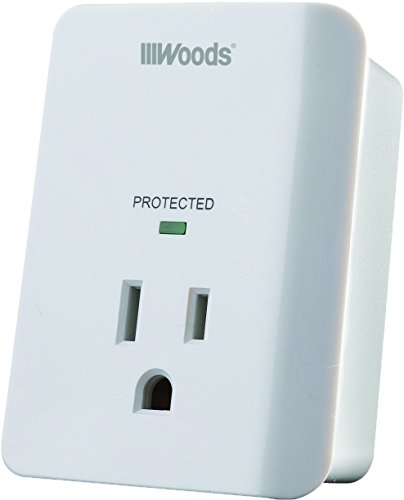
The Woods single-outlet protector is best for buyers who want a compact wall-mounted option with a visible status light and alarm. It has one grounded outlet and a listed surge rating of 1,080 joules. Its slim design may be easier to fit in a tight space than a full-size power strip.
The LED safety-status light and alarm are useful features to consider when you want an alert related to the unit’s status. The product description also identifies it for electronics and describes overload protection. As with any surge protector, follow the manufacturer’s instructions and verify how its indicator works before relying on it as a warning.
- Best for: One subwoofer or another single electronic device near a wall outlet.
- Why it was selected: It pairs a one-outlet form with a higher listed joule rating than the Cable Matters plug and includes an LED and alarm.
- Limitation: It does not provide extra outlets, so it is not a central power solution for a complete home theater system.
Buying Guide: How To Choose A Surge Protector For A Subwoofer
How many outlets does your setup need?
Start by counting every device you plan to connect at the same location. A subwoofer may be part of a system that also includes a receiver, TV, streaming device, or game console. A multi-outlet strip is more convenient for a cluster of equipment. A single-outlet wall protector is a better fit when you are protecting only one device and want to keep the setup compact.
Do not assume every plug will fit neatly beside another. Large adapters can block neighboring outlets. Rotating outlets, as listed on the Belkin, or a strip with more physical spacing may help. Check the product images and dimensions when available, especially if the protector will sit behind furniture.
What does the joule rating tell you?
Joules describe the surge-energy capacity listed for a protector. In this group, the ratings range from 490 joules for the Cable Matters single outlet to 4,320 joules for the Belkin strip. A higher listed figure can be a useful comparison point, but it is not a guarantee that connected equipment will never be damaged. It also does not tell you the protector’s remaining service life or every aspect of its electrical performance.
Compare products using the rating and the features that matter to your room. For example, the ECHOGEAR offers 3,420 joules with eight outlets, while the CyberPower offers six outlets, USB charging, and 1,500 joules. The right fit depends on the number of devices and your installation needs, not only on one specification.
Should you choose a strip or a wall plug?
A power strip is usually more practical when several entertainment components share one location. Consider cord length, plug orientation, mounting options, and whether the strip can be placed where its cable will not be pinched or create a trip hazard. A wall plug can reduce cable clutter for one device, but it offers no expansion for additional equipment.
Do you need voltage protection or status indicators?
Some products advertise functions beyond surge suppression, such as response to voltage fluctuations or an indicator light and alarm. Read the feature description carefully to understand what is claimed. An indicator can help communicate the device’s status, but it is not a substitute for following the product manual or checking whether the connected equipment’s operating requirements are met.
How should you connect a subwoofer safely?
Use a properly grounded outlet and stay within the surge protector’s stated electrical limits. Do not connect multiple power strips together unless the manufacturers expressly permit that arrangement. Keep the protector accessible enough to inspect, and do not use it if the cord, plug, or housing is damaged. For a built-in or hardwired audio system, consult the equipment documentation or a qualified electrician rather than improvising a connection.
Frequently Asked Questions
Can I plug a subwoofer into a surge protector?
In general, a powered subwoofer with a standard plug can be connected to a surge protector if the protector is properly grounded and its electrical ratings are suitable. Check the subwoofer and protector manuals for specific requirements.
Is a higher joule rating always better?
A higher listed joule rating indicates greater stated surge-energy capacity, but it does not by itself establish that one product is right for every setup. Compare outlet count, cord length, placement, electrical ratings, and any status features as well.
Should my subwoofer and receiver use the same power strip?
They may share a strip if the strip has enough outlets and the total electrical load stays within its stated limits. Follow both devices’ instructions, and avoid daisy-chaining strips.
Can I use a single-outlet protector for a whole home theater?
A single-outlet protector protects only the device plugged into it. If you want to connect a subwoofer, receiver, and other components through one unit, choose a suitable multi-outlet model instead.
Does a surge protector protect against every power problem?
No surge protector should be treated as protection against every electrical event or equipment failure. Product features differ, and protection depends on proper use, installation, and the device’s specifications.