
The best choice depends on whether you need an amplifier to drive speakers or a player that sends audio to an existing stereo. The AK-380 is best for compact two-channel playback with USB, SD, Bluetooth, FM, and AUX; the Daakro AK45 suits buyers who want bass and treble controls plus a remote. For microphone inputs, consider the Pyle PDA29BU.5, while the Pyle PMSA126BU is designed for PA-style speaker connections. The XRONG is a Bluetooth receiver and MP3 player, not a speaker amplifier.
| Product | Best suited for | Key listed feature |
|---|---|---|
| AK-380 | Compact stereo setups | USB, SD, Bluetooth, FM, and AUX |
| Daakro AK45 | Sound adjustment and remote control | Bass and treble controls |
| Pyle PDA29BU.5 | Home audio and microphone use | USB, SD, Bluetooth, FM, and mic inputs |
| Pyle PMSA126BU | PA and multi-speaker installations | 70V/100V and low-impedance outputs |
| XRONG Bluetooth receiver | Adding playback to an existing audio system | USB/TF playback and 3.5 mm output |
AK-380 USB SD Bluetooth Stereo Amplifier

The AK-380 is best for someone building a compact two-channel system and wanting several ways to play music. Its listed inputs and playback options include Bluetooth, USB, SD, FM, and AUX. The feature list describes it as compatible with sources such as phones, computers, tablets, MP3 players, TVs, and projectors with AV audio.
Front-panel controls include volume, treble, and bass adjustment, and the LCD display has a backlight. The specifications distinguish 40W+40W rated power from 400W+400W peak power, so buyers comparing amplifiers should focus on the stated rated output rather than treating the peak figure as continuous power.
- Best for: A small home or portable stereo setup with multiple playback options.
- Why it stands out: Combines source playback, Bluetooth, and tone controls in a two-channel amplifier.
- Limitation: The listing does not specify speaker impedance in the supplied details; check speaker requirements before connecting.
Daakro AK45 Bluetooth Stereo Amplifier

The Daakro AK45 is best for buyers who value direct sound adjustment and the convenience of a remote. Its listed features include volume, bass, and treble controls, allowing the listener to adjust the sound without relying only on source-device settings. The product name identifies Bluetooth 5.1 and a 300W rating, but the supplied feature details do not clarify the rating type or provide a continuous output figure.
Choose this model if you want a Bluetooth stereo amplifier with hands-off control from a distance and separate bass and treble knobs. Compared with the AK-380, the supplied details emphasize tone controls and the remote rather than USB, SD, or FM playback options.
- Best for: Listeners who want remote audio adjustments and simple tone controls.
- Why it stands out: Provides separate bass and treble knobs alongside a controller.
- Limitation: The supplied information does not list USB, SD, FM, or AUX playback. The remote’s battery isolation sheet must be removed before use.
Pyle PDA29BU.5 Bluetooth Stereo Amplifier

The Pyle PDA29BU.5 is best for home or computer audio setups that may also need microphone inputs. The listed output is 200 watts peak and 100 watts RMS continuous, and the amplifier accommodates two stereo speakers. It supports Bluetooth streaming and includes an RCA input, USB port, SD card slot, FM radio antenna, and two 1/4-inch microphone inputs.
These connections make it a better fit than a basic Bluetooth-only amplifier when a system needs local music playback or microphones for karaoke-style use. The listed details describe Bluetooth pairing with phones, tablets, and computers. Check the speaker’s requirements against the amplifier specifications before buying, because the provided feature list does not state the supported speaker impedance.
- Best for: Home audio or computer sound with microphone and removable-media playback needs.
- Why it stands out: Combines 100W RMS continuous output with USB, SD, Bluetooth, FM, RCA, and microphone connections.
- Limitation: It is a two-speaker stereo amplifier; the supplied details do not identify it as a multi-zone PA amplifier.
Pyle PMSA126BU PA Amplifier
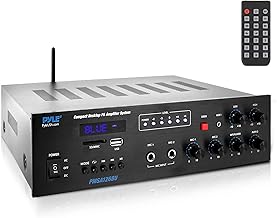
The Pyle PMSA126BU is best for buyers assembling a PA or commercial-style audio system, particularly when the speaker installation requires different output types. Its listed speaker outputs include 70V, 100V, 16-ohm, 8-ohm, 4-ohm, and common terminals. The feature list says it supports speakers rated from 4 to 16 ohms as well as 70V/100V speaker connections.
For MP3 playback, this receiver has a USB flash port and an SD card slot. It also lists Bluetooth streaming, AUX, RCA, microphone inputs, FM input, and 12V DC power input terminals. Those connections make it more versatile for PA sources than the smaller two-channel models, but the correct output must match the speaker system.
- Best for: PA-style installations needing USB or SD playback and multiple speaker-output options.
- Why it stands out: Offers listed 70V/100V and 4–16-ohm speaker connections, plus Bluetooth and microphone inputs.
- Limitation: Its output options require careful matching to the connected speakers; do not assume every output type suits every speaker.
XRONG Bluetooth Receiver And MP3 Player

The XRONG is best for someone who already has an amplifier or stereo and needs a compact playback source. It is a Bluetooth receiver and digital player with a 3.5 mm audio output, USB and TF-card playback, FM radio, and a four-digit LED display. The feature list describes it as suitable for home or vehicle audio systems and wired headphones when connected with the appropriate audio cable or adapter.
Unlike the other products in this comparison, the XRONG does not have a listed speaker power output. It cannot be treated as a standalone amplifier for passive speakers. Its role is to provide audio to an existing system through its output connection. The supplied details also state that a power adapter is not included.
- Best for: Adding Bluetooth, USB/TF playback, or FM radio to compatible existing audio equipment.
- Why it stands out: Provides several source options in a small receiver/player format.
- Limitation: It is not a speaker amplifier, and the listing says it is sold without a power adapter.
Buying Guide: How To Choose An MP3 Player Amplifier
Before choosing a product, decide whether you need a complete playback-and-amplification chain or just one component. An MP3 player or Bluetooth receiver provides a music signal. An amplifier increases that signal to drive passive speakers. Some amplifiers also include USB or SD playback, so they can play files without a separate MP3 player. Speakers are not listed as included with these products; confirm what is supplied before placing an order.
Do you need an amplifier or only a player?
Choose an amplifier if you need to power passive speakers. The AK-380, Daakro AK45, Pyle PDA29BU.5, and Pyle PMSA126BU are presented as amplifiers or receivers. Choose the XRONG if you already have audio equipment that can accept its 3.5 mm output and only need a playback or Bluetooth-receiver function. It is not a substitute for a power amplifier.
For a simple setup, a model with built-in USB or SD playback can reduce the number of separate devices. The AK-380, Pyle PDA29BU.5, and Pyle PMSA126BU list USB and removable-card playback. The supplied Daakro features focus on Bluetooth and tone controls, while the XRONG provides USB and TF-card playback but needs an existing system to amplify the signal.
Which connections do you need?
Make a list of the sources you plan to connect. Bluetooth is useful for wireless playback from a phone or computer. USB and SD or TF slots are relevant when you want to play stored audio files directly. AUX and RCA connections can connect wired sources, while microphone inputs matter for announcements or karaoke-style use.
Connection labels are not interchangeable. A 3.5 mm output on a receiver is not the same as a powered speaker output. Confirm that the source, amplifier input, and speaker connections form a compatible chain. If you plan to use a TV or projector, check the exact audio output type on that device against the amplifier’s listed inputs.
How should you compare power ratings?
Compare continuous or RMS output when that figure is provided, and treat peak power as a separate specification. The Pyle PDA29BU.5 lists 100 watts RMS continuous and 200 watts peak. The AK-380 lists 40W+40W rated and 400W+400W peak figures. Do not compare a peak figure from one product directly with another product’s continuous rating.
Power alone does not establish compatibility. Check the amplifier’s supported speaker impedance and the speaker’s own requirements. The PMSA126BU lists 4–16-ohm support and 70V/100V outputs, while the supplied information for the other models does not give a complete impedance specification. Consult the product details before connecting speakers.
When do 70V or 100V outputs matter?
70V and 100V outputs are commonly relevant to PA-style speaker installations, while conventional home stereo speakers generally use low-impedance connections. The PMSA126BU lists both kinds of output. Select the output type according to the speaker system and installation design; do not connect a speaker based only on the fact that its cable fits a terminal.
If you are shopping for a small home setup with a pair of speakers, a two-channel amplifier may be the more direct category to compare. For announcements, microphone use, or installations requiring PA speaker lines, a public address amplifier with the correct output options is a more relevant starting point.
Do you need microphone inputs or tone controls?
Microphone inputs are useful when the system needs voice announcements or microphone-based entertainment. The Pyle PDA29BU.5 lists two 1/4-inch microphone inputs, and the PMSA126BU lists microphone inputs. For buyers who mainly want to adjust the sound of music, the AK-380 and Daakro AK45 list separate bass and treble controls. The Daakro also includes a remote for audio adjustments.
What should you check before buying?
- Speaker requirements: Confirm impedance and connection type against the amplifier’s specifications.
- Playback method: Decide whether you need Bluetooth, USB, SD/TF, FM radio, wired inputs, or a combination.
- System role: Verify whether the product amplifies speakers or only sends audio to another device.
- Controls: Consider whether front-panel bass and treble adjustments, a display, or a remote matter to your setup.
- Included accessories: Check whether required cables, speakers, or a power adapter are included. The XRONG listing specifically says no power adapter is supplied.
- Installation type: Choose a conventional stereo amplifier for a compatible two-speaker setup or a PA receiver when its listed output types match the installation.
Frequently Asked Questions
Can an MP3 player connect directly to passive speakers?
Usually, a player or receiver with a line-level output cannot power passive speakers by itself. Connect the source to a compatible amplifier, then connect the amplifier to speakers that match its specifications. The XRONG is listed as a receiver/player with a 3.5 mm output, not as a speaker amplifier.
Which product includes USB and SD or card playback?
The AK-380 lists USB and SD playback. The Pyle PDA29BU.5 lists USB and an SD card slot. The Pyle PMSA126BU lists a USB flash port and SD card slot. The XRONG lists USB and TF-card playback.
Which amplifier is best for microphones?
The Pyle PDA29BU.5 is a home stereo option with two listed 1/4-inch microphone inputs. The Pyle PMSA126BU also lists microphone inputs and is described as a PA amplifier. Choose based on whether your system needs conventional stereo or PA-style speaker outputs.
Does the XRONG power speakers?
No speaker-amplifier output is listed for the XRONG. Its 3.5 mm audio output is intended to send audio to compatible equipment, such as an existing stereo or amplifier.
Should peak watts determine which amplifier I buy?
No. Peak and continuous ratings describe different measures. Compare continuous or RMS figures when available, and verify speaker compatibility. The PDA29BU.5 lists both 200 watts peak and 100 watts RMS continuous, while the AK-380 lists separate peak and rated figures.