
The best choice depends on whether you need a rackmount XLR patchbay or cables to connect XLR and 1/4-inch equipment. The AA Audio Accessory AP16 suits modular routing, while the ART P16 and Black Lion Audio PBR are straightforward 16-point XLR patchbay options. For connecting gear with different connector types, the JOLGOO and Smithok cables provide 1/4-inch TRS-to-XLR connections. These products serve different roles: the patchbays organize connections, and the cables link compatible outputs and inputs.
| Product | Type | Best For |
|---|---|---|
| AA Audio Accessory AP16 | 16-channel XLR patchbay | Modular, zone-based routing |
| ART P16 | 16-point XLR patchbay | Rackmount XLR connections |
| Black Lion Audio PBR | 16-point XLR patchbay | Gold-plated XLR connections |
| JOLGOO XLR-to-TRS Cable | 3.3-foot cable | Short balanced connections |
| Smithok TRS-to-XLR Cables | Two 6.6-foot cables | Longer runs and a two-cable set |
AA Audio Accessory AP16 XLR Patchbay

The AP16 is a 16-channel balanced XLR patch panel built from four independent modular blocks. Its design is intended to let users configure groups of four channels without cutting or modifying a traditional patchbay PCB. Each block can also be assigned to a different system zone, which can help keep studio routing organized.
Best for: Studios that want to divide XLR connections into separate zones or change channel groupings as equipment setups evolve. It was selected for its modular design and support for 4-, 8-, 12-, or 16-channel configurations.
The product features 24K gold-plated XLR pins, described as corrosion-resistant, and removable or replaceable modules. Those details may appeal to users who value accessible maintenance and clearly organized wiring.
Limitation: This is an XLR patchbay, not a direct 1/4-inch TRS patchbay. A compatible cable or adapter may be needed to connect equipment with 1/4-inch jacks.
ART P16 XLR Balanced Patchbay

The ART P16 provides 16 XLR connection points using 32 connectors: 16 female connectors on the front and 16 male connectors on the rear. Its connections use PCB wiring, and its 19-inch, 1U rackmount format is designed for installation in a compatible equipment rack. The enclosure is described as rugged, fully shielded, and made of black steel.
Best for: Rack-based studios that need a clearly laid-out, fixed 16-point XLR connection panel. It was selected because its front-to-rear connector arrangement and rack format make its intended role easy to identify.
Reversible rack ears provide flexibility in how the unit is mounted. The listed features focus on XLR connections and do not describe built-in 1/4-inch jacks, so users with TRS equipment should plan their signal path accordingly.
Limitation: The P16 is XLR-only based on the supplied product details. It is not the right standalone choice if the required patch points must be 1/4-inch TRS.
Black Lion Audio PBR XLR Patchbay

The Black Lion Audio PBR is a 16-point patchbay with 32 gold-plated XLR connectors. Its listed features emphasize the connector count and plating, making it a concise option to compare with other XLR-focused panels.
Best for: Buyers who want a 16-point XLR patchbay and prioritize gold-plated connectors. It was selected as one of the supplied products specifically identified as a patchbay, rather than a cable used to connect individual pieces of equipment.
Compare the PBR’s connector arrangement and installation requirements with the rest of your system before choosing it. The provided product information does not specify its rack size, front-and-rear connector gender arrangement, or modular configuration, so verify those details if they affect your setup.
Limitation: The listed features do not mention 1/4-inch connections. Users who need TRS patch points should not assume this XLR model provides them.
JOLGOO XLR Female-To-TRS Cable

This 3.3-foot cable connects an XLR female connector to a 1/4-inch, 6.35 mm TRS plug. Its listed construction includes 20 AWG 4N oxygen-free copper, foil shielding, metal braid shielding, and 24K gold-plated connectors. The cable is intended for audio equipment with matching XLR and TRS connections.
Best for: Short connections between compatible XLR and balanced 1/4-inch TRS equipment. It was selected because it directly addresses the XLR-and-1/4-inch part of the search, unlike the XLR-only patch panels.
The shielding is specified as a feature for reducing interference, while the gold plating is described as corrosion-resistant. Check the connector genders and signal direction required by your equipment before ordering; this cable has an XLR female end and a TRS plug.
Limitation: At 3.3 feet, it may not provide enough length for equipment placed farther apart. It is a cable, not a multi-channel patchbay.
Smithok Two-Pack TRS-To-XLR Cables
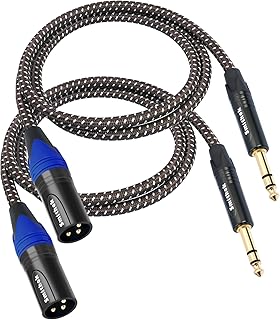
This product includes two 6.6-foot cables, each with a balanced 1/4-inch TRS connector and a three-pin XLR male connector. The listed features include shielded 24 AWG 4N oxygen-free copper, nylon-braided cable, gold-plated plugs, and a drag-resistant plug design. The described use is connecting a balanced TRS output to an XLR input.
Best for: Users who need two longer balanced connections, such as routing compatible mixer outputs to active-speaker inputs. It was selected because the set provides two cables and a different connector direction from the JOLGOO cable.
Confirm that the source has a balanced 1/4-inch TRS output and the destination has an XLR input. Connector shape alone does not guarantee that equipment uses a compatible balanced signal path.
Limitation: These cables do not provide patchbay channels or a way to switch routes. They are point-to-point interconnects, and their XLR ends are male.
Buying Guide: How To Choose An XLR And 1/4-Inch Setup
Do you need a patchbay or a cable?
A patchbay brings multiple connections to an accessible panel so a studio can organize or change signal routes more conveniently. A cable joins one output to one input. Choose a patchbay when you need to manage several connections from a central location; choose a cable when you need to connect two specific pieces of gear.
The products here are not interchangeable. The three patchbay options provide XLR connections, while the two cables connect XLR and 1/4-inch TRS equipment. If your goal is a patch panel with 1/4-inch sockets, check the product specifications for that connector type rather than assuming an XLR panel includes TRS points.
Which connector type and gender do your devices require?
Before buying, check each device’s output and input. Note whether the connection is XLR or 1/4-inch TRS, and whether each XLR port requires a male or female connector. The JOLGOO cable has an XLR female end and a TRS plug; the Smithok cables have a TRS plug and an XLR male end.
Also distinguish TRS from other 1/4-inch connectors. TRS means tip-ring-sleeve and is commonly used for balanced audio connections, but a 1/4-inch jack may serve a different purpose. Match the cable to the equipment’s actual connection and signal requirements.
How many channels and connection points are needed?
Count the devices and connections you plan to route, then allow for any additional channels your workflow may require. The AP16 supports configurations of 4, 8, 12, or 16 channels through its modular blocks. The ART P16 and Black Lion Audio PBR are both listed as 16-point patchbays.
A higher channel count is useful only if the panel’s connector layout works with your equipment. Compare the number of required XLR connections with the number of available patch points, and confirm whether you need a particular front-to-rear connector arrangement.
Will the patchbay fit your rack and workflow?
The ART P16 is described as a 19-inch, 1U rackmount unit with reversible rack ears. That information makes it a clear option to evaluate for a compatible rack. The supplied information for the other patchbays does not specify rack dimensions, so check their current product details if rack fit is essential.
For systems divided into separate groups, modular blocks can make organization and maintenance more manageable. The AP16 is specifically described as having four removable, independently assignable blocks. For a fixed XLR panel, compare the ART and Black Lion models by the connector details that matter in your rack.
What cable length and construction should you compare?
Choose a cable long enough to reach between devices without pulling tightly across a workspace. The JOLGOO cable is 3.3 feet long, while the Smithok set contains two 6.6-foot cables. Longer cable runs can make placement easier, but excess length may need to be managed to keep a studio tidy.
Shielding, conductor specifications, connector plating, and outer construction are useful comparison points because they are listed features. They do not replace checking connector compatibility, cable length, and the balanced or unbalanced requirements of the connected equipment.
Frequently Asked Questions
Is an XLR patchbay the same as a 1/4-inch patchbay?
No. An XLR patchbay uses XLR connections, while a 1/4-inch patchbay uses 1/4-inch jacks. Check the connector type on the product and on every device you plan to connect.
Can I connect a 1/4-inch TRS output to an XLR input?
Yes, when the equipment’s connection and signal requirements match the cable. The Smithok cables are described for a balanced 1/4-inch TRS output to a balanced XLR input. Confirm the connector gender and input/output direction for your specific devices.
Which listed product is a patchbay with modular channels?
The AA Audio Accessory AP16 is described as having four independent modular blocks that can be configured for 4, 8, 12, or 16 channels.
Which product is intended for rack mounting?
The ART P16 is specified as a 19-inch, 1U rackmount patchbay with reversible rack ears and a steel enclosure.
Are the JOLGOO and Smithok products patchbays?
No. They are cables. JOLGOO provides one 3.3-foot XLR-female-to-TRS cable, while Smithok provides two 6.6-foot TRS-to-XLR-male cables.
What should I verify before buying a cable?
Check connector type, XLR gender, cable length, signal direction, and whether the connected devices require balanced audio. These details help prevent buying a cable that fits physically but does not suit the intended connection.