
If you are looking for a guitar with a one-piece neck and rosewood playing surface, check whether “one piece” describes the entire neck or only the neck-and-heel construction. The YoungMonic kit is the closest match for a one-piece neck with a rosewood fingerboard; the Kisangel part is a rosewood fingerboard replacement, not a complete neck; and the ST-style neck has a rosewood fingerboard but a roasted maple neck. These distinctions matter when choosing a build kit, replacement part, or finished neck.
| Product | Best For | What To Check |
|---|---|---|
| YoungMonic DIY Guitar Kit | A custom build with a one-piece neck | Kit assembly and fit requirements |
| Kisangel Rosewood Fingerboard | A 20-fret acoustic fretboard replacement | Dimensions and fret layout |
| Vintage ST-Style Neck | An ST-style replacement neck with rosewood fingerboard | Heel and instrument-pocket fit |
YoungMonic One-Piece Neck DIY Guitar Kit
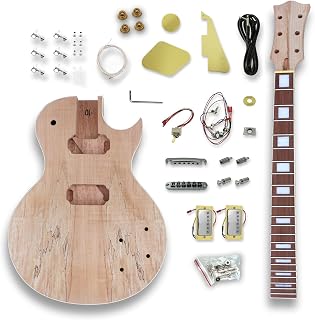
Best for: Guitar builders who want a semi-finished electric guitar kit that explicitly describes its 22-fret neck as one piece and specifies a rosewood fingerboard. It is the closest match in this selection to a search for a one-piece rosewood neck, although the listed details identify the fingerboard as rosewood rather than stating that the whole neck is made from rosewood.
The kit includes a mahogany body with map-texture veneer, white square fingerboard inlays, and accessories. Its stated effective string length is 628 mm. Those details make it a potential choice for a custom project where the buyer wants to assemble and personalize an instrument rather than install a standalone replacement neck.
Why it was selected: It is the only listed guitar product that specifically calls out a one-piece neck and a rosewood fingerboard together.
Limitation: This is a semi-finished kit, not a ready-to-play guitar. The supplied information does not specify neck-pocket dimensions or the precise work needed for assembly, so confirm the project requirements before buying.
Kisangel Rosewood Acoustic Fingerboard

Best for: Builders or repairers seeking a rosewood fretboard for a 20-fret acoustic guitar project. The product is a fingerboard, not a complete neck, so it suits buyers who already have a compatible neck or are planning a custom build.
The listed dimensions are 18.11 by 2.28 by 0.27 inches. The solid rosewood board has a shell-inlaid surround, providing a decorative edge. Its stated purpose includes acoustic-guitar fretboard replacement, repair, and DIY projects that need a matching 20-fret layout.
Why it was selected: It provides an actual rosewood guitar component and clearly states its intended fret count and measurements, useful details for assessing a replacement part.
Limitation: It is not a complete neck and is specified for 20-fret acoustic guitar use. Do not assume it will fit another instrument or fret layout without comparing measurements and construction needs.
Vintage ST-Style Roasted Maple Neck

Best for: Players or repair technicians looking for an ST-style replacement neck with a rosewood fingerboard. The neck itself is described as roasted maple, so this is not a one-piece rosewood neck; it is an option for someone whose priority is a rosewood playing surface.
Product details specify 21 frets, a dual-action truss rod, and a 56 mm heel width. The truss rod is described as adjustable, and the heel measurement is useful when checking whether the neck matches the intended ST-style pocket. Verify the dimensions of the existing instrument before choosing a replacement.
Why it was selected: It is a complete neck with a rosewood fingerboard, making it more relevant to replacement-neck shoppers than a fretboard-only part.
Limitation: The provided information does not establish compatibility with every ST-style body. The 56 mm heel measurement and other fit details should be compared with the target guitar.
Buying Guide: How To Choose A One-Piece Rosewood Neck
Does “rosewood neck” mean the whole neck is rosewood?
Not necessarily. Product descriptions often use “rosewood neck” loosely when the neck has a rosewood fingerboard. A guitar neck can have one wood for its main shaft and a different wood for the fingerboard. For example, the ST-style replacement listed above has a roasted maple neck and rosewood fingerboard. Read the construction description carefully if the wood used for the entire neck matters to you.
Also distinguish a one-piece neck from a one-piece neck-and-heel set or a neck paired with a separate fingerboard. The YoungMonic kit describes its neck as one piece, while identifying the fingerboard as rosewood. The provided description does not say that the entire neck is made from rosewood.
Are you buying a complete neck, fingerboard, or kit?
- Choose a complete neck when you need a replacement component with frets and adjustment hardware. Check its scale, heel width, fret count, and intended body style against your instrument.
- Choose a fingerboard when you are replacing or building the playing surface and have the skills and compatible neck structure to install it. Confirm length, width, thickness, and fret layout.
- Choose a kit when you want to assemble and customize a larger portion of the guitar. A kit is not equivalent to a finished instrument or a drop-in neck replacement.
Which measurements should you compare?
Fit depends on more than the product’s general style. Compare the neck heel width with the body pocket, and check the fret count, scale length, fingerboard dimensions, and mounting arrangement where those details are available. The ST-style neck lists a 56 mm heel width and 21 frets. The Kisangel fingerboard lists a 20-fret layout and overall dimensions. These figures are useful starting points, not a guarantee of fit.
For a kit, consider the full build rather than just the neck. The YoungMonic listing gives an effective string length of 628 mm and describes a mahogany body, one-piece 22-fret neck, and rosewood fingerboard. Confirm that its specifications meet your design plans before starting assembly.
Is a one-piece neck the right priority?
Decide whether you specifically need one-piece construction or whether you mainly want a rosewood fingerboard. These are separate requirements. Among the listed products, the DIY kit is the closest match to both terms because it describes a one-piece neck and a rosewood fingerboard. The ST-style neck is a complete replacement neck with a rosewood fingerboard, but its main neck wood is roasted maple. The Kisangel item is only a fretboard.
What should DIY builders consider?
Plan for the work involved in fitting and finishing a component. A replacement fingerboard may require careful matching and installation, while a semi-finished kit calls for a broader assembly project. The supplied product details do not specify every tool, adjustment, or fitting step. If you are not experienced with guitar setup or woodworking, seek qualified help before modifying the neck or body.
For any replacement part, compare the product measurements with the actual guitar rather than relying only on labels such as “acoustic” or “ST-style.” Small differences in scale, heel, fret layout, or pocket shape can prevent a part from fitting properly.
Frequently Asked Questions
Is the YoungMonic kit a one-piece rosewood neck?
The listing describes a one-piece 22-fret neck and a rosewood fingerboard. It does not state that the entire neck is made from rosewood, so it is more accurate to describe it as a one-piece neck with a rosewood fingerboard.
Is the Kisangel product a complete guitar neck?
No. It is a rosewood fingerboard intended for 20-fret acoustic-guitar projects. It is not a complete neck.
Does the ST-style neck have a rosewood neck shaft?
The listing describes the neck as roasted maple with a rosewood fingerboard. It should not be treated as an all-rosewood neck.
Can the ST-style neck fit any guitar body?
The listing identifies it as ST-style and gives a 56 mm heel width, but that information does not establish universal compatibility. Compare the heel and pocket dimensions, along with other relevant specifications, before buying.
What does a 20-fret fingerboard specification tell me?
It indicates the intended fret layout for the Kisangel fingerboard. Buyers should also compare its stated dimensions and the target guitar’s construction before using it as a replacement.