
The Yamaha RX-V4A is the clearest choice here for a home stereo setup that needs Wi-Fi, because its listed features include dual-band Wi-Fi, AirPlay 2, MusicCast, and Spotify Connect. The Sony STRDH190 is better for a straightforward two-channel system with Bluetooth and phono inputs. The Donner is suited to multi-speaker and karaoke setups, while the 1Mii and Esinkin adapters add Bluetooth streaming to compatible existing audio systems. These products differ: Bluetooth streaming is not the same as Wi-Fi audio.
| Product | Best suited for | Wireless connection listed |
|---|---|---|
| Yamaha RX-V4A | Wi-Fi-enabled home entertainment | Wi-Fi, AirPlay 2, MusicCast, Spotify Connect |
| Sony STRDH190 | Two-channel stereo with phono input | Bluetooth |
| Donner MAMP6 | Multi-channel amplification and karaoke | Bluetooth 5.3 |
| 1Mii B06Pro | Adding Bluetooth to an existing system | Bluetooth 5.3 receiver |
| Esinkin Bluetooth Adapter | Basic wireless streaming to existing speakers | Bluetooth receiver |
Yamaha RX-V4A 5.2-Channel AV Receiver
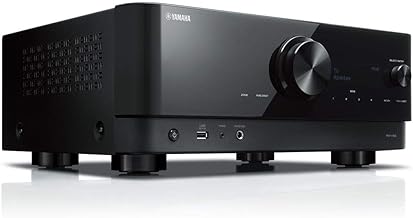
Best for: Buyers who specifically want a receiver with Wi-Fi features alongside home theater connectivity. The listed wireless options include 2.4 GHz and 5 GHz Wi-Fi, AirPlay 2, MusicCast, and Spotify Connect. Those features make this the most directly relevant product in this selection for a Wi-Fi home audio search.
The RX-V4A is a 5.2-channel AV receiver, rather than a basic two-channel stereo receiver. Its listed HDMI connections include four inputs and one output, with eARC and support for specified 4K and 8K formats. That combination may suit someone integrating music listening with a TV and other home entertainment equipment.
- Choose this if Wi-Fi streaming features are a priority.
- It is also a fit if you need HDMI connections for a home entertainment system.
- Check your desired streaming service and speaker setup against the receiver’s full specifications before purchase.
Limitation: This is a multichannel AV receiver, so it may be more equipment than needed for a simple two-speaker music system. The supplied information does not list every supported service or setup detail.
Sony STRDH190 Two-Channel Stereo Receiver

Best for: Buyers who want a conventional two-channel stereo receiver with Bluetooth and a phono input. Sony lists output at 100 watts per channel into 8 ohms, a phono input, four stereo RCA audio inputs, a 3.5 mm input, and a stereo RCA output.
The phono input is useful for shoppers whose system plan includes a turntable with a suitable phono-level output. Bluetooth provides a way to stream audio wirelessly from a paired device. This model is a more focused alternative to an AV receiver when the main goal is a traditional two-channel setup rather than HDMI-based home theater.
- Choose this if you need two-channel amplification and several analog inputs.
- It may be better suited than an AV receiver for a simpler stereo arrangement.
- Confirm that your speakers fall within the listed 6–16 ohm impedance range.
Limitation: The listed wireless connection is Bluetooth, not Wi-Fi. Avoid this model if Wi-Fi streaming or network-based multiroom playback is a requirement.
Donner MAMP6 Six-Channel Stereo Receiver
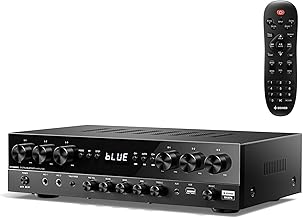
Best for: Buyers who need multiple channels, several input types, or microphone controls for karaoke. Donner lists 25 watts × 6 RMS power and 1000 watts peak power. The six channels can be independently controlled, and the product information says they support up to six groups of speakers with 4–16 ohm impedance.
Inputs include Bluetooth 5.3, USB, two pairs of RCA, two microphone inputs, AUX, FM radio, optical, and coaxial. The remote can adjust treble, midrange, bass, echo, and Talkover in any input mode. Optical and coaxial inputs may be useful when connecting supported digital audio sources, but this model has no HDMI input according to the supplied details.
- Choose this if multi-channel speaker connections and mic inputs matter more than Wi-Fi.
- It offers more input variety than a basic Bluetooth adapter.
- Check your speaker configuration and the required channel arrangement before buying.
Limitation: The listed wireless feature is Bluetooth 5.3, not Wi-Fi. Its stated peak power is not the same specification as its 25-watt-per-channel RMS figure.
1Mii B06Pro Long-Range Bluetooth Receiver

Best for: People who already own a stereo or speaker system and want to add Bluetooth streaming. The B06Pro is an audio receiver, not a standalone amplifier or Wi-Fi receiver. Listed connection options include optical, RCA, AUX 3.5 mm, and coaxial, allowing the adapter to connect to compatible audio equipment.
Its listed features include Bluetooth 5.3, dual antennas, aptX HD, aptX Low Latency, and a switchable 3D audio mode. The manufacturer states a range of up to 197 feet in open-air line of sight and 60–100 feet indoors without obstacles. The product information notes that interference and nearby equipment can affect range.
- Choose this if you need a Bluetooth source for an existing system with a matching input.
- It is a better fit than a basic adapter when optical or coaxial connections are useful.
- Volume and track controls are listed on the receiver.
Limitation: The stated range is conditional, not a guaranteed indoor distance. This adapter adds Bluetooth, not Wi-Fi, and it needs a separate audio system to play sound.
Esinkin Bluetooth Audio Adapter

Best for: Buyers seeking a simple way to stream from a phone or tablet to an existing stereo or speaker system. Esinkin connects using a 3.5 mm or RCA cable, then pairs with Bluetooth audio devices. A central button handles connection and disconnection, and the listed setup supports automatic reconnection to a previously paired device.
The adapter is a compact alternative to replacing a working receiver solely to add wireless playback. The manufacturer lists an indoor range of 30–40 feet without obstacles. Its controls are deliberately simple, which may suit a system that does not need advanced inputs or receiver features.
- Choose this if your existing system has a matching 3.5 mm or RCA input.
- It is a straightforward Bluetooth add-on rather than a complete stereo receiver.
- Consider the 1Mii if you need the additional connection types or control features listed for that model.
Limitation: It does not provide Wi-Fi, amplification, or the broader input selection of a receiver. The stated wireless range assumes an indoor space without obstacles.
Buying Guide: How To Choose A Wi-Fi Home Stereo Receiver
Do you need Wi-Fi, or is Bluetooth enough?
Start by identifying the wireless feature you actually need. Wi-Fi connects audio equipment to a home network; Bluetooth links a nearby source device directly to an audio receiver or adapter. In this group, the Yamaha is the product with Wi-Fi listed. The Sony, Donner, 1Mii, and Esinkin offer Bluetooth features, not Wi-Fi according to the supplied product details.
Choose Wi-Fi if you want network-based streaming features such as those listed for the Yamaha: AirPlay 2, MusicCast, and Spotify Connect. Choose Bluetooth if you mainly want to play audio from a nearby phone, tablet, or other paired device. If the current stereo already works well, a Bluetooth adapter may be enough.
Should you buy a full receiver or an adapter?
A full receiver provides amplification and connections for a speaker system. The Sony and Donner are stereo receivers, while the Yamaha is a multichannel AV receiver. The 1Mii and Esinkin are adapters: they send audio to existing equipment but are not replacements for an amplifier or speaker system.
Before choosing an adapter, check which inputs your current system has. The Esinkin lists RCA and 3.5 mm connections. The 1Mii lists optical, RCA, 3.5 mm AUX, and coaxial options. A connector match is essential; the adapter cannot replace a missing amplifier or speaker connection.
How many channels and speakers do you need?
For a basic two-speaker setup, the Sony’s two-channel design may be a direct fit. The Yamaha is a 5.2-channel AV receiver and is aimed at a broader home entertainment arrangement. The Donner lists six independently controlled channels and support for speaker groups, making it the option to examine if a multi-channel arrangement is important.
Do not select a receiver based only on a large peak-power figure. Compare the stated continuous or RMS output, channel count, speaker impedance, and intended speaker configuration. The supplied Donner information lists both 1000 watts peak and 25 watts × 6 RMS; these figures describe different power measures.
Which inputs and source devices should you check?
List the sources you plan to connect, such as a turntable, TV, phone, or other audio components. The Sony lists a phono input, RCA inputs, and a 3.5 mm input. The Donner lists analog and digital inputs, USB, FM, and microphone connections. The Yamaha lists HDMI inputs and eARC, which may be relevant to a TV-centered setup.
Match the connection on the source to the connection on the receiver. A phono input is not interchangeable with every line-level input. Likewise, an optical or coaxial digital connection requires a matching output on the source device.
Does wireless range matter in your room?
Range figures are not guarantees for every home. Walls, furniture, other wireless devices, and receiver placement can affect the connection. The 1Mii product information explicitly notes that range can be affected by nearby Wi-Fi routers and stereo antennas. The Esinkin range is listed for indoor use without obstacles.
If a source device will be far from the stereo, consider where the receiver can be placed and whether walls sit between the devices. For Wi-Fi streaming, check network coverage at the receiver’s location. For Bluetooth, keep the paired source within a practical distance and test placement in the intended room when possible.
What should you verify before ordering?
- Confirm whether the product provides Wi-Fi or only Bluetooth.
- Match receiver channels and speaker impedance to your system.
- Check that the receiver has the inputs your sources require.
- For an adapter, confirm that your existing stereo has a compatible audio input.
- Review the complete manufacturer specifications for streaming services and connection requirements.
Frequently Asked Questions
What is the best Wi-Fi home stereo receiver in this selection?
The Yamaha RX-V4A is the clearest Wi-Fi choice because its listed features include 2.4 GHz and 5 GHz Wi-Fi, AirPlay 2, MusicCast, and Spotify Connect.
Can a Bluetooth receiver connect to Wi-Fi?
Not based on the supplied details for the Bluetooth products here. The 1Mii, Esinkin, Sony, and Donner list Bluetooth features, while the Yamaha lists Wi-Fi.
Can I use the 1Mii or Esinkin without an existing stereo?
No. They are audio adapters that connect to an existing compatible stereo or speaker system; they are not complete amplifiers or standalone speaker systems.
Which option has a phono input?
The Sony STRDH190 lists a phono input. Check the turntable’s output requirements and the receiver’s full specifications before connecting it.
Which product is designed for multiple speaker channels and microphones?
The Donner MAMP6 lists six independently controlled channels and two microphone inputs. Its supplied specifications do not list Wi-Fi or an HDMI input.