
The best new floor-standing speakers depend on whether you need stereo sound at home, a home-theater setup, or a portable PA system. The Sony SS-CS3 is a strong fit for buyers seeking a home speaker pair, while the Klipsch R-610F is suited to listeners prioritizing the listed sensitivity and power handling. The Sony SS-CS3M2 is sold individually, and the EXOTON set is intended for event-style sound. A speaker stand is also included as a related accessory, not as a speaker.
| Product | Best For | Important Detail |
|---|---|---|
| Sony SS-CS3 | Home stereo buyers wanting a pair | Three-way, four-driver design |
| Sony SS-CS3M2 | Home theater buyers building a system | Sold individually |
| Klipsch Reference R-610F | Home audio and movie playback | 94 dB sensitivity |
| EXOTON S-1202 | Indoor or outdoor PA applications | Includes mixer and microphones |
| 30-inch Speaker Stands | Supporting compatible surround speakers | Accessory, not a floor-standing speaker |
Sony SS-CS3 3-Way Floor-Standing Speaker Pair

Best for: Home listeners who want a matched pair of passive floor-standing speakers for music or a living-room audio system. The listing describes a three-way, four-driver design and highlights high-resolution audio and room-filling sound.
Each speaker features a 1-inch polyester main tweeter and a ¾-inch super tweeter. The listed specifications include 145 watts peak power and 6-ohm impedance. A strong cabinet design is also cited as part of the speaker’s acoustic construction.
This model is a practical choice for buyers who prefer a pair in one listing rather than assembling a stereo setup from individual units. The tweeter configuration and three-way design make it distinct from a simple two-driver speaker.
Limitation: The listing gives peak power rather than a continuous power figure. Check that your amplifier can work with the stated 6-ohm impedance and that its power specifications suit your setup.
Sony SS-CS3M2 Hi-Res Floorstanding Speaker

Best for: Buyers adding a floor-standing speaker to a home theater or assembling a system one speaker at a time. The product is described as part of Sony’s CS Speaker Home Theater Series, with a three-way, four-driver design and high-precision tweeters.
The listed features include dual 5.12-inch woofers intended to boost low-end frequencies. This may appeal to listeners who want a tower speaker with dedicated drivers for bass alongside its tweeters. The listing also identifies the speaker as a high-resolution audio model with premium componentry.
Choose this if you want the described Sony home-theater series design and are comfortable purchasing speakers separately. It can also suit buyers who need to match their system’s speaker count to a particular room or layout, provided they confirm their equipment requirements before buying.
Limitation: This listing is for one speaker, not a pair. A stereo setup generally requires two speakers, so account for the individual-unit format when planning a purchase.
Klipsch Reference R-610F Floorstanding Speaker Pair

Best for: Home listeners who want a pair with clearly stated sensitivity, frequency response, and power-handling figures. The Klipsch Reference R-610F listing gives a 45 Hz to 21 kHz frequency response and 94 dB sensitivity, making those specifications easy to compare with other speakers under consideration.
The listing states 85 watts continuous and 340 watts peak power handling. It also positions the pair for music and movies, with a focus on detail and dynamic sound. These figures can help buyers compare the speaker’s stated capabilities with their room, receiver, and listening habits.
Choose this pair if you value a stated sensitivity rating and want two speakers for a home setup. The listed frequency range is also useful when comparing speakers, although frequency response alone does not describe how a speaker will sound in every room.
Limitation: The product details do not specify a matching amplifier or receiver. Check your electronics’ requirements and speaker connections before purchase rather than assuming every receiver is a suitable match.
EXOTON S-1202 Bluetooth PA System

Best for: Organizers looking for an event-oriented PA package rather than a conventional home stereo tower. The listing describes a 12-inch, 2000-watt Bluetooth PA system with passive speakers, a six-channel mixer, stands, a microphone, an effect controller, and 48-volt phantom power.
The package is presented for indoor and outdoor use. Its included mixer and microphone make it a different category from the Sony and Klipsch home-audio pairs. Consider it when the goal is to amplify speech or event audio and the bundled mixing features are relevant.
Choose this system if you need a multi-component PA setup. It is not the direct choice for someone shopping only for a pair of passive home listening speakers; compare the complete package against your venue, connection needs, and intended use.
Limitation: The listing describes passive speakers and a mixer-based system, so setup and connections differ from a straightforward home stereo purchase. Confirm the included components and power arrangement in the current listing before ordering.
30-Inch Speaker Stands With Glass Bases
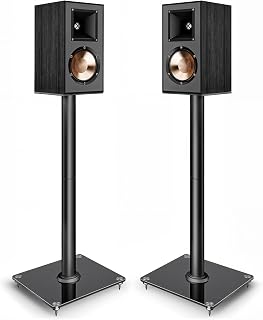
Best for: Buyers who need stands for compatible surround or bookshelf speakers, not buyers looking for floor-standing speakers. The listing describes a pair of fixed-height 30-inch stands with tempered-glass bases, cable management, and a stated 55-pound weight capacity.
The product is included as a related accessory because floor placement and speaker positioning can be part of planning an audio setup. Its listed 11.8-inch base and cable-management feature may be useful when a supported speaker needs a separate stand. Verify the speaker’s dimensions, mounting arrangement, and weight against the stand’s specifications before use.
Limitation: These are stands, not audio speakers, and the supplied details do not establish that they fit any of the speaker models above. They are not a substitute for a floor-standing speaker cabinet.
Buying Guide: How to Choose Floor-Standing Speakers
Do you need a home speaker or a PA system?
Start with the intended use. Home floor-standing speakers such as the Sony and Klipsch models are designed as components for a domestic audio system. The EXOTON product is a PA package with a mixer and microphone, which makes it a different type of purchase. Select based on whether you need everyday music and movie playback or a system for amplified events.
Should you buy a pair or an individual speaker?
Check whether the listing is for one speaker or a pair. The Sony SS-CS3 and Klipsch R-610F listings specify pairs, while the Sony SS-CS3M2 is sold individually. A stereo system typically needs left and right speakers, so a single-unit listing may require a separate purchase. For home theater, plan the number of speakers around your intended system layout.
How should you compare speaker specifications?
Use specifications that are explicitly provided, but avoid treating one number as a complete measure of sound quality. Sensitivity can help compare how efficiently speakers convert input power into output under stated conditions. Frequency response describes a range but does not fully predict performance in a particular room. Power figures also need context: note whether a listing says peak or continuous handling.
For these options, the Klipsch listing provides 94 dB sensitivity, a 45 Hz to 21 kHz frequency response, and continuous and peak power figures. The Sony SS-CS3 lists 6-ohm impedance and 145 watts peak power. Compare the specifications with the receiver or amplifier documentation before purchasing.
Will the speaker work with your receiver?
Confirm the speaker’s electrical requirements and your amplifier’s supported speaker impedance and power range. The SS-CS3 listing states 6-ohm impedance, while the other provided descriptions do not include enough information to confirm every equipment match. When a specification is missing, consult the full product details or manufacturer documentation rather than assuming compatibility.
Do you need floor-standing cabinets or separate stands?
A tower speaker is a complete speaker cabinet intended to stand on the floor. A speaker stand is a separate support for a compatible smaller speaker. The 30-inch stand listing does not make it a floor-standing speaker. Check the stand’s stated capacity and mounting requirements, and do not assume it supports a specific speaker unless fit information confirms it.
What should you check before ordering?
- Confirm whether the package includes one speaker, a pair, or a complete PA system.
- Check amplifier or receiver requirements, including impedance and relevant power specifications.
- Measure the intended placement area and allow room for positioning and cable routing.
- Review whether the product is intended for home playback, home theater, or event amplification.
- For accessories, verify capacity, dimensions, mounting details, and compatibility separately.
Frequently Asked Questions
Which listed floor-standing speakers are sold as a pair?
The Sony SS-CS3 and Klipsch Reference R-610F listings specify a pair. The Sony SS-CS3M2 listing specifies one speaker sold individually.
Are the Sony SS-CS3 and SS-CS3M2 the same purchase format?
No. The SS-CS3 listing is for a pair, while the SS-CS3M2 listing says each speaker is sold individually. Confirm the exact model and quantity before buying.
Is the EXOTON S-1202 a home stereo floor speaker?
The EXOTON S-1202 is presented as a Bluetooth PA system with passive speakers, a mixer, and event-oriented accessories. It is better categorized as a PA package than a conventional home stereo pair.
Can the 30-inch stands replace floor-standing speakers?
No. The stands are accessories that support compatible speakers. They do not produce sound and are not floor-standing speaker cabinets.
What does 6-ohm impedance mean when choosing an amplifier?
It is an electrical specification relevant to amplifier matching. Check the amplifier or receiver documentation to confirm it supports the speaker’s stated impedance.
Is peak power the same as continuous power handling?
No. Peak and continuous figures describe different power-handling measures. Compare like-for-like figures when evaluating speakers and follow the manufacturer’s guidance for the speaker and amplifier.