
The best 6-inch home subwoofer depends on whether you want a powered, ready-to-connect model or a passive speaker for a system you configure yourself. The Audioengine S6 is best for compact powered setups, the Kanto SUB6 suits small rooms and desks, and the Rockville Rock Shaker offers multiple connection options. The list also includes a white Audioengine S6 and a 6.5-inch passive subwoofer for buyers comparing nearby sizes and formats.
| Product | Best For | Key Detail |
|---|---|---|
| Audioengine S6 Mini, Black | Compact powered audio systems | 6-inch driver; 210 watts listed |
| Audioengine S6 Mini, White | Buyers seeking a white finish | 6-inch powered subwoofer by product name |
| Kanto SUB6 | Desks and small rooms | Sealed enclosure; 100 W RMS |
| Rockville Rock Shaker | Flexible wired connections | RCA and speaker-level inputs |
| 6.5-Inch Passive Subwoofer | Custom systems with external amplification | 100 W RMS / 150 W peak listed |
Audioengine S6 Mini Subwoofer, Black
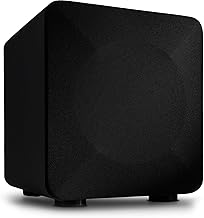
The Audioengine S6 Mini is a compact powered subwoofer with a 6-inch driver and a listed 210 watts of power. Its front-firing design is intended for music, movies, gaming, and home-office setups. Because it is an active subwoofer, it has built-in amplification rather than relying on a separate power amplifier for the subwoofer driver.
Best for: Buyers who want a compact powered subwoofer for a small home audio or entertainment setup. The 6-inch format and stated compatibility with the Audioengine W3 wireless adapter make it a candidate for buyers who want to add bass without choosing a larger subwoofer.
Why it was selected: It directly matches the 6-inch search and provides listed power and use-case details for comparison. Limitation: The provided product information does not specify connection details beyond W3 adapter compatibility, so check the listing for the inputs required by your system.
Audioengine S6 Mini Subwoofer, White

The white Audioengine S6 Mini is listed as a compact 210W powered bass speaker for music, movies, gaming, and home-office setups. Its product name identifies it as a 6-inch mini subwoofer. The supplied information does not include a separate feature list for this color version, so buyers should confirm specifications and connections on the product listing before ordering.
Best for: Buyers who want the S6 Mini’s stated compact format in a white finish to suit their room or equipment arrangement. It is also relevant to shoppers comparing the same named model in different finishes.
Why it was selected: It is a directly relevant 6-inch powered subwoofer and gives finish-conscious buyers a second option. Limitation: Detailed specifications were not provided for this listing; do not assume that every listed feature of the black version is confirmed here without checking the product page.
Kanto SUB6 Compact Sealed Subwoofer

The Kanto SUB6 is a powered subwoofer with a 6-inch woofer, a sealed enclosure, and a Class-D amplifier rated at 100 W RMS. Kanto describes the sealed design as delivering quick, accurate low-frequency response with reduced distortion. Its compact dimensions are presented as suitable for placement under a desk or in a small apartment.
Best for: Buyers who prioritize a small footprint and controlled bass for music, movies, or games. The sealed enclosure and stated RMS power make its design and output rating straightforward to compare with other compact models.
Why it was selected: It is an exact 6-inch powered option with specific information about enclosure type, intended placement, and power. Limitation: Its compact format is designed to save space; buyers seeking the strongest possible low-frequency output should compare larger subwoofers as well.
Rockville Rock Shaker 6.5-Inch Subwoofer
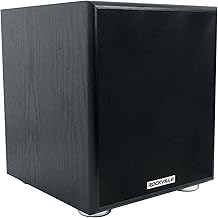
The Rockville Rock Shaker is a powered 6.5-inch home-theater subwoofer with a listed 100 W RMS and 200 W peak. Its feature list includes an adjustable crossover and phase controls for tuning integration with other speakers. RCA and speaker-level inputs and outputs provide connection options for receivers, amplifiers, and audio systems.
Best for: Buyers who want more connection flexibility and adjustment controls than a basic compact subwoofer listing may provide. The adjustable crossover and phase controls can help users tailor integration to their speaker setup and room.
Why it was selected: Its 6.5-inch driver is close to the requested size, and its input and output types are clearly listed. Limitation: At 6.5 inches, it is not an exact 6-inch model; check available space and system connections before choosing it.
6.5-Inch Passive Home Subwoofer

This 6.5-inch subwoofer is described as passive, with a 100 W RMS and 150 W peak rating. The product name also identifies a wood enclosure and a shock-absorbing base. Unlike powered subwoofers, passive models do not have built-in amplification, so they need a suitable external amplifier as part of the system.
Best for: Buyers building or adapting a system who already plan to use appropriate external amplification. It may suit shoppers who are open to a 6.5-inch driver and want a passive rather than powered subwoofer.
Why it was selected: It is a close size alternative and its passive format offers a different system-building choice. Limitation: It is not a ready-to-use powered subwoofer; confirm amplifier suitability and wiring requirements before purchase. The supplied details do not specify additional connection or setup information.
Buying Guide: How to Choose a 6-Inch Home Subwoofer
A small subwoofer can add low-frequency sound while taking up less floor or desk space than a larger cabinet. The best choice depends on the full audio system, not just the driver diameter. Compare powered versus passive design, dimensions, connection types, power ratings, and the placement you have available.
Do you need a powered or passive subwoofer?
A powered subwoofer has built-in amplification. This can simplify a setup because the subwoofer does not depend on a separate external amplifier to drive its speaker. The Audioengine S6 Mini, Kanto SUB6, and Rockville Rock Shaker are described as powered models.
A passive subwoofer requires suitable external amplification. It may make sense for a buyer assembling a system around a separate amplifier, but it adds a compatibility step. Check that the amplifier and subwoofer are appropriate for one another before connecting them.
Is a 6-inch driver enough for your room?
Driver size is one factor in subwoofer performance, not a complete measure of how deep or loud bass will sound. A compact 6-inch model can be useful where space is limited, such as near a desk or in a small apartment. The Kanto SUB6 is specifically described as compact enough for under-desk placement or small spaces.
A 6.5-inch model is a nearby alternative rather than an exact 6-inch match. The Rockville and passive options in this list use 6.5-inch drivers. Compare their cabinet dimensions with your available space, since the driver measurement alone does not reveal the complete footprint.
What do RMS and peak power ratings tell you?
RMS and peak figures are different types of power ratings and should not be treated as interchangeable. The Kanto is listed at 100 W RMS, while the Rockville is listed at 100 W RMS and 200 W peak. The passive model lists 100 W RMS and 150 W peak. The Audioengine black model is described as 210 watts, but the supplied details do not label that figure as RMS or peak.
When comparing models, look for the same type of rating and review the product specifications rather than comparing headline numbers alone. Also confirm that a passive subwoofer’s amplification is suitable for its stated ratings.
Which connections should you check?
Match the subwoofer’s inputs and outputs to the equipment you already own. The Rockville lists RCA and speaker-level inputs and outputs, which gives buyers specific connection types to check against their receiver or audio system. The Audioengine S6 feature information mentions compatibility with the Audioengine W3 wireless adapter, but does not provide a complete list of wired inputs in the supplied details.
For the white Audioengine listing and the passive 6.5-inch model, the supplied product details are limited. Check the current listing for connection, wiring, and setup information before making a decision.
Should you choose a sealed enclosure?
The Kanto SUB6 is explicitly described as a sealed subwoofer. Kanto associates its sealed enclosure with quick, accurate bass and low distortion. Buyers who value a compact cabinet and controlled low-frequency response may find this design relevant. Enclosure type alone does not establish whether a subwoofer will suit every room or listening preference.
How should you compare compact subwoofers?
- For a compact powered 6-inch model: Compare the Audioengine S6 Mini and Kanto SUB6, including their listed power details and available connections.
- For connection flexibility: Review the Rockville’s RCA and speaker-level connections, along with its crossover and phase controls.
- For a white finish: Consider the white Audioengine listing, but confirm its detailed specifications on the product page.
- For a system with external amplification: Consider the passive 6.5-inch model only after checking amplifier and wiring requirements.
- For a tight space: Measure the intended placement area and compare cabinet dimensions, not just woofer size.
Frequently Asked Questions
What is the difference between a powered and passive subwoofer?
A powered subwoofer has built-in amplification. A passive subwoofer needs a suitable external amplifier to drive it.
Is a 6.5-inch subwoofer close to a 6-inch model?
It is a nearby size alternative, but not an exact 6-inch match. The Rockville and passive models listed here have 6.5-inch drivers.
Which listed subwoofer is designed for a desk or small apartment?
The Kanto SUB6 is described as compact enough for under-desk placement or small apartments. Measure your space before choosing any model.
What does RMS power mean on a subwoofer listing?
RMS is a power rating that should be compared with other RMS ratings, rather than directly with peak power. Check how each listing labels its power figure.
Can I connect any subwoofer to my receiver?
No. Connection types and system requirements vary. Compare the subwoofer’s inputs with your receiver’s outputs, and check amplification requirements for passive models.
Does a smaller subwoofer always produce less bass?
Driver diameter alone does not determine bass performance. Design, amplification, enclosure, room, and placement also matter, so compare the full specifications and intended use.