
The best pedal steel guitar tuner is a chromatic tuner pedal that makes individual notes easy to read and lets you tune quietly between songs. The Peterson StroboStomp HD is a strong choice for players who prioritize a full-color display; the LEKATO offers adjustable reference pitch and half-flat settings; and the Donner adds a stated ±1-cent strobe mode. The STRICH emphasizes a large screen and metal casing, while the KLIQ is a compact option with needle and strobe modes. These pedals are not described as pedal-steel-specific, so confirm your tuning workflow and power needs before choosing.
| Product | Best for | Standout listed feature |
|---|---|---|
| Peterson StroboStomp HD | Players who want a color display | Full-color display |
| LEKATO Tuner Pedal | Pitch and flat-tuning adjustments | 430–450 Hz calibration and half-flat options |
| Donner DT-1 | Players who want a stated precision figure | Strobe mode rated at ±1 cent |
| STRICH Tuner Pedal | Players who value a large screen | 2-inch color display |
| KLIQ TinyTune Pro | Compact pedalboards and stage use | Needle and strobe modes |
Peterson StroboStomp HD

The Peterson StroboStomp HD is a pedal tuner with a full-color display. That makes it a candidate for pedal steel players who want a dedicated floor unit with a display that presents tuning information in color. Its listing provides limited feature detail, so compare its current specifications with other models if you need particular functions such as adjustable reference pitch, a specified accuracy rating, or a specific bypass mode.
Best for: Players who prioritize a full-color tuner display and want a pedal-format unit. It was selected because it is explicitly a pedal tuner and has a clearly stated display feature.
Limitation: The supplied product information does not specify tuning range, accuracy, power requirements, or switching behavior. Check those details before purchase if they are essential to your setup.
LEKATO Guitar Tuner Pedal

The LEKATO tuner pedal has a color LCD, adjustable A4 calibration from 430 to 450 Hz, and four half-flat options. Its listed tuning tolerance is about 0.499%. The maker also describes the unit as compact and says its screen is intended to remain visible in bright or dim conditions.
Best for: Players who need to adjust reference pitch or use flat-note settings. Those controls can be useful when a player’s tuning routine calls for a pitch other than the standard reference or for note-flat adjustments. It was selected for its explicit calibration and flat-tuning features.
Limitation: Its stated tolerance is not presented in the same format as the Donner’s ±1-cent claim, so avoid treating the figures as directly comparable without checking how each specification is defined. The listing describes it for electric guitar and bass, not specifically pedal steel.
Donner DT-1 Chromatic Tuner
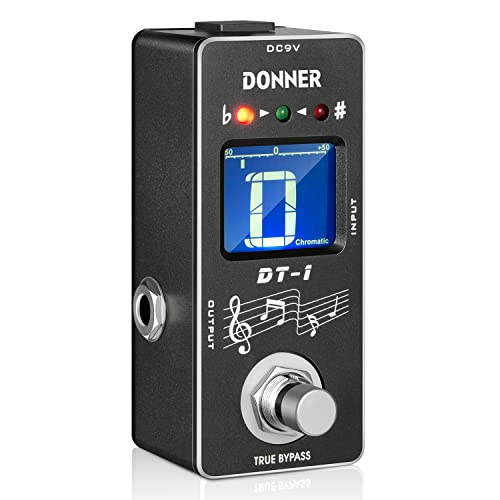
The Donner DT-1 is a chromatic pedal tuner with a listed range of A0 to C8 and a fast strobe mode rated at ±1 cent. Its listing describes two modes: tuning mode cuts the signal output while the player tunes, and bypass mode sends the instrument signal to the amplifier. It also has a color-and-brightness-adjusted LED display paired with a mini LCD screen.
Best for: Players who want a stated accuracy figure and a mute-style tuning mode. Cutting the output while tuning is useful when you want to adjust notes without sending them through the amplifier. It was selected for its clear mode descriptions and broad stated range.
Limitation: The product is described for electric guitar and bass, and the listing does not identify a pedal-steel-specific mode. Confirm that its display and control layout suit your preferred note-by-note tuning process.
STRICH Tuner Pedal

The STRICH tuner pedal features a 2-inch color screen, a stated tuning range of B0 to C8, and adjustable A4 calibration from 430 to 450 Hz. Its listed casing is zinc alloy, and the product description calls the design robust. It is presented as a chromatic, drop-tuning pedal for electric guitar and bass.
Best for: Players who prefer a larger display and want adjustable reference pitch. The screen size is a specific advantage for shoppers comparing display dimensions, while the calibration range may suit players who need to change the reference tone. It was selected for these clearly listed features.
Limitation: The listing says a DC 9V adapter with negative inside and positive outside is required, and that the adapter is not included. Check your power supply’s polarity and output before connecting it.
KLIQ TinyTune Pro Stage Tuner

The KLIQ TinyTune Pro is a mini chromatic pedal tuner with a stated A0–C8 range, needle and strobe display modes, and a recessed LED display. Its listing specifies true-bypass circuitry and silent relay-based switching. It also lists flat tuning and pitch calibration, though the supplied features do not state the calibration range.
Best for: Players with limited pedalboard space who want a compact tuner with multiple display modes. The needle and strobe options provide different ways to read pitch, and the silent-switching claim may matter for players tuning during a performance. It was selected for its compact format and stage-oriented listed features.
Limitation: The listing states that a 9V power supply is required but does not include further power details in the supplied feature text. Verify the required supply specifications before use.
Buying Guide: How to Choose a Pedal Steel Guitar Tuner
Does a pedal steel guitar need a special tuner?
The products here are described as chromatic tuners for electric guitar and bass, or as general pedal tuners; none is identified in the supplied information as a pedal-steel-specific model. A chromatic tuner can display the note being played, which supports tuning individual strings. Pedal steel players often need to check notes across multiple strings and positions, so a readable display and a quiet tuning workflow may be more important than an instrument-specific label.
Before buying, consider how you tune: whether you mute the instrument, tune one string at a time, and make adjustments while seated at your steel. If you rely on a particular tuning method or need special tempering settings, verify that the product supports those requirements. The listed features do not establish specialized pedal steel temperaments or presets.
Which display is easiest to read?
Display size and format affect how quickly you can read a tuner from your playing position. The STRICH lists a 2-inch color screen. The LEKATO and Peterson list color displays, while the Donner combines colored LED beads with a mini LCD screen. The KLIQ lists a recessed LED display with needle and strobe modes.
For a stage setup, consider viewing angle, brightness, and whether the display remains legible under your lighting. Only rely on the details the manufacturer provides: the LEKATO describes visibility in bright and dim conditions, and the KLIQ describes a bright LED display. A larger screen may be easier to see, but actual readability depends on placement and your setup.
Do pitch calibration and flat tuning matter?
Adjustable A4 calibration lets a player set the tuner’s reference pitch within the range specified by the manufacturer. The LEKATO and STRICH list 430–450 Hz adjustment. This is useful if you need a nonstandard reference pitch, but it is not automatically necessary for every player.
Flat-tuning features are separate from reference calibration. The LEKATO lists four half-flat options, and the KLIQ lists flat tuning. The STRICH and Flatsons listing also mention drop or flat tuning, but the Flatsons model is not included among the five picks. Check how a pedal implements flat settings if you need a particular number of semitones or a specific workflow.
How should I compare tuning accuracy?
Compare accuracy claims carefully because product descriptions may use different measures. The Donner lists ±1-cent accuracy in strobe mode, while the LEKATO lists about 0.499% tuning tolerance. These are not expressed in the same format. Peterson’s supplied feature information only confirms a full-color display, so it does not support a direct accuracy comparison.
For practical selection, first check whether a product offers a display mode you can read and the tuning controls you need. If a specific precision figure is important, look for the manufacturer’s full specifications and confirm the meaning of the stated measurement instead of assuming that different figures are interchangeable.
Should the tuner mute the signal?
A mute function can let you tune without sending the instrument’s sound to the amplifier. The Donner describes a tuning mode that cuts output, while the LEKATO lists a mute feature in its product name. The KLIQ describes silent switching and true bypass. These terms describe different aspects of operation, so check the product’s mode instructions if you need to know exactly when the signal is muted.
If you tune between songs, consider whether you want the tuner to mute automatically when engaged and whether switching noise is a concern. If preserving a direct signal path when the tuner is off matters to you, look for a clearly stated bypass type. Do not assume every pedal has the same switching behavior.
What power and pedalboard details should I check?
Check the power supply requirements before adding a tuner to your pedalboard. The STRICH listing explicitly requires a DC 9V adapter with negative inside and positive outside and says it is not included. The KLIQ listing says a 9V supply is required. For other models, confirm current power details with the seller or manufacturer rather than assuming a connector or polarity.
Also compare the pedal’s footprint with the space available on your board. The LEKATO is described as small, and the KLIQ is identified as a mini pedal. A compact unit can leave room for other equipment, while a larger display may be easier to read. Balance those priorities against your layout and playing position.
Frequently Asked Questions
Can I use a chromatic pedal tuner with pedal steel guitar?
The listed tuners are not described as pedal-steel-specific, but their chromatic tuning features are relevant for reading individual notes. Confirm that the tuner’s range and controls fit your instrument and preferred tuning method.
Which tuner in this list has adjustable A4 calibration?
The LEKATO and STRICH list adjustable A4 calibration from 430 to 450 Hz. The supplied Peterson feature information does not state an A4 calibration range.
Which model lists a large display?
The STRICH lists a 2-inch color screen. The LEKATO, Peterson, and Donner also describe color display features, but the supplied information does not give their screen dimensions.
Which tuner has a stated ±1-cent accuracy figure?
The Donner DT-1 lists a fast strobe mode with ±1-cent accuracy. The other supplied product details use different descriptions or do not provide an accuracy figure.
Do these tuner pedals include a power adapter?
The STRICH listing says its required DC 9V adapter is not included. The KLIQ listing states that a 9V power supply is required, but the supplied features do not say whether one is included. Check the current product details for the other models.