
The best 70V amplifier system depends on how many speakers and independently controlled areas you need. The Rockville RCS350-6 is best for smaller multi-zone installations, while the RCS650-6 offers more stated amplifier power for larger or more demanding setups. Pyle’s PMSA126BU and PMX3500PH add 70V/100V output with different input and control features. The Rockville RPA5 is included for comparison, but its listed specifications do not identify 70V output, so it is not a direct 70V-system choice.
| Product | Best suited for | Key distinction |
|---|---|---|
| Rockville RCS350-6 | Smaller multi-zone installations | Six zones and three mic inputs |
| Rockville RCS650-6 | Multi-zone systems needing more stated power | 650W and six zones |
| Pyle PMSA126BU | Basic commercial or home PA setups | 70V/100V output and USB-A |
| Pyle PMX3500PH | Rack-based systems needing varied sources | Bluetooth, optical, coaxial, and mic inputs |
| Rockville RPA5 | Conventional speaker systems, not confirmed 70V | Stereo/bridged modes and built-in crossover |
Rockville RCS350-6 350W 6-Zone Amplifier

The RCS350-6 is a 350W commercial amplifier with six zone volume controls and listed 70V, 100V, 8-ohm, and 4-ohm operation. Its source and input features include Bluetooth, USB/SD, FM radio, optical input, three microphone inputs, and a chime function. The product is also described as rack mountable.
Best for: Smaller businesses, restaurants, or facilities that need separate volume control across multiple areas and want several audio-input options. It was selected because its listed outputs directly include 70V and its six-zone controls address multi-area installations.
Limitation: Its stated 350W output is lower than the RCS650-6’s stated 650W. Check the combined speaker tap-wattage plan and required headroom before choosing it.
Rockville RCS650-6 650W 6-Zone Amplifier
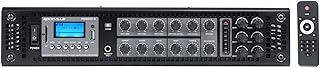
The RCS650-6 is listed as a 650W, six-zone commercial amplifier with 70V and 100V outputs, as well as 4–8 ohm operation. Its features include Bluetooth, USB/SD, three microphone inputs, optical input, a chime function, rack mounting, and zone volume controls.
Best for: Installations that need six areas of volume control and want more stated amplifier power than the RCS350-6. The matching zone count and expanded 650W rating make it a useful comparison for larger speaker loads or systems planned with additional headroom.
Limitation: The product details do not specify power allocation per zone. Confirm how the amplifier’s total output relates to your speaker layout rather than assuming every zone has a separate full-power channel.
Pyle PMSA126BU 500W PA Amplifier

The Pyle PMSA126BU is described as a 500W compact digital receiver with 70V and 100V output. Listed features include a dual microphone input, USB-A input with an MP3 player, FM radio, RCA connectivity, and continuous volume control. The product is presented for home and commercial use.
Best for: Buyers assembling a straightforward PA system who need 70V/100V output, microphone connections, and USB playback. It was selected because it supports the target line-voltage formats and provides common audio sources without the six-zone positioning of the Rockville models.
Limitation: The supplied details do not list independent multi-zone controls, Bluetooth, or an optical input. Choose another option if those functions are essential to the installation.
Pyle PMX3500PH Bluetooth PA Mixing Amplifier

The PMX3500PH is a 500W rack-mount stereo PA mixing amplifier with listed 70V and 100V output. Its described inputs and playback features include Bluetooth, USB, AUX, microphone, optical, and coaxial connections, along with a digital LED display and AC-3 support.
Best for: Buyers who want a 70V-capable amplifier with several wired source connections and Bluetooth in a rack-mount format. It is a stronger fit than the basic PMSA126BU when optical or coaxial inputs are relevant to the source equipment.
Limitation: The listed features do not mention six-zone volume controls. Do not treat “stereo” as proof of independent commercial zones; verify the intended speaker wiring and control arrangement.
Rockville RPA5 Conventional Power Amplifier

The RPA5 is a two-channel professional and DJ rack-mount power amplifier. Its listed specifications include 1,000W peak and 400W RMS, a built-in crossover, stereo and bridged modes, XLR, 1/4-inch, and RCA inputs, and Speakon or banana outputs.
Best for: Buyers comparing conventional two-channel amplification for a separate speaker application. It is included to clarify an important distinction: its supplied features do not identify 70V or 100V output.
Limitation: Avoid selecting this model as a 70V amplifier based on the provided description alone. Its peak-power figure does not establish compatibility with distributed 70V speaker wiring.
Buying Guide: How To Choose A 70V Amplifier System
What does a 70V amplifier do?
A 70V amplifier is designed to drive compatible distributed speaker systems using a higher-voltage audio line. In commercial installations, speakers are commonly connected in parallel, with each speaker’s transformer tap setting its power draw. This approach can make it practical to run multiple speakers over long cable routes, but the amplifier and speakers must be configured for the same system.
Do not confuse a 70V output with a regular low-impedance speaker output. The products above may list both types of output, but the correct connection depends on the speaker system and the amplifier’s terminal selection. Check the product documentation before wiring.
How much amplifier power should I choose?
Start with the speaker count and the selected tap wattage for each speaker. Add the tap ratings to estimate the total load, then compare that figure with the amplifier’s rated output for the intended 70V mode. Leave appropriate headroom rather than planning to operate continuously at the maximum stated output.
In this group, the RCS350-6 is listed at 350W, the PMSA126BU and PMX3500PH at 500W, and the RCS650-6 at 650W. These headline ratings alone do not determine which is right: speaker load, coverage, operating level, and whether zones share the total output matter too. Confirm mode-specific ratings in current manufacturer documentation.
Do you need separate volume control by zone?
Choose an amplifier with explicitly listed zone controls if different rooms or areas need independent volume adjustment at the equipment. Both Rockville RCS models specify six-zone volume controls. The supplied descriptions for the two Pyle models do not state that they have this feature.
Zone volume controls should not be mistaken for separate amplifier channels or independent audio sources. Confirm whether the installation needs separate volume, separate program material, or both. These are different system requirements.
Which inputs and playback sources matter?
List the sources that will connect to the system before choosing an amplifier. The RCS models list Bluetooth, USB/SD, FM radio, optical input, microphone inputs, and chime functionality. The PMSA126BU lists a dual-mic input, USB-A MP3 playback, FM radio, and RCA connectivity. The PMX3500PH lists Bluetooth, USB, AUX, microphone, optical, and coaxial connections.
Match those features to actual equipment. For example, optical or coaxial inputs may matter when connecting a compatible digital source, while microphone inputs and chime functions may be useful for announcements. Do not assume a feature not named in the supplied product details is included.
Should the amplifier be rack mounted?
Rack mounting can help organize equipment in a fixed installation. The RCS350-6, RCS650-6, and PMX3500PH are identified as rack-mount models; the RPA5 is also described as a 2U rack-mount amplifier. The PMSA126BU is described as compact, but the supplied information does not state rack-mount capability.
Check physical dimensions, ventilation requirements, and available rack space in the manufacturer’s documentation. The product titles alone do not establish exact fit or installation clearances.
What should I verify before installation?
- Confirm that the amplifier has a 70V output, not merely a high wattage rating.
- Check that every speaker supports the intended 70V line and transformer-tap configuration.
- Calculate the combined speaker tap load and compare it with the amplifier’s 70V rating.
- Decide whether you need zone volume controls, multiple microphones, chime, Bluetooth, or specific wired inputs.
- Review manufacturer instructions for wiring, output terminals, ventilation, and supported operating modes.
Frequently Asked Questions
Can I connect 8-ohm speakers to a 70V output?
Do not assume that an 8-ohm speaker can connect directly to a 70V output. Use speakers and transformers intended for the chosen system, and follow the amplifier’s wiring instructions. Some listed amplifiers support both 70V and low-impedance modes, but the correct output connection still matters.
Is a 70V amplifier suitable for a restaurant?
A 70V amplifier can suit a restaurant that needs to distribute audio to multiple speakers, particularly when speakers are spread across rooms or areas. Choose zone controls if each area needs independent volume adjustment, and size the amplifier for the combined speaker load.
Which listed model has six-zone volume controls?
The Rockville RCS350-6 and RCS650-6 are both listed with six-zone volume controls. The RCS650-6 has a higher stated total output, while both models list 70V and 100V operation.
Is the Rockville RPA5 a 70V amplifier?
The supplied RPA5 product details list conventional amplifier features, including stereo and bridged modes, but do not specify 70V or 100V output. It should not be treated as a confirmed 70V amplifier without checking the manufacturer’s specifications.
Can a 70V system play music and announcements?
It can if the system includes suitable audio sources and microphone inputs. Among these products, several list microphone connections, while the Rockville RCS models also list chime functionality. Verify the input types and controls needed for the specific announcement setup.