
The best locking tuning keys for a guitar are the ones that match its headstock layout, mounting-hole size, and string arrangement. The five options below cover different configurations: the Flexzion set is listed as six right-side tuners, the 21:1 set is designed for three-per-side headstocks, and the Guyker set specifies a modern 10 mm mounting hole. Check your guitar’s existing hardware before choosing a replacement.
| Product | Best suited for | Key detail |
|---|---|---|
| Flexzion Locking Tuners | Players needing six right-side tuners | 1:18 ratio; finish wording needs checking |
| Three-Per-Side 21:1 Tuners | Compatible three-per-side headstocks | 21:1 ratio; Keystone-style handle |
| 18:1 Gold Left Tuners | Players needing left-side tuners | Gold finish; left configuration |
| Six Locking Tuners, 3 Left + 3 Right | Mixed-side layouts and 10 mm holes | Hardware included; 18:1 ratio |
| Guyker 1:18 Locking Tuners | Modern 10 mm headstock holes | Sealed housing and mounting hardware |
Flexzion 1:18 Locking Tuners
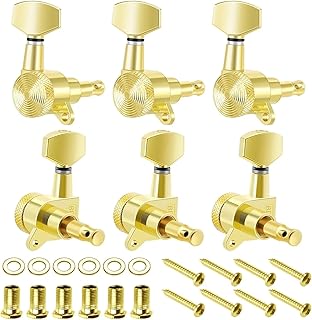
This set is listed as six right-side locking tuners with a 1:18 gear ratio. Its stated use includes acoustic and electric guitar tuning-peg replacement, making it a possible choice when a guitar requires six tuners with the same orientation. The product title also mentions a chrome finish and gold, so confirm the finish and exact version before ordering.
Best for: A player replacing six right-oriented keys who has verified the headstock layout and mounting measurements. Why it was selected: Its six-piece quantity and 1:18 ratio make it relevant to buyers comparing standard locking tuner sets. Avoid this set if your guitar needs a mixed left/right arrangement or if the listing’s finish or orientation is unclear for your instrument.
Three-Per-Side 21:1 Locking Tuners

This set is described as three-per-side locking tuning machines, with a 21:1 ratio and Keystone-style handles. The listing names acoustic guitars and LP, Les Paul, SG, and ES guitars as intended applications. These details make it a better match for players whose headstock has three tuners on each side and whose existing tuner arrangement aligns with the product.
Best for: Guitar owners looking specifically for a three-per-side layout and a 21:1 gear ratio. Why it was selected: Its stated arrangement and named guitar styles help distinguish it from six-in-line or all-one-side sets. The available product information does not specify mounting-hole dimensions or included hardware, so verify both before buying. Avoid choosing it based only on a guitar model name; headstock measurements and mounting layout still matter.
18:1 Gold Left Locking Tuners

This product is listed as a left-side set with an 18:1 ratio and a gold finish. The description names Strat, Tele, Les Paul, electric, and acoustic guitars, but the left-side orientation is the important detail to confirm. Its finish may suit a player coordinating replacement hardware with other gold-colored parts.
Best for: A buyer who needs left-oriented tuners and specifically wants a gold appearance. Why it was selected: The clear orientation and ratio offer a useful alternative to the right-side and mixed-layout options in this comparison. Product details supplied here do not state the number of pieces, mounting-hole size, or included hardware. Confirm those specifications and compare them with the guitar before ordering; do not assume the set replaces all six keys.
Six Locking Tuners With Mixed Orientation

This gold set includes six tuners arranged as three left and three right. Listed features include an 18:1 gear ratio, a locking mechanism, and a standard 10 mm (25/64-inch) pin hole. The package is described as including six tuners, nuts, collars, and screws. The product title also says “6 Inline,” so buyers should verify the actual layout shown in the listing and compare it to their headstock.
Best for: Players who need three tuners on each side and have modern 10 mm headstock holes. Why it was selected: It specifies both the mixed orientation and hole size, two practical replacement checks. Its stated 18:1 ratio is another clear comparison point. Avoid this set if your guitar has a different mounting-hole diameter or an all-on-one-side layout.
Guyker 1:18 Locking Tuners

The Guyker set is listed as six right-side tuners with a 1:18 ratio, sealed lubrication, cast housings, and metal knobs. It is designed for modern 10 mm headstock peg holes and has hexagonal buttons and a 45-degree fixing tag. The listing says that screws, bushings, and washers are included.
Best for: A player whose guitar needs six right-side tuners and has modern 10 mm peg holes. Why it was selected: The hole size, orientation, gear ratio, and included mounting hardware are specified, making it easier to check fit before purchase. The listed six-right configuration is not the right choice for every headstock. Avoid it if you need three-left/three-right tuners or a different hole size.
Buying Guide: How To Choose Guitar Locking Tuning Keys
Does the tuner layout match your headstock?
Start by counting the tuning keys on each side of the headstock. Common arrangements include six in a row, three on each side, and sets with a specified left or right orientation. A six-piece set is not automatically suitable: all six tuners may be oriented the same way, or the product may use a three-left/three-right arrangement.
Compare the product photos and description with the keys currently installed. If a listing uses terms such as “inline,” “left,” or “right” inconsistently, contact the seller or inspect the item details before ordering. Orientation matters because the tuner posts and fixing points need to sit correctly on the headstock.
What mounting-hole size should you measure?
Measure the diameter of the existing tuner holes if you can do so accurately, and check the replacement’s stated peg-hole requirement. One product in this comparison specifies a modern 10 mm (25/64-inch) hole. That measurement should not be assumed for the other sets, since their supplied details do not establish a hole size.
Also check how the tuner attaches to the back of the headstock. Screw placement, fixing-tab angle, bushings, and washers can affect whether a replacement fits existing holes. A tuner that needs new screw holes may require careful installation to avoid damaging the instrument.
What does a gear ratio tell you?
A tuner’s gear ratio describes how many turns of the tuning key correspond to one turn of the post. In general, a higher ratio allows smaller changes at the post for a given movement of the key. The products listed here include 18:1 and 21:1 options. These figures help compare adjustment characteristics, but they do not establish that one set will fit a particular guitar.
Choose a ratio based on your preference for tuning adjustment and the options that fit your instrument. Do not use gear ratio as a substitute for checking orientation, mounting dimensions, or hardware.
Which finish and hardware details matter?
Choose a finish that suits your guitar’s existing hardware if appearance is important. These products include gold and chrome descriptions, but check the exact finish variant in the listing. One supplied title combines “chrome finish” and “Gold,” so confirm which version is being offered before purchase.
Check whether the package includes the hardware needed for installation. The mixed-orientation set lists nuts, collars, and screws; the Guyker listing specifies screws, bushings, and washers. The supplied descriptions for the other products do not confirm what installation parts are included.
Can locking tuners fix every tuning problem?
Locking tuners secure the string at the tuning post and can reduce string slippage at that point. They do not guarantee that a guitar will stay in tune under every condition. Strings that are not installed correctly, issues elsewhere in the setup, or changes in temperature and humidity can still affect tuning stability.
When replacing tuners, use the locking mechanism as intended and follow the manufacturer’s installation instructions. If the new keys do not align with the existing holes or screw locations, stop and verify the fit rather than forcing the hardware into place.
Frequently Asked Questions
Are locking tuners universal for guitars?
No. Guitar locking tuners can differ in orientation, headstock-hole diameter, fixing-tab position, and mounting hardware. Check those details against your instrument before choosing a set.
What does a 1:18 gear ratio mean?
A 1:18 ratio means the tuning key turns 18 times for one full turn of the tuner post. It is a comparison specification for how the tuning mechanism moves, not a guarantee of guitar compatibility.
Can I put six right-side tuners on any guitar?
No. A six-right set is intended for a matching orientation and layout. Many headstocks require a combination of left- and right-side tuners, so check the existing arrangement before buying.
Do locking tuners improve tuning stability?
Locking tuners hold the string at the post, which can help limit slippage there. They cannot prevent every cause of tuning changes, and correct installation and stringing still matter.
Should I choose a 21:1 tuner over an 18:1 tuner?
Not automatically. The 21:1 and 18:1 figures indicate different gear ratios, but fit should come first. Choose a set only after confirming its layout, mounting dimensions, and installation requirements for your guitar.