
The best state of charge gauge depends on your battery system and how much information you need. For a quick visual reading across several system voltages, consider the JDIAG LED meter; for detailed battery monitoring, the AILI shunt monitor displays charge percentage, current, voltage, and remaining capacity. Golf cart owners with a 36-volt system can compare the Prosport round meter, while the Buggies Unlimited analog gauge offers a simple needle display. The DFCROMI LCD meter adds selectable display modes and battery-type settings.
| Product | Best For | Display Or Measurement |
|---|---|---|
| JDIAG Store LED Meter | Multiple selectable system voltages | 10-segment LED charge indication |
| Buggies Unlimited Analog Meter | Simple golf cart charge checks | Color-coded needle |
| Prosport 36-Volt Meter | 36-volt golf carts | Round state of charge gauge |
| AILI Battery Monitor | Detailed battery-bank monitoring | Charge, voltage, current, and capacity |
| DFCROMI LCD Meter | Selectable readings and backlight | Voltage or battery percentage |
JDIAG Store 10-Segment LED Meter
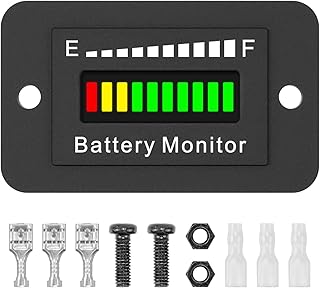
This JDIAG meter is best for buyers who want a straightforward battery-level display for a battery-powered vehicle or device. Its selectable voltage options cover 12V, 24V, 36V, 48V, 60V, and 72V systems. The listed applications include golf carts, boats, scooters, forklifts, and other battery-powered equipment.
The display uses 10 LED segments, with one red, two yellow, and seven green segments. Each segment represents 10% according to the product details, making the reading easy to interpret at a glance. It is a practical choice when a simple visual indication matters more than detailed readings of current or remaining amp-hours.
- Best for: Buyers who need a selectable-voltage indicator for several types of equipment.
- Why it stands out: It combines a broad listed voltage range with a color-coded bar graph.
- Limitation: The listed display is a segmented indicator, not a detailed screen showing current or remaining capacity in amp-hours.
Buggies Unlimited Analog Charge Meter

The Buggies Unlimited gauge is best for golf cart owners who prefer a traditional needle over a digital readout. Its color-coded face helps make the power level easier to read, and the product is described as a universal-fit analog golf cart battery charge meter.
The meter is designed to mount flush with a dashboard. It can also be mounted on top of the dash with a universal mount bracket, which is sold separately. Installation instructions are included, a useful detail for buyers planning a do-it-yourself replacement or addition.
- Best for: Golf cart users who want a simple, glanceable analog reading.
- Why it stands out: The colored dial and needle make the indicated power level easy to scan.
- Limitation: The top-of-dash mounting bracket is sold separately, so check the intended mounting arrangement before ordering.
Prosport 36-Volt Round Golf Cart Gauge

This Prosport meter is best for owners of 36-volt golf cart systems who want a round, dash-mounted state of charge gauge. Its stated 36-volt design makes it a more specific choice than meters that list several selectable system voltages. The product information describes a 2-1/16-inch gauge with mounting hardware for a 2-inch hole.
Installation uses one power wire and one ground wire connected to standard 1/4-inch slip-on terminals. A U bracket, nuts, and washers are included. The meter measures approximately 2-3/16 inches in outside diameter and 1-3/4 inches deep, so check available dash space before choosing it.
- Best for: Golf cart owners seeking a dedicated gauge for a 36-volt system.
- Why it stands out: The listed two-wire hookup and included mounting hardware offer a defined installation approach.
- Limitation: It is specified for 36-volt systems; buyers with another system voltage should choose a gauge that lists their voltage.
AILI Shunt Battery Monitor

The AILI monitor is best for buyers who want more than a basic voltage or segment display. It reports state of charge, voltage, charge or discharge current, and remaining capacity up to 999Ah. A 100A shunt is included, and the product describes the monitor as using coulomb counting for smaller battery systems.
Its listed input range is 8V to 120V, with support for 12V, 24V, 36V, and 48V systems. The stated battery types include LiFePO4, lithium-ion, AGM, gel, and sealed lead-acid. Listed applications include RVs, camper vans, boats, solar systems, golf carts, and backup power. The backlit LCD, low standby power, sleep mode, and memory function are additional features.
- Best for: RV, marine, solar, or other battery-bank users who need several battery readings.
- Why it stands out: It shows current and remaining capacity as well as charge percentage and voltage.
- Limitation: Unlike a simple gauge, it includes a shunt and is intended for a more involved monitoring setup.
DFCROMI LCD Battery Capacity Meter

The DFCROMI meter is best for buyers who want an LCD display with selectable readings. Its listed input range is 12V to 84V for lead-acid batteries and 3S to 26S for several listed lithium battery types. The screen has a green backlight, and the meter can show battery percentage or voltage alongside a battery symbol.
Its right switch can change between voltage, battery percentage, and off. The left setting key provides functions including display cycling, backlight control, sleep mode, and battery-type selection. These options make it more flexible than a basic LED bar, particularly for people who want to choose which reading appears.
- Best for: Buyers who want to switch between voltage and percentage readings on an LCD.
- Why it stands out: It lists multiple display modes, backlight control, and battery-type settings.
- Limitation: Confirm that the battery chemistry and system voltage fall within the listed ranges before purchase.
Buying Guide: How To Choose A State Of Charge Gauge
A state of charge gauge estimates or displays how much usable charge remains in a battery or battery bank. The right model depends on the system voltage, battery type, desired level of detail, and installation location. A basic indicator can be sufficient for a quick check, while a monitor with a shunt is better suited to buyers who need current and capacity readings.
Which system voltage should the gauge support?
Start by confirming the battery system’s nominal voltage. A 36-volt golf cart needs a gauge that specifically supports 36V or offers a selectable setting for it. Some products list multiple voltage options, while others are designed for one system voltage. Do not assume a gauge will work simply because its appearance or wiring resembles another model; check the product’s stated voltage range and setup requirements.
Do you need a simple indicator or detailed readings?
LED segments, analog needles, and basic LCD percentage readings provide quick visual information. They can suit vehicles where the main task is checking whether it is time to recharge. A shunt monitor adds more detailed measurements, such as charge and discharge current, voltage, and remaining amp-hours. Choose a more detailed monitor if those additional readings are important to managing a battery bank.
- Choose an LED bar for a fast, color-coded visual check.
- Choose an analog gauge if you prefer a needle and dial.
- Choose an LCD meter if you want selectable voltage and percentage views.
- Choose a shunt monitor if you want current and remaining-capacity information.
Does battery chemistry affect your choice?
Check the gauge’s stated support for the battery chemistry in your equipment. The listed products cover different combinations of lead-acid and lithium batteries, but their supported ranges are not identical. For example, the AILI monitor lists LiFePO4, lithium-ion, AGM, gel, and sealed lead-acid compatibility, while the DFCROMI meter lists several lithium types and lead-acid batteries. Match the product specifications to the actual battery rather than relying on a broad label such as “universal.”
What should you check before installation?
Confirm the required mounting hole, gauge dimensions, wiring, and any separate mounting parts. A flush-mount gauge may require a suitable opening in the dash. The Prosport product lists a 2-inch mounting hole, a U bracket, and a two-wire connection. The Buggies Unlimited meter can be mounted flush, while its optional top-mount bracket is sold separately. Review your available space and wiring access before selecting a replacement.
How much precision do you need?
Different display styles provide different levels of information. A ten-segment bar divides the display into broad increments, while a percentage readout gives a more specific displayed value. A shunt-based monitor can also show current and remaining capacity. These features do not remove the need to follow the product’s installation and battery-selection instructions. Choose based on the readings you need, not just the number of features.
Will the display be easy to read where it is installed?
Think about where the gauge will sit and how you will view it during use. A color-coded LED bar or analog dial may be easy to scan quickly. An LCD can show multiple types of information, and some models list a backlight. Consider the dash layout, lighting conditions, and whether you prefer a single glanceable reading or controls for switching between views.
Frequently Asked Questions
What does a state of charge gauge show?
It shows an indication of the battery’s remaining charge. Depending on the model, the reading may appear as LED segments, a needle position, a percentage, or a combination of voltage and capacity information.
Is a voltage meter the same as a state of charge gauge?
Not necessarily. A voltage meter displays battery voltage, while a state of charge gauge presents an estimate or indication of remaining charge. Some products can show both voltage and battery percentage, but the display modes and measurements depend on the model.
Can one gauge work with different system voltages?
Some gauges list multiple selectable voltage options, while others are designed for a specific voltage. Check the product’s stated range and required settings. The JDIAG meter, for example, lists selectable options from 12V through 72V, while the Prosport gauge is described as a 36-volt meter.
What is a shunt used for in a battery monitor?
A shunt is part of a monitoring setup that allows a monitor to measure current flowing into or out of a battery system. A shunt-based monitor can report information beyond a basic voltage display, including charge or discharge current and remaining capacity, as listed for the AILI monitor.
Should I choose an analog or digital gauge?
Choose an analog gauge if you prefer a needle and color-coded dial. Choose a digital model if you want LED segments, a numeric percentage, voltage readings, or selectable display modes. The best option depends on the information you need and the display style that suits your installation.