
For tube-amp-style spring reverb in a pedal format, the Crazy Tube Circuits White Whale Junior is the closest match in this selection: it combines analogue spring reverb, a coil-driving power amplifier, and tube and saturation emulation. The Keeley Hooke is best for players who want spring reverb and tremolo together, while the Fender 4AB3C1B is a replacement-style four-spring unit for suitable equipment. These products are not interchangeable, and the listed features do not confirm that every option contains a vacuum tube.
| Product | Best suited for | Key distinction |
|---|---|---|
| Crazy Tube Circuits White Whale Junior | Players seeking analogue spring character with tube-style emulation | Three coils and a coil-driving power amplifier |
| Keeley Hooke | Players wanting spring reverb and tremolo in one pedal | Tone and Spring controls |
| Crazy Tube Circuits White Whale V2 | Players who want a three-spring tank with adjustable reverb depth | Dwell control and upgraded power amp |
| SolidGoldFX Surf Rider IV | Players seeking compact spring reverb with modulation | Compact pedal format |
| Fender 4AB3C1B | Equipment owners seeking a four-spring reverb unit | 8-ohm unit with RCA-style connections |
Crazy Tube Circuits White Whale Junior

Best for: Guitarists looking for an analogue spring-reverb pedal with features specifically described as emulating tube and saturation character.
The White Whale Junior uses three reverb coils and a special power amplifier to drive them. Its listed features also specify analogue tube and saturation emulation for the reverb. This combination makes it the clearest match here for someone searching for tube-driven spring-reverb character in a pedal, while remaining careful about the distinction between emulation and a confirmed physical tube.
Choose this model if the coil-driving design and analogue processing matter more to you than having only a minimal spring effect. The provided features establish its reverb design, but do not specify control ranges, power requirements, or whether tremolo is included in this Junior model’s operation. Check the full product details for those practical requirements before buying.
Keeley Hooke Spring Reverb And Tremolo

Best for: Players who want vintage tube-amp-inspired spring reverb and tremolo together in one pedal.
The Hooke combines spring reverb and tremolo, according to its listed features. Its Tone control shifts the reverb toward a bright, spanky sound or a darker, thicker one. The Spring control adjusts the stated “looseness” or “Sproing!” of the reverb pan. Those controls give buyers clear ways to shape the effect’s described tone and spring character.
Choose this pedal if the ability to adjust brightness and springiness is more useful than a stated three-coil design or a separate reverb tank. The product information describes a vintage tube-amp spring-reverb sound, but does not say that the pedal itself contains a tube. It also does not provide details here about power, dimensions, or other control functions, so confirm those before purchase.
Crazy Tube Circuits White Whale V2
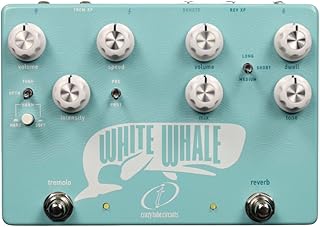
Best for: Guitarists who want a three-spring reverb design and a dedicated control for adjusting the reverb’s character.
The White Whale V2 features a real three-spring reverb tank, an upgraded power amplifier, and a Dwell control. The manufacturer’s listed description says the power amp provides increased headroom and wider frequency response. Dwell adjusts the effect from subtle and mellow to thick and splashy, making it the most explicitly adjustable option in this group for that range of reverb character.
Choose this version if a physical three-spring tank and Dwell control fit your needs. Its features position it as a spring-reverb-and-tremolo pedal, but the supplied description does not specify a tube or tube emulation. Do not assume that “upgraded power amp” means a tube amplifier; check the full specifications if actual tube circuitry is essential.
SolidGoldFX Surf Rider IV

Best for: Players looking for a compact spring-reverb pedal with modulation.
The supplied product information describes the Surf Rider IV as a compact spring-reverb pedal with modulation. That makes it relevant for buyers who want the reverb effect in a pedal format and value modulation as part of the feature set. Its listing provides less detail than those for the White Whale models or the Keeley Hooke, so it is difficult to compare exact control options or spring design from the information available here.
Choose this model if compactness and modulation are the primary stated requirements. Avoid treating it as a confirmed tube-driven design: the listed feature does not identify tube circuitry, tube emulation, or a physical spring tank. Review the product’s full description to verify its controls and other setup needs before deciding.
Fender 4AB3C1B Four-Spring Reverb Unit

Best for: Owners of equipment that specifically calls for a compatible 8-ohm, four-spring reverb unit with RCA-style input and output jacks.
This Fender component is not described as a complete guitar effects pedal. Its listed specifications are an 8-ohm, four-spring reverb unit, RCA-style input and output jacks, and a long decay design of 2.75 to 4.0 seconds. Those details make it a different kind of option from the pedal-based products in this list and potentially relevant to equipment maintenance or a compatible reverb system.
Choose it only after checking the target equipment’s required impedance, connections, and physical fit. The listing does not establish that it is a standalone effect, nor does it specify a tube driver. Its spring count and decay description alone do not confirm compatibility with a particular amplifier or device.
Buying Guide: How To Choose A Spring Reverb
Do you need a pedal or a reverb unit?
Start by identifying how the reverb will connect to your setup. The White Whale Junior, White Whale V2, Keeley Hooke, and Surf Rider IV are described as pedals. The Fender 4AB3C1B is a component-style four-spring unit with RCA-style connections. A pedal and a reverb unit serve different roles; do not assume that a reverb unit can be connected directly in place of a pedal or used by itself.
If you are replacing a component, match the required impedance, connectors, and physical dimensions to the existing equipment. The Fender listing specifies 8 ohms and RCA-style input and output jacks, but the available information does not give its dimensions or confirm fit with any specific amplifier. Confirm the equipment documentation before ordering.
Does “tube-driven” mean the pedal contains a tube?
Not necessarily. Product descriptions can refer to a tube-amp-style sound, tube emulation, or a circuit that physically uses a tube. These are different claims. The White Whale Junior’s supplied features explicitly mention analogue tube and saturation emulation, while the Keeley description refers to vintage tube-amp spring-reverb character. Neither statement, as provided here, confirms a physical tube inside the pedal.
The White Whale V2’s listed upgraded power amplifier is not identified as a tube amplifier. The Surf Rider IV description does not discuss tube circuitry. If a real tube is a requirement, check the manufacturer’s complete technical specifications rather than relying on words such as “vintage,” “analogue,” or “tube-amp-inspired.”
Which controls help shape the reverb?
Choose according to the adjustment you want. The Hooke lists Tone and Spring controls: Tone changes the described brightness or darkness, while Spring adjusts the stated looseness or “Sproing!” The White Whale V2 lists a Dwell control for moving between subtle, mellow reverb and thicker, splashier character. The supplied White Whale Junior and Surf Rider IV descriptions do not provide comparable control details.
A named control can be useful when its function matches your goal, but the descriptions here do not give exact control ranges. If you need fine control over decay, mix, or other specific parameters, check the full product information before selecting a pedal.
Do spring count and tank design matter?
They can help distinguish products, but spring count by itself does not tell you whether a pedal is right for your sound or setup. The White Whale Junior is described as having three reverb coils, and the White Whale V2 as having a real three-spring tank. The Fender unit has four springs. Those descriptions refer to different products and do not establish that their tanks are interchangeable.
For a pedal, consider the complete effect design and its controls alongside the spring description. For a replacement unit, treat specifications and equipment compatibility as essential. Do not assume a higher spring count automatically means a better match.
How should you compare features with limited information?
Use only the attributes that are stated clearly. The Junior stands out for its specified coil-driving amplifier and analogue tube and saturation emulation. The V2 lists a real three-spring tank, an upgraded power amp, and Dwell. The Hooke lists tremolo plus Tone and Spring controls. The Surf Rider IV is described as compact and modulated. The Fender is specified as an 8-ohm, four-spring unit with RCA-style connections and a stated long decay.
For features not stated in the supplied descriptions—such as power requirements, dimensions, full control layouts, or exact connection details for the pedals—consult the full product listing. Avoid filling in missing information based on another model’s specifications.
Frequently Asked Questions
Which product here is the closest match to tube-driven spring reverb?
The Crazy Tube Circuits White Whale Junior is the closest match based on the supplied features because it has a special amplifier for driving its reverb coils and analogue tube and saturation emulation. Its description does not confirm that it contains a physical tube.
Is the Fender 4AB3C1B a complete reverb pedal?
No. The supplied information describes it as an 8-ohm four-spring reverb unit with RCA-style input and output jacks. Check your equipment documentation to determine whether it is the correct component for your setup.
Which option combines spring reverb and tremolo?
The Keeley Hooke and both White Whale products are identified as spring reverb and tremolo pedals in their product names or listed descriptions. The Surf Rider IV is described as a spring-reverb pedal with modulation, which is not the same specific claim as tremolo.
Which pedal has a Dwell control?
The Crazy Tube Circuits White Whale V2 lists a Dwell control. Its stated purpose is to adjust the reverb from subtle and mellow to thick and splashy.
What should I check before buying a replacement spring unit?
Compare the unit’s impedance, connectors, dimensions, and other requirements with the equipment documentation. The Fender 4AB3C1B listing specifies 8 ohms and RCA-style connections, but does not confirm compatibility with a particular amplifier.
Does “analogue” prove a pedal uses a tube?
No. Analogue describes a signal-processing approach, not necessarily the presence of a vacuum tube. Check the product’s technical specifications for explicit confirmation if physical tube circuitry is important.