
The best audio center channel speaker depends on your room, existing speakers, and placement: the Polk Audio T30 is a practical match for a first home theater, the slim Polk ES35 suits installations with limited vertical space, and the Klipsch R-52C is a choice for buyers seeking a horn-loaded design. The Dayton Audio Classic C40 offers a straightforward 100-watt-max option, while the Polk Blackstone TL1 has a compact curved enclosure. Compare the listed features below, then confirm the speaker will fit your setup.
| Speaker | Best suited for | Standout listed feature |
|---|---|---|
| Polk Audio T30 | First home theater systems | Dual 5.25-inch woofers and 1-inch tweeter |
| Polk Audio Signature Elite ES35 | Slim installations | Six 3-inch woofers and a 1-inch tweeter |
| Klipsch R-52C | Horn-loaded speaker preference | Tractrix horn and dual 5.25-inch woofers |
| Dayton Audio Classic C40 | Buyers comparing power handling | 100 watts maximum, 50 watts RMS |
| Polk Audio Blackstone TL1 | Compact, TV-oriented setups | Curved high-gloss enclosure |
Polk Audio T30 Home Theater Center Speaker

The Polk Audio T30 is best for buyers building a first home theater or upgrading a TV’s sound with a dedicated center speaker. Its two 5.25-inch woofers and 1-inch silk dome tweeter are designed to reproduce dialogue and midrange sound. Polk also describes it as timbre matched to the T-Series, making it a relevant option for shoppers assembling a system from that speaker family.
A tuned rear port and Dynamic Balance woofers are listed as features intended to provide balanced sound and bass. The T30 is a sensible comparison point if you want a conventional two-woofer center speaker rather than a slim model. Choose it if its stated driver arrangement and T-Series relationship fit your priorities.
Limitation: The rear port may affect placement options. Check the space behind the speaker and the product’s physical dimensions before choosing a shelf or cabinet location.
Polk Audio Signature Elite ES35 Slim Center

The Polk Audio Signature Elite ES35 is best for buyers who need a slim center-channel format. Its listed array includes six 3-inch woofers, a 1-inch Terylene tweeter, and cascading crossovers. Polk says the arrangement is designed for clear, room-filling sound, while the slim profile may be useful where a taller speaker is difficult to position.
This model is also listed as compatible with 4- and 8-ohm systems and with Dolby Atmos and DTS:X AV receivers. Its Dual Power Port technology is described as supporting bass output. Those details make it a useful option to compare when you want a narrow design with multiple small woofers rather than a conventional dual-woofer cabinet.
Limitation: A slim shape does not guarantee that the speaker will fit every TV stand or shelf. Check its exact dimensions and confirm the receiver’s requirements before purchase.
Klipsch R-52C Center Channel Speaker

The Klipsch R-52C is best for buyers specifically considering a horn-loaded center speaker. It combines dual 5.25-inch spun-copper IMG woofers with a 1-inch aluminum LTS tweeter attached to a 90-by-90-degree square Tractrix horn. The manufacturer lists a frequency response of 89 Hz to 21 kHz, plus or minus 3 dB.
Its driver and horn configuration distinguish it from the Polk and Dayton models in this selection. Choose the R-52C if you want to compare a Tractrix horn design and dual 5.25-inch woofers against other center speakers. As with any center channel, it should be considered alongside the rest of the system and the available placement space.
Limitation: The listed frequency response begins at 89 Hz, so buyers comparing bass performance should review their full system requirements rather than assume the center speaker alone covers every low-frequency need.
Dayton Audio Classic C40 Center Speaker
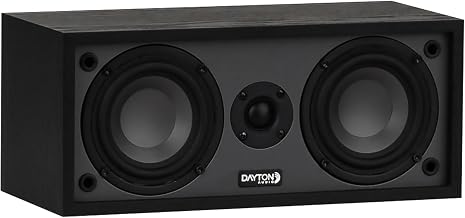
The Dayton Audio Classic C40 is best for shoppers comparing clearly stated power-handling and impedance specifications. Its listed handling is 50 watts RMS and 100 watts maximum, with a 6-ohm impedance and a frequency response of 70 Hz to 20 kHz. The cabinet uses custom 4-inch poly drivers and a 1-inch silk dome tweeter.
Dayton describes the drivers and cabinet as producing bass, while the tweeter is intended to reproduce detailed treble without harshness. These specifications give buyers useful points to compare with their receiver and other speakers. Choose the C40 if the listed 6-ohm impedance, response range, and power figures fit your system’s requirements.
Limitation: The product information does not specify a matching speaker series or a slim profile. Confirm system matching and cabinet fit rather than assuming either feature.
Polk Audio Blackstone TL1 Center Speaker

The Polk Audio Blackstone TL1 is best for buyers looking for a compact-looking, TV-oriented center speaker with a curved, high-gloss enclosure. Its listed drivers are a half-inch silk dome tweeter and dual 2.5-inch Dynamic Balance mids/woofers. Polk also lists Time Lens technology, which aligns the drivers to support soundstaging and imaging.
The curved cabinet and glossy finish are described as design features intended to complement flat-panel TVs. Compared with the larger-woofer models in this guide, the TL1 uses smaller drivers. That makes it a distinct option for shoppers prioritizing its enclosure design and driver arrangement over the larger woofer sizes listed for the T30 or R-52C.
Limitation: The supplied product details do not include a frequency-response range or power-handling figure. Buyers who need those specifications should verify them before comparing system performance.
Buying Guide: How To Choose A Center Channel Speaker
What does a center channel speaker do?
A center channel speaker handles much of the dialogue and other sounds anchored to the middle of a home theater soundstage. It is typically part of a multichannel speaker system. A dedicated center can help keep voices centered on the screen, including for viewers sitting away from the middle seat, though results depend on speaker placement, room acoustics, and system setup.
Which driver configuration should you compare?
Driver size and count are useful comparison points, but they do not tell the whole story about sound. The T30 and Klipsch R-52C each list dual 5.25-inch woofers, while the ES35 uses six 3-inch woofers. The Dayton C40 lists 4-inch drivers, and the Blackstone TL1 has dual 2.5-inch mids/woofers. Compare these configurations alongside the speaker’s stated frequency response, power handling, and design.
Will the speaker fit below your TV?
Measure the available width, height, and depth before selecting a model. Also consider whether the speaker will sit on a shelf, inside a cabinet, or directly below the television. A slim speaker such as the ES35 may be worth examining when vertical space is limited, but the exact dimensions still need to be checked. A rear port, as listed for the T30, can also make the distance behind the speaker relevant.
Should you match the center speaker to your other speakers?
Matching the center channel to the left and right speakers can help maintain a consistent character as sound moves across the front of a system. Polk says the T30 is timbre matched to the Polk T-Series. For other combinations, check the manufacturer’s guidance and compare the system’s impedance and power requirements. Do not assume that speakers from different product families will have identical voicing.
How should you compare power and impedance?
Use the speaker’s stated specifications to check compatibility with your receiver or amplifier. The Dayton C40 lists a 6-ohm impedance and 50 watts RMS handling; the ES35 lists compatibility with 4- and 8-ohm systems. The product details supplied for the other models do not give the same information, so consult their complete specifications if those figures matter to your setup. Avoid treating maximum power figures as the only measure of suitability.
Do you need a subwoofer with a center speaker?
A center channel is not automatically a replacement for a subwoofer. The R-52C lists a lower frequency limit of 89 Hz, while the Dayton C40 lists 70 Hz. Those figures can help compare the models, but actual bass depends on room setup and the rest of the system. If deep low-frequency effects are a priority, consider how your receiver and any subwoofer will share bass duties.
Frequently Asked Questions
Is a center channel speaker necessary for a home theater?
A center speaker is useful in a multichannel home theater because it is dedicated to the center portion of the soundstage, including much dialogue. Whether it is necessary depends on your system configuration and listening preferences.
Can I place a center channel speaker inside a cabinet?
Possibly, but first check the speaker’s dimensions, ventilation and clearance needs, and whether its design uses a rear port. Follow the manufacturer’s placement recommendations for the specific model.
Does a larger woofer always mean clearer dialogue?
No. Woofer size alone does not establish dialogue clarity. Driver design, speaker placement, room acoustics, receiver settings, and the complete system all affect what you hear.
What does a center speaker’s impedance mean?
Impedance is an electrical specification that should be checked against the receiver or amplifier’s supported load. Confirm compatibility using the specifications for both components before connecting them.
Can I use a center speaker from a different brand than my other speakers?
It may be possible, but timbre and tonal balance can differ between speaker models. Check manufacturer guidance and compare the specifications and listening characteristics when building a mixed-brand system.
What should I measure before buying?
Measure the available width, height, and depth where the speaker will sit. Include room for cables and any clearance needed for the speaker’s ports, then compare those measurements with the model’s full product dimensions.