
The best wireless module for speakers depends on whether you need a plug-in audio link or a board for a DIY build. The 1Mii set is best for connecting a TV or PC to powered speakers over a longer distance. The DROK and Acxico boards suit Bluetooth receiver projects, while the ARRAROWN amplifier boards add wireless input and speaker amplification in one unit.
| Product | Best For | Type |
|---|---|---|
| 1Mii 2.4GHz Transmitter Receiver Set | Connecting audio equipment to powered speakers | Paired transmitter and receiver |
| ARRAROWN ZK-TB21 | DIY 2.1-channel speaker systems | Bluetooth amplifier board |
| ARRAROWN ZK-1002T RPO | DIY 2.0-channel stereo systems | Bluetooth amplifier board |
| DROK Bluetooth 4.2 Board | Adding Bluetooth reception to a DIY audio setup | Audio receiver board |
| Acxico Bluetooth 4.1 Module | Simple stereo wireless audio projects | Bluetooth audio module |
1Mii 2.4GHz Transmitter Receiver Set
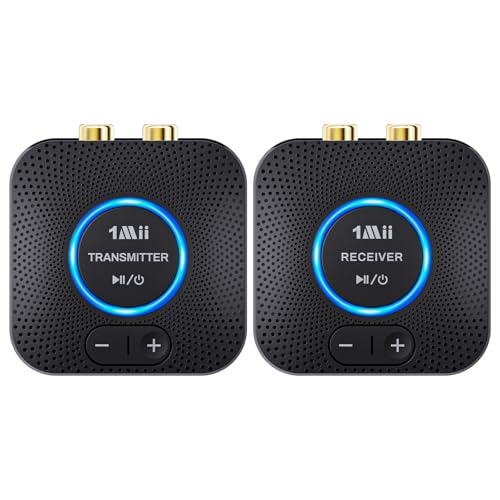
Best for: Sending audio from a TV, PC, CD player, or other source to powered speakers, an amplifier, or a home theater system without running a long audio cable.
This is a paired transmitter-and-receiver kit rather than a bare circuit board. It uses a 2.4GHz wireless connection and supports AUX and RCA input and output. The included 3.5mm-to-RCA adapter cable offers another connection option. The receiver can send audio to two powered speakers at once using AUX and RCA outputs.
The manufacturer lists a range of up to 262 feet and latency of 25 milliseconds. The units automatically power on and enter pairing mode after connecting to power, with a blue ring light indicating operating status. These features make the set a practical choice for someone who wants to link existing equipment with less setup than a DIY board requires.
Choose this if you want a ready-to-connect wireless audio link and your speakers are powered or attached to an amplifier. Limitation: the product information says it is not suitable for a subwoofer. It also advises against using AUX and RCA inputs simultaneously because the audio may be mixed at the receiver.
ARRAROWN ZK-TB21 2.1 Amplifier Board

Best for: DIY speaker systems that need Bluetooth audio input, two stereo channels, and a separate subwoofer channel.
The ZK-TB21 is an amplifier board with Bluetooth 5.0 and AUX audio input. Its listed 2.1-channel output is 50W + 50W for the stereo channels and 100W for the subwoofer channel. It also provides independent treble and bass adjustment buttons, allowing users to change those settings on the module rather than through the audio player.
This board is a better fit than a receiver-only module when the project needs amplification as well as wireless audio reception. The product description also notes an AM interference suppression function, shielding power inductance, and a low-noise front-stage operational amplifier. Those details may matter to builders comparing boards for a compact audio system.
Choose this if your build is designed around a 2.1-channel arrangement and you want onboard tone controls. Limitation: the listed inputs are Bluetooth and AUX, not USB. The product instructions say to disconnect Bluetooth when using AUX mode.
ARRAROWN ZK-1002T RPO 2.0 Board

Best for: DIY stereo speaker builds that need a 2.0-channel amplifier with Bluetooth and several audio input choices.
This board is listed as a 100W + 100W Bluetooth 5.0 amplifier with stereo 2.0-channel output. It accepts Bluetooth, USB, and AUX audio input, giving a builder more source options than a Bluetooth-only receiver. Independent treble and bass adjustment buttons provide direct tone control on the module.
The ZK-1002T RPO is better for a conventional left-and-right speaker setup than the ZK-TB21, which includes a dedicated subwoofer channel. Its listed AM interference suppression, shielding power inductance, and low-noise front-stage operational amplifier are design features stated by the manufacturer.
Choose this if you want wireless playback and amplification in a stereo DIY project, with USB and AUX as additional inputs. Limitation: this is a 2.0-channel board, so the provided product information does not describe a separate subwoofer output. When using AUX, the instructions say to disconnect the Bluetooth connection.
DROK Bluetooth 4.2 Audio Receiver Board
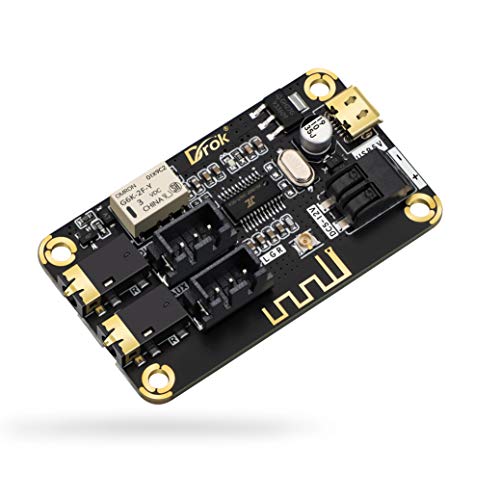
Best for: DIY users who need a Bluetooth receiver board for a speaker, headphone, or home stereo project.
The DROK board receives wireless audio using Bluetooth 4.2. It accepts DC input from 5V to 12V and can also be powered through its micro USB port at 5V. For audio connections, it provides a 3.5mm AUX input and a 2.54mm three-pin AUX input. The product description identifies headphones, speakers, and DIY home stereo systems as applications.
Unlike an amplifier board, this product is presented as a receiver module. That distinction is important: buyers should check whether their project already has the amplification needed to drive its speakers. Its power-input range and two stated audio connection formats can make it useful for builders matching a module to an existing setup.
Choose this if your project needs Bluetooth reception and you can provide the rest of the audio system. Limitation: the listing does not specify amplifier output, channel power, or a wireless range, so do not treat it as a standalone speaker amplifier.
Acxico Bluetooth 4.1 Stereo Module

Best for: Simple wireless audio projects that need a Bluetooth stereo module with a line input.
The Acxico module uses Bluetooth 4.1 and is described for wireless speakers, wireless audio, and wireless headphones. It has a stereo line input and an LED indicator. The listed wireless transmission distance is at least 10 meters, giving buyers a stated range to compare with modules that do not provide one.
This is a compact, basic option for a DIY project where the builder is comfortable integrating a module into a larger audio setup. The LED indication can help show operating status, while the stereo line input supports an audio connection in addition to its wireless function.
Choose this if you want a straightforward Bluetooth stereo module and do not need a complete transmitter-and-receiver kit. Limitation: the product details do not state amplifier power, supply voltage, or speaker-driving capability. Confirm that the module’s connections suit your project before buying.
Buying Guide: How To Choose A Wireless Speaker Module
“Wireless module for speakers” can refer to several different products. Some receive Bluetooth audio; some transmit audio from a source to a separate receiver; and some combine wireless reception with speaker amplification. Identify which job you need the module to perform before comparing wireless versions or advertised power figures.
Do You Need A Receiver, A Transmitter, Or Both?
A Bluetooth receiver takes audio from a compatible wireless source and passes it into an audio system. The DROK and Acxico products are listed as receiver or audio modules for DIY use. A transmitter sends audio from a source, such as a TV, toward a receiver. The 1Mii set includes both transmitter and receiver units, so it is the clearest fit when you need to connect separate audio equipment without a long cable.
Check the direction of the signal. A product described as a Bluetooth receiver may not send audio from a television to wireless speakers. A transmitter-and-receiver pair is a different category from a receiver board, even when both use wireless audio.
Are Your Speakers Powered Or Passive?
Powered speakers have amplification built in and can accept a suitable audio signal directly. A receiver or adapter can be appropriate if its outputs match the speaker inputs. Passive speakers need an amplifier between the audio source and the speaker drivers. The ARRAROWN ZK-TB21 and ZK-1002T RPO are amplifier boards, while the DROK and Acxico listings do not specify speaker-driving amplifier output.
Before choosing a board, confirm the speaker’s impedance, required power, connection type, and the module’s power-supply requirements. Do not assume an advertised wattage will be available in every build; the supplied product details may not provide the conditions or supporting specifications needed to determine actual system output.
Should You Choose A 2.0 Or 2.1 Amplifier?
A 2.0 system has left and right stereo channels. The ARRAROWN ZK-1002T RPO is listed as a 2.0-channel board with 100W + 100W output. A 2.1 system adds a subwoofer channel. The ZK-TB21 is listed with two 50W channels and a 100W subwoofer channel.
Choose based on the layout of your speakers and the outputs your project needs. A 2.1 board is not automatically a better choice if you are building a two-speaker system. Conversely, a 2.0 board is not a substitute for a dedicated subwoofer channel when that is part of the design.
Which Audio Connections Matter?
Compare the module’s inputs and outputs with the equipment you already own. The 1Mii set offers AUX and RCA connections. The DROK lists 3.5mm AUX and a 2.54mm three-pin AUX connection. The Acxico module lists stereo line input. The ZK-1002T RPO adds USB input, while both ARRAROWN boards list AUX and Bluetooth input.
Connection names alone are not enough: verify whether a port is an input or an output and whether it is intended for line-level audio or speaker output. Also check cable and connector availability. A mismatch can require additional adapters or make a module unsuitable for a particular source.
How Much Range And Latency Do You Need?
Wireless range and delay matter most when the source and speakers are separated by a room or when audio must stay synchronized with video. The 1Mii listing states a range of up to 262 feet and 25ms latency. Acxico lists a transmission distance of at least 10 meters. The other selected product details do not provide comparable range figures.
These stated distances are not a guarantee of performance in every home. Walls, layout, and other conditions can affect a wireless link. If you are connecting a television, pay particular attention to the listed latency and whether the module’s connection method is designed for your use.
What Power And Setup Details Should You Check?
DIY boards often require a separate power supply and careful wiring. The DROK lists a 5V-to-12V DC input range and micro USB 5V power. The OUCUC mono amplifier board, which is not included among the five top picks, lists DC 7V-to-24V input and a 100W mono amplifier. Always compare the exact requirements on a product listing with your planned supply; do not infer power requirements from the module’s name.
For a faster setup, a paired adapter kit such as the 1Mii may be simpler than installing a bare circuit board. For a custom speaker build, amplifier boards can reduce the number of separate components, but they require more attention to the enclosure, wiring, speaker specifications, and power source.
Frequently Asked Questions
What Is A Wireless Module For Speakers?
It is a device or circuit that adds wireless audio reception, transmission, or both to a speaker setup. Some products only receive audio, while others also amplify the signal or pair a transmitter with a receiver.
Can A Bluetooth Receiver Power Passive Speakers?
Not necessarily. A receiver can provide an audio signal without including a speaker amplifier. Check the product specifications for amplifier output and confirm that the module is designed to drive the speakers directly.
Which Product Is Best For Connecting A TV To Powered Speakers?
The 1Mii transmitter-and-receiver set is the most directly suited option in this list. It is described for TV audio and powered speakers and provides AUX and RCA connections, with a listed 2.4GHz range of up to 262 feet.
What Is The Difference Between A 2.0 And 2.1 Board?
A 2.0 board provides two main audio channels, typically for left and right speakers. A 2.1 board adds a separate subwoofer channel. Select the format that matches the speakers and outputs in your system.
Does A Wireless Speaker Module Always Include An Amplifier?
No. Receiver modules and transmitter kits may pass audio without amplifying it for passive speakers. Look for explicit amplifier specifications if you need a board to drive speaker drivers.