
The best car power adapter for a 120V device is a vehicle power inverter that converts a car’s 12V DC power into AC power. The Ampeak is the closest listed match for buyers seeking a stated 120V output; the PiSFAU and FOVAL suit lower-power charging needs, while Pro Chaser offers the highest stated continuous wattage. Check your device’s power requirements before choosing: these products have different output ratings, and most list 110V AC rather than 120V.
| Product | Best For | Listed AC Output |
|---|---|---|
| Ampeak 150W | Buyers seeking stated 120V output | 120V, 150W |
| Pro Chaser 400W | Higher stated power capacity | 110V, 400W |
| BESTEK 300W | 300W rating and aluminum housing | 110V, 300W |
| PiSFAU 200W | AC outlets plus USB-A/C | 110V, 200W |
| FOVAL 200W | Several USB charging ports | 110V, 200W |
Ampeak 150W 120V Car Power Inverter
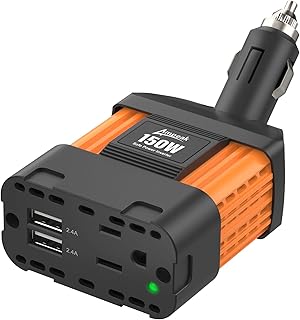
The Ampeak is the clearest choice for shoppers searching specifically for a car power adapter with stated 120V AC output. Its listed features include a 150W rating, a 300W peak rating, one AC outlet, dual USB ports rated at 4.8A, and 11 safety protections. The compact design is described as suitable for road trips and travel.
Best for: Buyers who want a stated 120V output for a compatible, lower-power device and also need USB charging. The 150W rating provides an important limit to check against the device label.
Limitation: The listed continuous output is 150W, so it is not the best fit for equipment requiring more than that. The 300W peak figure should not be treated as continuous capacity.
Pro Chaser 400W Vehicle Power Inverter

The Pro Chaser converts 12V DC vehicle power to 110V AC and lists 400W of power. It has dual AC outlets and two USB charging ports with a stated combined rating of 6.2A. The product name identifies laptops and an air compressor as example uses, but buyers should still confirm the actual electrical requirements of any device they plan to connect.
Best for: Shoppers prioritizing the highest stated wattage among these five selections, plus two AC outlets and USB charging. Choose this if your device’s requirements fit its 400W rating and 110V output.
Limitation: Its listed AC output is 110V, not 120V. Avoid assuming that a device requiring a particular voltage or more than 400W will work; check its label and instructions first.
BESTEK 300W Car Plug Adapter

The BESTEK inverter is listed as converting DC input of 12–17V to 110V AC, with a 300W rating. It has a car plug, dual USB ports rated at 4.8A, and an aluminum housing. The product name presents it as a vehicle charger for phones and laptops, making it a middle-ground option between the 150W Ampeak and 400W Pro Chaser by stated wattage.
Best for: Buyers who want a 300W-rated inverter with dual USB charging and an aluminum housing. It may be a better match than a 150W model when the intended device’s requirements exceed 150W but remain within the inverter’s stated rating.
Limitation: The listed AC output is 110V, so it is not the closest match for a buyer specifically requiring stated 120V output. Confirm the input range and power needs of your equipment before use.
PiSFAU 200W Inverter With USB-A/C
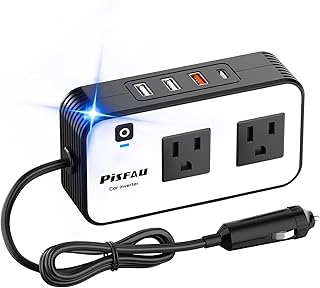
The PiSFAU is a 200W inverter that converts 12V DC to 110V AC. Its listed connections include two AC outlets and USB-A and USB-C ports, with the USB ports described as 4.8A and 24W. The product name positions it for laptops, camping, and road trips, but the 200W rating remains the key limit for devices connected to AC outlets.
Best for: Travelers who want AC outlets alongside both USB-A and USB-C charging. It is a practical option to compare when connected devices fit within the stated 200W output.
Limitation: The AC output is listed as 110V, and the inverter is rated at 200W. It is not the strongest choice for equipment needing greater wattage or specifically requiring 120V.
FOVAL 200W Inverter With Four USB Ports
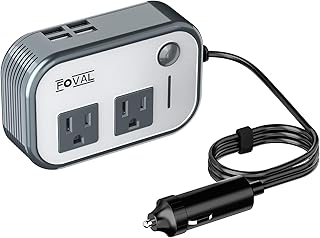
The FOVAL model converts 12V DC to 110V AC and is rated at 200W. Its product name highlights four USB ports, in addition to an AC outlet, and describes it as an option for charging a laptop or computer charger. The multiple USB connections make it distinct from models with only two USB ports, while its AC rating matches the PiSFAU’s stated 200W.
Best for: Buyers who expect to charge several USB devices and want an AC outlet in the same adapter. Choose this over a model with fewer USB ports if the number of charging connections is a priority.
Limitation: Its listed AC output is 110V and its rating is 200W. The product information provided does not specify the individual or combined USB output, so check the product details for your devices’ charging requirements.
Buying Guide: Choosing a Car Power Adapter
Do you need an inverter or a USB car charger?
A USB car charger provides power through USB ports, while a car power inverter converts a vehicle’s 12V DC supply into AC power for compatible devices with a regular AC plug. If your device charges only over USB, an inverter may not be necessary. If it uses an AC power cord, an inverter with an AC outlet is the relevant product type.
These five products are inverters, not simple USB-only adapters. Each lists at least one AC outlet and USB charging connections. Count the ports you will use at the same time, but do not assume that the number of ports alone indicates how much power each can deliver.
Should you choose 110V or 120V output?
Read the input information on your device’s power supply and compare it with the inverter’s stated AC output. Four products here list 110V AC. The Ampeak lists 120V AC, making it the most direct match in this selection for a search specifically asking for 120V output.
Do not choose by voltage wording alone. Confirm that the device can accept the inverter’s output and that its wattage needs fit the inverter’s rating. If the device label or manufacturer instructions specify a required voltage or power arrangement, follow those instructions rather than assuming that any car inverter will work.
How much wattage do you need?
Check the device label for its power draw, usually expressed in watts, and compare that value with the inverter’s stated rating. Among these products, the listed ratings range from 150W to 400W. The Pro Chaser has the highest stated rating at 400W, followed by BESTEK at 300W, the PiSFAU and FOVAL at 200W, and Ampeak at 150W continuous with a separately stated 300W peak.
Peak power and continuous power are not interchangeable. The Ampeak’s 300W peak figure should not be used as though the inverter continuously supplies 300W. The supplied product details do not state peak ratings for every model, so compare devices using the ratings and instructions provided for the specific inverter.
Which ports and outlets matter?
Count AC outlets if you plan to connect appliances or chargers with AC plugs. The PiSFAU and Pro Chaser list two AC outlets; the Ampeak and FOVAL list one, while the BESTEK description identifies a car plug and dual USB ports. For USB devices, consider whether you need USB-A, USB-C, or several ports. The PiSFAU specifically lists both USB-A and USB-C, and the FOVAL lists four USB ports.
Port count does not establish the charging speed of every connected device. Check the stated output for each port and any shared-output limits in the product details. The PiSFAU lists 4.8A and 24W for its USB-A/C charging, while the BESTEK and Ampeak list dual USB ports rated at 4.8A.
What should you check before connecting a device?
- Confirm that the inverter’s DC input matches the vehicle power source. These products are described as 12V vehicle inverters; BESTEK lists a 12–17V DC input range.
- Check the device’s required voltage and wattage on its label or power supply.
- Keep the total connected AC load within the inverter’s stated rating.
- Review product instructions for use, connection limits, and any device-specific cautions.
- For USB charging, verify the required connector type and the listed port output.
Which model fits common buyer priorities?
For a stated 120V output, compare the Ampeak first, while accounting for its 150W rating. For the highest listed continuous wattage, the Pro Chaser is the 400W option, but it lists 110V AC. For a 300W rating and aluminum housing, the BESTEK is the relevant choice. For a combination of two AC outlets and USB-A/C ports, consider the PiSFAU; for four USB ports alongside an AC outlet, compare the FOVAL.
Frequently Asked Questions
Can I use a car power adapter to run a 120V device?
Only if the inverter’s output and power rating are suitable for that device. Of these five products, the Ampeak specifically lists 120V AC output. Check the device’s voltage and wattage requirements before connecting it.
Is a 110V car inverter the same as a 120V inverter?
They are not described with the same output rating in the supplied product information. Several models here list 110V AC, while the Ampeak lists 120V AC. Match the stated output to the device’s requirements and instructions.
Which product has the highest listed wattage?
The Pro Chaser lists 400W, the highest stated rating among these five products. Its listed AC output is 110V. Confirm that your device’s power needs are within the inverter’s rating.
Can I charge a laptop with a car inverter?
A laptop may be connected if its power supply is compatible with the inverter’s AC output and its power demand fits within the inverter’s rating. Check the laptop charger label and the inverter specifications before use.
Can I charge USB devices and use the AC outlet at the same time?
The product names list both USB charging ports and AC outlets on these models, but the supplied details do not establish every combined-load limit. Check the manufacturer’s instructions and output specifications for simultaneous use.