
The best home audio subwoofer speaker depends on whether you need a standalone bass unit or a complete soundbar system. The Polk Audio PSW10 is best for adding powered bass to a home theater, while the Klipsch R-100SW offers a 10-inch driver and adjustable controls. For a soundbar-and-subwoofer setup, consider the ULTIMEA Poseidon M60 or Saiyin system. The BESTISAN is a connection-focused option for buyers comparing multiple input types.
| Product | Best suited for | Type |
|---|---|---|
| Polk Audio PSW10 | Adding bass to a home theater | Powered subwoofer |
| Klipsch R-100SW | Adjustable low-frequency output | Powered subwoofer |
| BESTISAN Powered Subwoofer | Flexible connection options | Powered subwoofer |
| ULTIMEA Poseidon M60 | Surround sound with a subwoofer | Soundbar system |
| Saiyin Sound Bar with Subwoofer | Simple TV or PC audio setup | Soundbar system |
Polk Audio PSW10

The Polk Audio PSW10 is a powered 10-inch subwoofer designed to add bass and impact to a home theater or music system. Its built-in amplifier is rated at 50 watts RMS and up to 100 watts of power. Polk lists a Dynamic Balance woofer and directed port as part of its design for bass output.
Best for: Buyers with an existing audio system who want a separate subwoofer for a small-to-mid-size room. Its powered design and stated ability to blend with different speakers make it a practical choice for adding low-frequency support without replacing the main speakers.
Why it was selected: The PSW10 is a clear standalone option among these products, with a 10-inch driver and built-in amplification. It is also identified as timbre-matched with Polk Monitor and T-series speakers.
Limitation: This is a subwoofer, not a complete soundbar or surround system. Check that your system has a suitable connection method before choosing it. The product information also states that it is not waterproof.
Klipsch R-100SW

The Klipsch R-100SW is a 10-inch powered subwoofer with a front-firing spun-copper IMG woofer. Its all-digital amplifier is listed at 300 watts peak power. Volume, low-pass crossover, and phase controls give users ways to adjust the subwoofer’s behavior within their setup.
Best for: Home audio buyers who want a dedicated subwoofer with adjustable controls. The low-pass crossover and phase control are useful features to compare when positioning and integrating a subwoofer with other speakers.
Why it was selected: Its 10-inch driver and specified peak amplifier power make it a distinct standalone bass option. It is better suited to a buyer building or expanding a speaker system than to someone who needs an all-in-one TV soundbar.
Limitation: The listed 300-watt figure is peak power, not a stated continuous rating. The supplied product details do not specify included cables or every compatible connection, so confirm the required hookup for your equipment.
BESTISAN Powered Subwoofer

The BESTISAN is a powered, down-firing subwoofer intended for use with a home theater system, receiver, or speakers. Its listed connection options include RCA, LFE, AUX, and high-level speaker input and output. The product name also specifies that a coaxial cable is included.
Best for: Buyers who want to compare several connection methods before selecting a subwoofer. The range of listed inputs and high-level speaker connections may be relevant for people whose existing audio equipment has different output options.
Why it was selected: This model stands out for its stated connection flexibility and down-firing design. It is a separate bass component rather than a complete soundbar package.
Limitation: The supplied details do not state driver size, amplifier output, or frequency response. Compare those specifications with your room and system needs if bass capacity is a deciding factor.
ULTIMEA Poseidon M60

The ULTIMEA Poseidon M60 combines a soundbar and a dedicated wired wooden subwoofer in a 5.1-channel system. It includes five built-in speakers, two of which are side-firing drivers, and supports Dolby Atmos. The system lists up to 300 watts of peak output and a frequency response of 45 Hz–18 kHz.
VoiceMX is designed to enhance vocal frequencies, while BassMX is included in the product’s feature set. The system also supports app control and Bluetooth 5.4. ULTIMEA states that setup takes less than one minute and that its DSP has less than 0.5 ms latency.
Best for: TV owners who want a soundbar-based surround setup with an included subwoofer rather than a standalone bass unit. Its built-in speakers are intended to create surround sound without separate rear speakers.
Limitation: The subwoofer is wired, so placement requires accommodating its cable. Choose a standalone model instead if you already have a soundbar or only want to add bass to an existing system.
Saiyin Sound Bar With Subwoofer
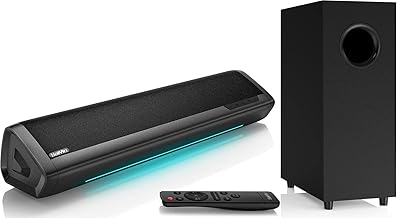
The Saiyin package pairs a soundbar with a 5-inch subwoofer. The subwoofer has dual bass reflex ports, and the system includes adjustable bass and a volume indicator. Listed input options are optical, AUX, and Bluetooth 5.3.
Best for: Buyers looking for a soundbar package for a TV or PC, with a compact subwoofer included. It is a better fit for someone seeking a combined audio setup than for a listener who already owns speakers and needs a standalone subwoofer.
Why it was selected: The product offers several stated input types and a dedicated bass adjustment, making it a straightforward option to compare for everyday TV and computer audio.
Limitation: The listed subwoofer is 5 inches, smaller than the 10-inch standalone options in this selection. The supplied details do not specify total system power or a frequency response.
Buying Guide: How to Choose a Home Audio Subwoofer
Do you need a standalone subwoofer or a complete system?
Start by checking what you already own. A standalone powered subwoofer, such as the Polk PSW10, Klipsch R-100SW, or BESTISAN, is intended to add bass to a larger audio setup. A soundbar package, such as the ULTIMEA or Saiyin, includes the main TV speaker component as well as a subwoofer. If you do not already have speakers or a soundbar, a bundled system may reduce the number of separate components you need to select.
Which connections should you check?
Match the subwoofer’s inputs to the outputs on your receiver, soundbar, or other audio equipment before buying. The BESTISAN listing names RCA, LFE, AUX, and high-level speaker connections. The Saiyin system lists optical, AUX, and Bluetooth 5.3 inputs. The ULTIMEA listing includes Bluetooth 5.4. Do not assume that two products connect directly just because both have a subwoofer; check the connection details for the complete system.
How important are driver size and power?
Driver size and amplifier specifications help distinguish models, but they do not tell the whole story of how a system will sound in your room. The Polk and Klipsch options both list 10-inch drivers. The Saiyin package includes a 5-inch subwoofer. Polk lists 50 watts RMS and up to 100 watts of power, while Klipsch lists 300 watts peak. Compare RMS and peak ratings carefully because they describe different power measures.
What controls or sound features matter?
Controls can help tailor a subwoofer to the rest of your system. The Klipsch includes volume, low-pass crossover, and phase control. Polk’s stated features focus on its powered design, woofer, and directed port. For dialogue-focused TV viewing, the ULTIMEA system includes VoiceMX processing. For a simpler soundbar setup, the Saiyin provides adjustable bass and a volume indicator.
How should room size and placement affect the choice?
Consider available space, cable routing, and where the subwoofer can sit. Polk describes the PSW10 as suitable for small-to-mid-size rooms, while the ULTIMEA subwoofer is wired and requires a cable route. The BESTISAN is described as down-firing, and the Klipsch has a front-firing driver. These design details can guide placement planning, but the supplied product information does not establish a universal room-size rule for every model.
What should you verify before ordering?
- Confirm that the product type matches your goal: standalone bass upgrade or complete soundbar system.
- Check the available audio outputs on your TV, receiver, or speakers against the product’s listed inputs.
- Look for the power rating type, driver size, and adjustment controls that matter to your setup.
- Check whether the subwoofer is wired and whether its placement and cable routing work in your room.
- For products with limited specifications, verify any missing details that are important to your decision.
Frequently Asked Questions
Can I use a standalone subwoofer without a soundbar?
A standalone powered subwoofer can be used as part of a system with compatible audio equipment. Check that your receiver or speakers provide a suitable connection before choosing a model.
Is a 10-inch subwoofer always better than a 5-inch subwoofer?
Not automatically. Driver size is one comparison point, but room, system compatibility, placement, and the complete set of specifications also matter. The 10-inch Polk and Klipsch models are standalone subwoofers, while the 5-inch Saiyin subwoofer comes in a soundbar package.
What is the difference between peak and RMS power?
Peak power and RMS power are different rating types and should not be treated as equivalent. The Polk listing gives both 50 watts RMS and up to 100 watts of power; Klipsch lists 300 watts peak.
Which option is best if I need a soundbar too?
The ULTIMEA Poseidon M60 and Saiyin are soundbar systems that include subwoofers. The ULTIMEA offers a stated 5.1-channel Dolby Atmos setup, while the Saiyin lists optical, AUX, and Bluetooth 5.3 inputs.
Should I choose a wired or Bluetooth connection?
Choose based on the connections your equipment supports and your preferred setup. The ULTIMEA specifies a wired subwoofer, while the Saiyin and ULTIMEA listings include Bluetooth input for their systems. Confirm the intended connection for each component before buying.