
The best USB SD FM power amplifier depends on whether you need playback from removable media, radio reception, microphone inputs, or compact stereo amplification. The Pyle PDA29BU.6 is best for users who want two microphone inputs and multiple source options; the Pyle PDA29BU suits a one-pair-speaker karaoke or home stereo setup. The AK45 Pro adds USB, SD, FM, and Bluetooth, while the AK-380 models prioritize compact two-channel audio. Compare the listed inputs and power descriptions before choosing.
| Product | Best suited for | Notable listed features |
|---|---|---|
| Pyle PDA29BU.6 | Karaoke and flexible input selection | USB, SD, FM, RCA, two mic inputs |
| AK45 Pro | Bluetooth and direct USB/SD playback | FM, USB, SD, remote control |
| Pyle PDA29BU | One pair of speakers and karaoke | USB-A, SD, FM, two mic inputs |
| AK-380 USB SD BT.C FM AUX | Compact amplification with several sources | USB, SD, Bluetooth, FM, AUX in product name |
| AK-380 HiFi Stereo Amp | Compact stereo listening and tone adjustment | Bluetooth 5.0, LCD, bass and treble controls |
Pyle PDA29BU.6 200W Stereo Amplifier

The Pyle PDA29BU.6 is best for buyers who want a compact receiver with several ways to connect sources and two microphone inputs. Its listed inputs include RCA, USB, SD card, Bluetooth, and FM radio. The product description identifies it for karaoke and home theater audio, making it a flexible option when music playback and microphone use matter in the same system.
- Power description: 200 watts, with 100 watts RMS stated in the listing.
- Speaker setup: The description says it accommodates two sets of speakers.
- Microphones: Two 1/4-inch microphone inputs are listed.
- Sources: RCA, USB, SD, Bluetooth, and FM are named.
Choose this model if you want more than one speaker set accommodated and need microphone connections alongside USB and SD playback. It is more input-focused than the AK-380 models. One limitation is that the supplied details do not specify USB or SD file formats, speaker impedance, or whether the stated 200-watt figure is peak output; verify those requirements before buying.
AK45 Pro Bluetooth USB SD Amplifier

The AK45 Pro is best for listeners seeking a two-channel amplifier with Bluetooth as well as direct music playback from USB drives or SD cards. The listed features also include FM radio and a remote control. Bluetooth 5.0 is described as supporting connections up to 33 feet, or 10 meters, and the product is presented as a home stereo receiver.
- Wireless audio: Bluetooth 5.0, with a stated range of up to 33 feet.
- Local playback: USB and SD card support are listed.
- Radio: FM reception is listed.
- Controls: A remote control is included according to the product name.
Choose this model if USB, SD, FM, and Bluetooth are all central to your setup. It is a more directly matched option for that combination than the AK-380 listing whose supplied feature details focus on Bluetooth and tone controls. The listing claims 400 watts across two channels, but does not clarify in the provided details whether that figure is peak or RMS power. Do not treat it as a verified continuous rating.
Pyle PDA29BU Compact Karaoke Amplifier

The Pyle PDA29BU is best for a smaller home stereo or karaoke system that uses one pair of speakers. The product description specifies 200 watts peak power and 100 watts RMS, and lists Bluetooth, RCA, USB-A, SD card, FM radio, and two 1/4-inch microphone inputs. These details make it a straightforward choice for users who want music playback and wired microphone connections.
- Speaker capacity: The listing says it accommodates one pair of speakers.
- Inputs: RCA, USB-A, SD, Bluetooth, and FM are named.
- Karaoke: Two microphone inputs are listed.
- Power: 200 watts peak and 100 watts RMS are stated.
Choose this model if you need the listed input range and one speaker pair rather than the PDA29BU.6’s stated support for two sets. Its limitation is that it is not described as accommodating two speaker sets. The supplied details also do not state USB or SD file-format support, so check that before relying on a particular music library or file type.
AK-380 USB SD BT.C FM AUX Amplifier

This AK-380 listing is best for buyers looking for a small two-channel amplifier whose product name identifies USB, SD, Bluetooth, FM, and AUX. Its supplied feature description focuses on Bluetooth 5.0, an LCD display, and independent bass and treble controls. It also identifies a 40-watt-per-channel rated output and a 400-watt-per-channel peak figure.
- Power: 40W + 40W rated; 400W + 400W peak, as stated.
- Adjustment: Separate bass and treble controls and a backlit LCD are listed.
- Connectivity: Bluetooth 5.0 is described; USB, SD, FM, and AUX appear in the product name.
- Use: The description mentions phones, computers, tablets, TVs, and projectors with AV audio.
Choose this option if compact size, tone adjustment, and the named media features fit your needs. A key caution is that the detailed feature text supplied here does not explain USB, SD, or FM operation, despite their appearance in the title. Confirm those functions and the connection types you need before purchase.
AK-380 Bluetooth 5.0 HiFi Stereo Amp
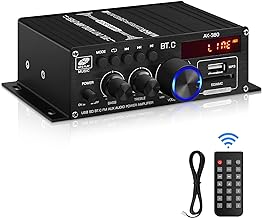
This AK-380 listing is best for buyers who want a compact Bluetooth stereo amplifier with manual tone controls. Its features specify a two-channel design, Bluetooth 5.0, an LCD display, and separate volume, bass, and treble controls. The description gives a rated output of 40 watts per channel and a peak figure of 400 watts per channel.
- Rated output: 40W + 40W is stated separately from the peak rating.
- Bluetooth: Bluetooth 5.0 is listed for wireless streaming.
- Sound adjustment: Bass and treble can be adjusted separately.
- Potential sources: The description names phones, computers, tablets, TVs, and projectors with AV audio.
Choose this version if Bluetooth playback and straightforward bass and treble adjustment are more important than confirmed USB, SD, or FM playback. Unlike the other AK-380 listing above, its name and supplied features do not identify USB, SD, or FM. Avoid choosing it solely for those functions without confirming that the exact listing supports them.
Buying Guide: How To Choose A USB SD FM Amplifier
Do you need all three playback options?
Check that the exact model lists USB, SD card, and FM support. Product names and feature descriptions do not always provide the same level of detail. In this group, the Pyle models explicitly list USB, SD, and FM in their supplied features. The AK45 Pro also lists all three. One AK-380 product name includes those terms, but its detailed feature text does not explain them.
Also consider how you will use each source. USB and SD playback are useful when you want to play stored music without streaming from a phone. FM is useful for radio listening, but the supplied descriptions do not specify station presets, display details for tuning, or antenna arrangements for every model. Check the manufacturer’s listing for those specifics if they matter.
How should you compare amplifier power?
Read the type of power rating, not just the largest number in a product name. The AK-380 listings state 40W + 40W rated power and 400W + 400W peak power. The Pyle PDA29BU states 100 watts RMS and 200 watts peak. The PDA29BU.6 states 100 watts RMS alongside 200 watts of power. These figures are presented differently, so they should not be treated as directly equivalent without matching rating methods.
For a practical comparison, look for continuous or RMS output, the number of channels, and the speaker requirements. The supplied information does not give speaker impedance requirements for these models. Confirm that the amplifier’s specifications match your speakers before connecting them, and do not assume a peak figure represents continuous output.
What inputs are important for your setup?
Choose an amplifier based on the devices you actually plan to connect. RCA inputs can serve compatible audio components, while Bluetooth supports wireless streaming from a paired device. USB and SD slots are useful for stored files, and microphone inputs matter for karaoke or announcements. The Pyle PDA29BU.6 and PDA29BU each list two 1/4-inch microphone inputs; the AK-380 feature descriptions emphasize Bluetooth and tone controls instead.
Check whether you need AUX, RCA, or another specific connection. The first AK-380 product name includes AUX, while its detailed feature text also mentions devices with AV audio. The Pyle models list RCA input. Do not assume a connection is present just because another product in the same family includes it.
How many speakers will the amplifier support?
The Pyle PDA29BU is described as accommodating one pair of speakers. The PDA29BU.6 is described as accommodating two sets. The AK-380 and AK45 Pro descriptions identify two-channel amplification, but the supplied details do not state a comparable speaker-set capacity. If you plan to connect more than one pair, verify the supported speaker configuration and impedance before choosing.
Should you prioritize Bluetooth or physical media?
Bluetooth is convenient for streaming from a phone, tablet, or computer. The AK-380 products and AK45 Pro specify Bluetooth 5.0; the AK45 Pro listing gives a range of up to 33 feet. USB and SD playback can reduce dependence on a paired device, while FM offers radio reception. If you need all of these, prioritize listings that explicitly state each feature in the detailed specifications, not only the product title.
When do microphone inputs matter?
For karaoke or a simple microphone-based setup, the Pyle PDA29BU and PDA29BU.6 list two 1/4-inch microphone inputs. The PDA29BU.6 also states support for two sets of speakers, while the PDA29BU is described for one pair. The supplied AK-380 and AK45 Pro details do not list microphone inputs, so they are less clearly matched to karaoke use.
Frequently Asked Questions
Which listed amplifier explicitly includes USB, SD, and FM?
The Pyle PDA29BU.6, Pyle PDA29BU, and AK45 Pro list USB, SD card, and FM support in their supplied features. The first AK-380 product name includes these terms, but its detailed feature text does not describe their operation.
Which model is best suited to karaoke?
The Pyle PDA29BU and PDA29BU.6 are the clearest karaoke options because both list two 1/4-inch microphone inputs. The PDA29BU is described for one pair of speakers, while the PDA29BU.6 says it accommodates two sets.
What is the difference between peak and RMS power?
Peak power describes a maximum figure rather than the continuous output represented by an RMS rating. Compare like-for-like ratings when assessing amplifier output. The provided listings identify 40W per channel rated output for the AK-380 models and 100 watts RMS for the Pyle models.
Does every AK-380 listed here support USB, SD, and FM?
No. One AK-380 product name includes USB, SD, and FM, but its detailed supplied features focus on Bluetooth and tone controls. The other AK-380 listing does not name USB, SD, or FM. Confirm the exact model’s specifications if these functions are required.
Can these amplifiers connect to a television?
The AK-380 feature descriptions mention TVs and projectors with AV audio. The Pyle descriptions list RCA input. Check the television’s available audio output and the amplifier’s exact inputs before connecting them; the supplied details do not establish compatibility with every TV connection type.
Should I choose an amplifier based on its largest wattage number?
No. Compare rated or RMS power, channel count, and speaker requirements. A large peak figure alone does not show the amplifier’s continuous output or confirm that it suits a particular pair of speakers.