
If you need to convert microcassette recordings to MP3, first check the recorder format: the products below are designed for standard audio cassette tapes, and the supplied information does not confirm microcassette compatibility. For standard cassettes, ClearClick is best for direct USB conversion, while SEMIER and KLIM offer SD-card workflows. The guide explains how to identify your tape and choose a conversion method without risking the wrong equipment.
| Product | Best suited for | Digital output listed |
|---|---|---|
| ClearClick Cassette Tape to USB | Simple standard-cassette conversion without a computer | MP3 files on USB flash drive |
| Auto Reverse Cassette Player Converter | Standard-cassette playback and computer-based conversion | Computer conversion software |
| SEMIER Small Cassette Player | Standard tapes with SD-card or computer conversion | SD card or USB-connected computer |
| KLIM K7 Cassette Player | Portable standard-cassette conversion to SD card | MP3 files on SD card |
| Gracioso Cassette Tape Converter | Standard tapes with USB or TF-card playback and recording | USB drive or TF card |
Check the Tape Format Before Buying
A microcassette is smaller than a standard compact cassette. The devices in this roundup are described as cassette players or cassette converters, but their supplied product details do not specifically say that they accept microcassettes. Do not assume that a standard-cassette converter will fit or play a microcassette.
This distinction matters because a tape can sometimes appear similar in an online listing while requiring a different deck. Check the tape’s dimensions and format label, then look for explicit microcassette support in the device’s instructions or manufacturer information. If you cannot confirm compatibility, avoid inserting the tape.
The five products below may suit people digitizing standard audio cassettes. They are included as relevant cassette-to-digital options, not as confirmed microcassette converters. If your recordings are on microcassette, use the buying guide to identify a suitable player or transfer service before choosing a product.
ClearClick Cassette Tape to USB

Best for: People digitizing standard audio cassettes who want a direct-to-USB process. ClearClick says the device saves high-quality MP3 files to a USB flash drive and includes a 16 GB drive. Its listed instant setup does not require a computer, software, or drivers.
A listed automatic track-splitting feature can separate recordings into individual MP3 files. That may be useful for tapes containing multiple songs or segments, though the product details do not explain how it determines where one track ends and another begins.
Why it was selected: Among these choices, it has the clearest standalone workflow: play a cassette and save digital MP3 files to USB storage. It is a practical option for buyers who do not want to configure computer recording software.
Limitation: The supplied details do not confirm microcassette support. Choose it only for standard cassettes unless compatibility with your smaller tape format is verified separately.
Auto Reverse Cassette Player Converter

Best for: Buyers seeking a portable standard-cassette player with a computer conversion route. The product name lists auto reverse, stereo playback, an earphone, and tape-converter software. It can be powered by a USB power cord or an AA battery, according to the listing.
Compared with a standalone USB converter, this model is a better fit for someone comfortable using a computer and conversion software. Auto reverse may reduce the need to turn a standard cassette over during playback, though the listed details do not specify how the conversion software handles long recordings or track breaks.
Why it was selected: It combines cassette playback with a software-based digitizing approach and offers two stated power options.
Limitation: The supplied product information does not provide detailed file-format, storage, or microcassette compatibility specifications. Confirm those points before purchase, especially if your source tape is not a standard cassette.
SEMIER Small Cassette Player
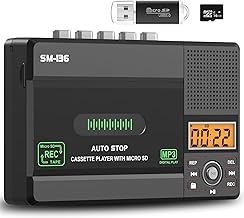
Best for: People who want a choice between direct SD-card conversion and a computer-based method. SEMIER lists conversion to MP3 on an included SD card, as well as USB connection to a computer using Audacity software. The product information also lists SD-card music playback, a built-in microphone, and an LCD.
The dual conversion methods offer flexibility: use the SD-card route for a computer-free transfer, or use the computer workflow if you prefer managing recordings on a computer. Its compact listed dimensions and weight may be useful for buyers who want a smaller player.
Why it was selected: It clearly describes two routes for turning standard cassette audio into digital files, along with an included 16 GB SD card.
Limitation: The listing says it does not support Type IV or metal tapes. It also does not confirm microcassette compatibility, so it should not be treated as a microcassette deck.
KLIM K7 Cassette Player

Best for: Buyers converting standard cassettes to MP3 files on an SD card. The listed package includes a 16 GB SD card and an SD card reader. The product description says conversion can be done without extra devices or app downloads by following the user manual.
The K7 also works as an SD-card music player and lists a built-in microphone and speaker. An earphone and 3.5 mm earphone jack are included, according to the product details. These playback and recording features may suit someone who wants a portable device for more than cassette transfers.
Why it was selected: Its stated SD-card conversion process and included storage make it a straightforward option for standard-cassette digitizing.
Limitation: The listing says the K7 does not record onto cassette tapes. It also does not specify microcassette support, so buyers with microcassette recordings need another confirmed-compatible solution.
Gracioso Cassette Tape Converter

Best for: Buyers who want a multifunction standard-cassette player with USB-drive and TF-card playback. Gracioso lists three playback modes: tape, USB drive, and TF card. Its built-in microphones can record to a USB drive or TF card, and the product details also describe recording to tape and support for an external microphone.
The device offers Type-C power or four C-size batteries, plus a 3.5 mm headphone jack and a retractable handle. That combination may suit users who need a portable player and recorder with multiple media options, rather than a dedicated cassette-to-MP3 converter alone.
Why it was selected: It offers several stated playback and recording paths, giving standard-cassette users alternatives for handling audio.
Limitation: The listed digital recording features do not specify detailed MP3 conversion steps or confirm microcassette support. Verify the exact output format and tape fit before relying on it for a particular archive.
Buying Guide: How to Choose a Cassette-to-MP3 Setup
Is your tape a microcassette or a standard cassette?
Identify the tape before choosing a converter. Microcassettes are smaller and commonly associated with compact voice recorders, while standard audio cassettes are the larger format used in many music players. A device described simply as a cassette player is not automatically compatible with both formats.
Look for an explicit statement that the deck supports microcassettes. If the product description does not say so, check the instruction manual or ask the manufacturer. Do not force a smaller tape into a standard-cassette mechanism; the fit and tape path are different.
Should you choose USB, SD card, or computer conversion?
- USB flash drive: ClearClick is the clearest listed option for saving MP3 files directly to USB without a computer.
- SD card: SEMIER and KLIM list conversion to SD storage. SEMIER also lists a computer-based route.
- Computer workflow: The auto-reverse model lists conversion software, while SEMIER describes use of Audacity over USB. Check the instructions to understand the setup before starting a long transfer.
A direct-storage converter can reduce setup steps. A computer-based method may be preferable if you want to manage or edit files on a computer, but the supplied product details do not establish the quality or editing capabilities of a particular software workflow.
Do you need automatic track splitting?
Automatic splitting can create separate files from a continuous cassette recording. ClearClick lists this feature. It may be helpful for music tapes with pauses between tracks, but do not assume it will identify every song boundary correctly. Review the resulting files and be prepared to split or rename them if needed.
For interviews, dictation, or family recordings, one continuous file may be acceptable. Decide whether you want individual tracks before selecting a device, and check how the product handles pauses and long recordings.
What should you check about tape condition?
Inspect the cassette before playback. If the shell is damaged, the tape is visibly tangled, or the tape does not turn freely, avoid using a converter until the cassette has been assessed. A device cannot fix damaged recordings, and repeated playback may be unwise for fragile or valuable tapes.
For an important archive, consider making a test transfer with a less valuable tape first. Listen to the resulting file and check that the recording starts, continues, and ends as expected. Keep the original cassette after digitizing it.
Do power and portability matter?
Choose based on where you plan to work. ClearClick’s listed workflow is intended to save directly to USB. The auto-reverse model lists USB power or an AA battery, while Gracioso lists Type-C power or four C-size batteries. SEMIER and KLIM list compact or portable designs. Confirm the exact power requirements in the product instructions before use.
How should you verify the final MP3 files?
After conversion, open the files on a computer or compatible player and check the beginning, middle, and end of each recording. Confirm that the files are saved to the intended USB drive or card before removing it. If the audio is split into tracks, check that no speech or music is missing at the boundaries.
Frequently Asked Questions
Can these products convert microcassettes to MP3?
The supplied product information does not confirm microcassette support for any of the five products. Treat them as standard-cassette options unless the manufacturer explicitly verifies compatibility with your tape format.
What is the difference between microcassette and standard cassette?
A microcassette is a smaller tape format often used for voice recordings. A standard audio cassette is larger and used in conventional cassette players. Their size and deck mechanisms differ, so a standard-cassette converter may not accept a microcassette.
Which option is easiest for standard cassette conversion without a computer?
ClearClick is the most clearly described computer-free option in this list. It states that it saves MP3 files to an included USB flash drive and does not require a computer, software, or drivers.
Which products list SD-card conversion?
SEMIER and KLIM list cassette conversion to an SD card. SEMIER also lists a computer-based conversion option through USB and Audacity.
Can I convert a cassette without checking its condition?
It is safer to inspect a tape first, particularly if it is valuable, old, or visibly damaged. Do not force a cassette into a player or repeatedly play a tape that appears tangled or damaged.
Will MP3 conversion improve the sound of an old recording?
MP3 conversion changes the recording into a digital file; it does not restore missing audio or repair deterioration. The resulting file can preserve what the playback device reads from the tape, so the source condition and transfer process both matter.