
Wireless headphones that do not sit inside the ear canal include open-ear earbuds, clip-on designs, bone-conduction models, and some TV headphone systems. The Soundcore V20i is best for adjustable everyday comfort, OHAYO T10 for a long stated battery total, TOZO OpenEarRing for a lightweight clip-on fit, Gavhaio for active outdoor listening, and Dytole for watching TV without raising the room’s volume. Compare fit style first: “open ear” can describe several different ways of keeping the ear canal uncovered.
| Product | Best For | Fit Style Or Key Feature |
|---|---|---|
| Soundcore V20i | Adjustable everyday fit | Open-ear earbuds with four positions |
| OHAYO T10 | Long listening sessions | Earhook design; up to 40 hours stated |
| TOZO OpenEarRing | Lightweight clip-on wear | 5.1 g per earbud; up to 40 hours stated |
| Gavhaio Bone Conduction | Outdoor exercise | Wraparound bone-conduction design |
| Dytole TV Headphones | Private TV listening | Transmitting and charging dock |
Soundcore V20i Open-Ear Earbuds

The Soundcore V20i is best for people who want wireless audio without inserting earbuds into the ear canal and value the ability to adjust how the earbuds sit. Its open-ear design is intended to let the wearer remain aware of nearby sounds while listening, which can suit everyday use and outdoor activities where awareness matters.
Its distinguishing fit feature is four adjustable positions. Rotating the earbuds lets the wearer look for a comfortable, stable placement rather than relying on a single fixed angle. That adjustability is the main reason to choose it over a simpler, non-adjustable open-ear design.
- Best for: Buyers who want an adaptable open-ear fit for daily listening.
- Why it was selected: The listed features specifically emphasize non-intrusive wear, situational awareness, and four fit positions.
- Consider: Open-ear listening does not seal out surrounding sound, so it may be less suitable when noise isolation is the priority.
OHAYO T10 Open-Ear Headphones

The OHAYO T10 is best for buyers who want an earhook-style open-ear fit and prioritize the manufacturer’s stated total battery figure. The product listing describes earbuds weighing 8 grams each, a Bluetooth 5.4 connection, touch controls, and a charging case. Its design keeps the ear canal open while the hooks provide a way to secure the earbuds around the ears.
OHAYO lists up to 10 hours of playback from the earbuds and an additional 30 hours from the case, for a stated total of 40 hours. The listing also describes a quad-speaker arrangement with dual drivers per earbud and 15 mm dynamic drivers. Those specifications may appeal to buyers comparing audio hardware, but listening preferences and results can vary.
- Best for: People seeking an earhook fit and a stated 40-hour combined playback total.
- Why it was selected: It combines an open-ear design with listed running and workout use, Bluetooth 5.4, and a charging case.
- Consider: The 40-hour figure includes case charges; the listed earbud playback figure is up to 10 hours.
TOZO OpenEarRing Clip-On Earbuds
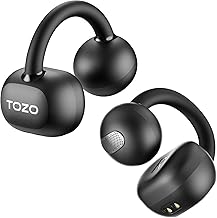
The TOZO OpenEarRing is best for shoppers looking for a lightweight clip-on design rather than an in-ear tip or a wraparound headband. TOZO lists each earbud at 5.1 grams and describes the fit as secure, pressure-free, and made with high-resilience materials. Because it clips on, its wearing feel differs from earhook and bone-conduction styles.
The product features TOZO’s proprietary OrigX acoustic technology, which the listing associates with stereo sound, music, and movie listening. The case has a digital display and supports Type-C charging. TOZO states up to 10 hours of playback per charge and an additional 30 hours from the case, for up to 40 hours combined.
- Best for: Buyers who want a light clip-on fit and a case with a battery display.
- Why it was selected: The clip-on construction keeps the product in the non-in-ear category, while its listed weight and battery details help with comparison.
- Consider: The listed 40-hour total includes the charging case; it is not the stated single-charge earbud runtime.
Gavhaio Bone-Conduction Headphones

The Gavhaio model is best for active listeners who want a wraparound frame and bone-conduction audio instead of earbuds placed in the ear canal. The listed design weighs 28 grams and uses a flexible frame intended to stay in place during movement. The product description names running, cycling, hiking, and workouts as suitable activities.
Rather than directing sound through a conventional in-ear speaker, this model is described as sending audio through the cheekbones. Its listed features include Bluetooth 6.0, a stated connection range of up to 33 feet, a microphone, and an IP54 rating. It is designed to leave the ears uncovered, which can help the wearer remain aware of surrounding sounds, though it does not replace attentive listening or safe outdoor practices.
- Best for: Runners and other active buyers seeking an open-ear, wraparound fit.
- Why it was selected: Bone conduction is a distinct alternative for people who do not want devices inside their ears.
- Consider: Its wraparound frame is less compact than a small clip-on earbud, and an open design does not provide noise isolation.
Dytole Wireless TV Headphones

The Dytole system is best for people who want to listen to television at an individually adjusted volume, especially when other household members prefer a lower room volume. The listing describes a transmitting and charging dock, vocal enhancement, personalized volume adjustment, and wireless range of up to 100 feet. Its stated latency is less than 40 milliseconds, a feature intended to reduce audio delay relative to the picture.
This product serves a different need from open-ear exercise earbuds: it is presented as a TV listening system, not as a lightweight everyday open-ear model. The listing does not specify the exact wearing style, so buyers who specifically need a device that rests outside the ear canal should check the product details before choosing it.
- Best for: TV viewers who want personal volume control and a dock-based wireless setup.
- Why it was selected: It is relevant to buyers seeking wireless listening without inserting standard earbuds, particularly for television use.
- Consider: The product information provided does not establish its precise fit style; confirm that it meets your no-in-ear requirement.
Buying Guide: How To Choose Headphones That Stay Out Of Your Ears
Which fit style should you choose?
Open-ear products are not all built the same way. Earhook earbuds rest around the outer ear, clip-on models attach at the ear, and bone-conduction headphones use a wraparound frame with contact points near the cheekbones. A TV headphone system may have a different fit altogether. Choose by the physical design you are comfortable wearing, not just by the phrase “open ear” in a product title.
- Choose earhooks if you want a small earbud-style device secured around the ear, as with the OHAYO T10.
- Choose clip-on earbuds if you prefer a light attachment at the ear, as with the TOZO OpenEarRing.
- Choose bone conduction if you want a wraparound frame and audio delivered through the cheekbone area, as described for the Gavhaio model.
- Choose a TV system if private television listening and separate volume adjustment matter more than an exercise-ready open-ear fit.
Do you need awareness or noise isolation?
Open-ear headphones leave the ear canal uncovered, so nearby sounds can remain audible. This can be useful when you need to hear conversations or environmental sounds. It also means they generally do not create the same enclosed listening experience as sealed in-ear headphones. If blocking background noise is your priority, a non-in-ear design may not be the right match.
Awareness is not a substitute for attention. Keep volume at a level that lets you respond to your surroundings, and follow applicable rules when walking, cycling, or exercising near traffic. Product descriptions can explain a design goal, but they cannot guarantee safety in every setting.
How should you compare battery life?
Separate the earbuds’ single-charge playback time from the total time that includes a charging case. OHAYO lists up to 10 hours from the earbuds and 30 additional hours from the case. TOZO also lists up to 10 hours per charge plus 30 hours from its case. Those are manufacturer-stated figures, and actual runtime can vary with use and settings.
The Soundcore and Gavhaio details provided here do not state a battery duration, so compare their fit and other listed features rather than assuming a runtime. The Dytole listing highlights a transmitting and charging dock but does not provide a battery figure in the supplied information.
What features matter for exercise?
For workouts, consider how the headphones attach, whether the frame feels appropriate for movement, and whether the product lists a water-resistance rating. The Gavhaio listing states an IP54 rating and describes a flexible wraparound design. OHAYO lists an IPX6 rating and an earhook fit. These ratings are different classifications; do not assume they indicate identical protection. Check the manufacturer’s product information for the conditions covered.
What should you check for TV listening?
For television, prioritize the connection setup, controls, dialogue clarity, and whether the headphones’ physical fit meets your needs. Dytole lists a transmitting dock, customized volume, vocal enhancement, a stated 100-foot range, and less than 40 ms latency. Since the provided product details do not say exactly how the headphones sit on or around the ear, verify that point before buying if avoiding all in-ear contact is essential.
Frequently Asked Questions
What are wireless headphones that don’t go in your ear called?
They are commonly described as open-ear headphones, earhook or clip-on earbuds, or bone-conduction headphones. The terms refer to different designs, so check how each model rests on the ear and head.
Do open-ear headphones block outside noise?
Open-ear headphones are designed to leave the ear canal uncovered, so they do not provide the same sealed fit as many in-ear headphones. They may be a poor choice when noise isolation is the main goal.
Are bone-conduction headphones the same as open-ear earbuds?
No. Bone-conduction headphones use contact near the cheekbones and commonly have a wraparound frame. Open-ear earbuds may instead use earhooks or clip-on attachments while placing a speaker near the ear.
Which option is best for running?
The Gavhaio model is the clearest match in this selection for running because its listing names running and describes a lightweight, flexible wraparound frame. OHAYO also lists running and an earhook fit. Fit preferences vary, so choose the attachment style that feels secure to you.
Can I use open-ear headphones for watching TV?
Yes, but check connection requirements, volume controls, and fit. The Dytole product is specifically described as a wireless TV headphone system, while the other options are open-ear listening products. Confirm its wearing style if avoiding in-ear contact is a firm requirement.
Does a 40-hour battery claim mean 40 hours on one charge?
Not for the OHAYO T10 and TOZO OpenEarRing as described here. Each listing separates up to 10 hours from the earbuds and additional playback from the case, reaching a stated combined total of up to 40 hours.