
An audio input selector switch box lets you choose between connected audio sources without repeatedly swapping cables. The four-input passive stereo switchers are best for several audio devices, while the Panlong and Duttek AV switchers suit setups that also need composite video selection. The two-input RCA model is better for a simpler stereo setup. Check the connection types and direction of switching before choosing.
| Product | Best For | Connections Or Switching |
|---|---|---|
| 4×1 RCA L/R + 3.5mm Aux | Multiple stereo sources | RCA and 3.5mm; bidirectional |
| Panlong 4-Way AV Switch | Older AV devices | Composite video and stereo audio |
| 4-Way RCA L/R & 3.5mm | Flexible stereo switching | RCA and 3.5mm; bidirectional |
| Duttek AV Switch Box | Composite AV equipment | Three-RCA AV; no power required |
| RCA Audio Switch 2 in 1 Out | Two-source stereo setups | RCA; switch between two inputs or outputs |
4×1 RCA And 3.5mm Audio Switcher

This passive switch box combines RCA left/right connections with a 3.5mm auxiliary connection. Its name describes two possible configurations: four inputs to one output, or one input to four outputs. In either configuration, only one of the four ports works at a time, so it is a selector rather than a device for playing audio through several outputs simultaneously.
- Best for: A setup with multiple stereo sources and a mixture of RCA and 3.5mm connections.
- Why it stands out: It offers both connection types and bidirectional switching, giving it more routing flexibility than a basic RCA-only selector.
- Keep in mind: Only one of the four ports is active at a time. Do not choose it if you need simultaneous output to multiple devices.
Choose this model if your equipment uses analog stereo connections and you want the option to select a source or route a source to one of several destinations. Confirm that your setup uses compatible RCA or 3.5mm connections before ordering.
Panlong 4-Way AV Switch
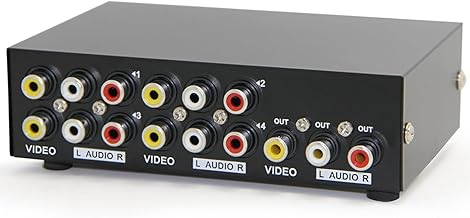
The Panlong is a four-input, one-output AV selector for composite video and left/right stereo audio. The product listing identifies DVD players, set-top boxes, and game consoles as example source devices. Because it switches video along with audio, it is a better fit for a group of composite AV sources than a music-only setup.
- Best for: People connecting several composite AV devices to one display or AV destination.
- Why it stands out: It handles composite video and stereo audio together and provides four inputs to one output.
- Keep in mind: This is a composite AV switcher, not a 3.5mm auxiliary selector. Check that your devices use the matching AV connections.
Choose this unit when reducing cable changes between older AV sources is the priority. It is not the right match if you only need to switch between RCA audio sources and do not need composite video switching.
4-Way RCA And 3.5mm Stereo Switcher

This passive analog stereo selector supports RCA left/right and 3.5mm connections. It is described as bidirectional, with a four-input-to-one-output configuration or a one-input-to-four-output configuration. The listing specifies that only one output plays at a time, an important distinction for buyers who might otherwise expect audio to be distributed to multiple destinations.
- Best for: Users who need a four-port analog stereo selector with both RCA and 3.5mm connections.
- Why it stands out: The bidirectional design supports either source selection or destination selection, depending on how it is connected.
- Keep in mind: It does not play through multiple outputs at the same time. Select a different type of device if simultaneous distribution is required.
Compared with the two-input RCA switch, this model is better for a larger number of analog connections and mixed RCA/3.5mm equipment. Check the intended signal direction and port arrangement before connecting devices.
Duttek Four-Input AV Switch Box

The Duttek switch box routes four composite AV inputs to one output using three RCA connections for video and left/right audio. The listing names Wii, PS2, Xbox, DVD players, set-top boxes, and HDTV among its intended equipment examples. It also states that the device requires no power.
- Best for: A setup with multiple devices that use composite video and RCA stereo audio.
- Why it stands out: It combines three-RCA AV switching with four-input-to-one-output routing and does not require power according to the listing.
- Keep in mind: This is not a standalone audio-only switcher. Choose it only if you also need to switch composite video.
Choose the Duttek when consolidating several composite AV sources is more important than switching modern digital connections. The listed connection type is the key selection point: make sure your source devices and destination accept composite AV.
RCA Audio Switch 2 In 1 Out

This RCA stereo switcher is designed for two possible arrangements: two inputs to one output or one input to two outputs. The listing describes switching between TVs, computers, and speakers, and states that it needs no power. Its simpler port count makes it a practical choice when a four-way selector would provide more connections than the setup needs.
- Best for: Buyers switching between two RCA stereo sources or choosing between two destinations.
- Why it stands out: It provides a straightforward two-way RCA option and is described as requiring no power.
- Keep in mind: It has fewer ports than the four-way models and uses RCA connections. It is not the best choice for several sources or 3.5mm-only devices.
Choose this model for a compact two-device arrangement where RCA stereo is already available. Before selecting the one-input-to-two-output mode, confirm that the desired use is switching between destinations, not sending audio to both at once.
Buying Guide: How To Choose An Audio Input Selector
How many sources do you need to connect?
Count the devices that will share the same audio destination. A four-input selector can accommodate more sources than a two-input model, but unused ports do not improve the connection itself. For two sources, the RCA 2-in-1-out switch may be a simpler match. For three or four sources, consider one of the four-way products and confirm the number of inputs in the intended configuration.
Also distinguish source selection from output selection. In a 4-in-1-out arrangement, several sources connect to one destination, and the switch chooses the active source. In a 1-in-4-out arrangement, one source connects to several possible destinations. A bidirectional label does not necessarily mean that all connected destinations play together.
Do you need audio only, or composite AV?
Audio-only selectors are designed around sound connections. The listed RCA and 3.5mm models are intended for analog stereo audio. The Panlong and Duttek products add composite video switching, making them relevant when the video signal must be switched along with left/right audio.
Composite AV typically uses separate connections for video and the left and right audio channels. Check the ports on each device rather than relying only on the device name. A product described as an AV switch is not automatically compatible with every video format or digital audio connection.
Which connectors does your equipment use?
RCA stereo uses separate left and right connections. A 3.5mm auxiliary connection uses a small audio plug. The first and third products in this list are described as supporting both RCA L/R and 3.5mm; the two-input model is described as an RCA audio switch. The AV models use composite video and RCA audio connections.
Match the selector to the source and destination connections. If a device has a different connector type, do not assume the switch box can accept it directly. Check the product specifications and determine whether a suitable separate adapter would be needed before purchase.
Will the switch need a power supply?
The listed four-way audio products are described as passive. The Duttek AV switch and the two-input RCA switch are described as requiring no power. The Panlong listing information provided here does not specify a power requirement, so check its current product details if power use is a deciding factor.
A passive or no-power design can simplify placement because it avoids adding a power connection. However, power requirements alone do not establish compatibility, sound quality, or whether a product meets a specific installation need. Confirm the connections and switching direction first.
Do you need to play audio on more than one output?
Read the output limitation carefully. Both four-way RCA/3.5mm products specify that only one output plays at a time. They are selectors, not simultaneous multi-room distribution devices. The two-input RCA switch is also described as a switch between destinations, rather than as a device that plays through both outputs at once.
If you need one source to play through several destinations simultaneously, look for a product explicitly designed for signal distribution. Do not treat a 1-in-4-out switching arrangement as a promise of four concurrent outputs.
What should you check before connecting the switch?
- Confirm whether the setup is input selection or output selection.
- Match the number of sources or destinations to the switch’s port count.
- Check that every device uses the required RCA, 3.5mm, or composite AV connections.
- For AV models, verify that composite video switching is needed in addition to stereo audio.
- Review whether the product is passive or requires power, using the listing information.
- Check whether only one output can be active at a time if you plan to connect multiple destinations.
Frequently Asked Questions
What does an audio input selector switch do?
It lets a user choose which connected audio source sends its signal to a shared output. A four-input, one-output model is intended to select among multiple sources.
Can an RCA audio switch also select 3.5mm sources?
Only if the product is designed with a 3.5mm connection. The first and third four-way products listed here specify both RCA L/R and 3.5mm; the two-input RCA model is described as an RCA switch.
Can a 4-in-1-out switch play all four sources at once?
No. A 4-in-1-out selector chooses one source for one output. The listed four-way audio models specify that only one port or output works at a time.
What is the difference between an audio switch and an AV switch?
An audio switch selects audio connections. An AV switch can also route composite video along with left and right audio, as described for the Panlong and Duttek products.
Does a passive audio switch need power?
Passive switches generally do not use a separate power connection, and the four-way audio products are described as passive. Check the individual product listing for its stated requirements.
Which switch is better for two RCA sources?
The two-input RCA audio switch is the direct match when selecting between two RCA sources and one destination. Choose a four-way model if you need additional inputs or 3.5mm connections.