
If you need to connect a TV or other optical-audio source to red-and-white RCA inputs, choose an optical-to-RCA digital-to-analog converter. A Toslink cable alone cannot make that connection because optical audio is digital and RCA audio is analog. The AUTOUTLET 7-foot converter is best for buyers who want a stated cable length and sampling details; the PROZOR converters offer alternate cable lengths and formats. The Bangun optical cable is best only when you already have a compatible DAC.
| Product | Best For | What It Does |
|---|---|---|
| AUTOUTLET 7ft Optical-to-RCA Converter | Buyers seeking a cable-style converter | Converts optical digital audio to RCA analog output |
| PROZOR Optical-to-RCA/3.5mm DAC | Buyers who want RCA and 3.5mm outputs | Converts digital optical audio to analog |
| AUTOUTLET 6ft SPDIF-to-RCA Converter | Buyers seeking a shorter listed cable | Converts SPDIF digital audio to RCA analog |
| PROZOR 7ft Optical-to-RCA Converter | Buyers who need a 7-foot option | Converts optical digital audio to RCA analog |
| Bangun 6ft Toslink Optical Cable | Buyers who already own a DAC | Carries digital optical audio; does not convert to RCA |
AUTOUTLET 7ft Optical-to-RCA Converter

This AUTOUTLET product combines an optical-to-analog DAC with a 7-foot cable and red-and-white RCA male output. It is designed to connect an optical Toslink audio source to a stereo amplifier or another device with RCA inputs. Its listed uses include HDTVs, DVD and Blu-ray players, and game consoles.
The converter supports 24-bit audio and sampling rates up to 192 kHz. Its description also identifies a built-in audio amplifier chip and dual-channel operational amplifier intended to increase the RCA output level. These details make it a suitable choice for someone looking for a direct cable-style solution rather than a separate converter box and RCA leads.
- Best for: Buyers who want an integrated optical-to-RCA cable and a stated 7-foot length.
- Why it was selected: It directly matches the optical digital-to-red-and-white analog connection in the search.
- Consider: Confirm that the source has an optical output and the receiving device has RCA inputs. The listing describes RCA male output, so it may not suit a receiver that only accepts another connector type.
PROZOR Optical-to-RCA and 3.5mm DAC

The PROZOR converter is a digital-to-analog adapter with optical Toslink input and RCA left/right and 3.5mm analog output, according to its product name. It is intended for setups that need to route a digital optical signal to analog audio equipment. The named applications include game consoles, DVD players, an amplifier, and home-cinema equipment.
Unlike a passive optical cord, a DAC actively converts the digital signal to analog. This distinction matters when connecting a newer TV or media device with an optical output to older equipment that uses red-and-white RCA inputs. The product name identifies a 192 kHz conversion capability and an aluminum-alloy construction.
- Best for: Buyers who want an optical-to-analog converter with both RCA and 3.5mm output options listed.
- Why it was selected: It directly addresses the required conversion and offers more than one analog output format.
- Consider: The provided product information does not specify an included optical cable length or power arrangement. Check the listing details to confirm what accessories are supplied and how the converter is powered.
AUTOUTLET 6ft SPDIF-to-RCA Converter

This AUTOUTLET model converts SPDIF digital audio to analog RCA output and lists a 6-foot converter cable, plus a 0.7-meter RCA cable. Its stated applications include HDTVs, DVD players, and game consoles. It is a practical option for buyers who want a shorter optical-to-RCA setup than a 7-foot model, while retaining a separate RCA cable for connecting to the receiving equipment.
The product description specifies a built-in audio amplifier chip and support for 24-bit audio at sampling rates up to 192 kHz. It lists optical input rates of 32, 44.1, 48, 96, and 192 kHz. Those specifications describe supported input formats; the source device’s selected audio output format still needs to be compatible with the converter.
- Best for: Buyers who want a 6-foot converter with a separately listed 0.7-meter RCA cable.
- Why it was selected: It supports the exact digital optical-to-analog RCA conversion needed for red-and-white inputs.
- Consider: Check the distance between devices and the available space for the included cable arrangement before buying.
PROZOR 7ft Optical-to-RCA Converter
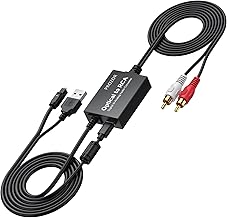
This PROZOR model converts SPDIF optical digital audio to left-and-right RCA analog audio and has a listed 7-foot cable. The product description names HDTVs, amplifiers, Blu-ray and DVD players, and PS3 and PS4 consoles as intended sources or equipment. It also identifies a built-in audio amplifier chip and a dual-channel operational amplifier to address low RCA output levels.
The converter supports sampling rates of 32, 44.1, 48, 96, and 192 kHz, with a 24-bit SPDIF input stream. The product information gives an important setup instruction: set the TV’s audio output format to PCM. It also notes that TV volume should be adjusted through the TV settings and that optical output is not supported as a feature of the converter.
- Best for: Buyers who need a 7-foot optical-to-RCA connection and can set the source audio to PCM.
- Why it was selected: It provides a clearly specified cable length, conversion direction, and setup guidance.
- Consider: It may not work as expected if a TV sends an unsupported bitstream format. Check the audio settings before troubleshooting the hardware.
Bangun 6ft Toslink Optical Cable

This Bangun product is a 6-foot Toslink optical cable, not an optical-to-RCA converter. It carries digital audio between devices with standard optical ports, such as a TV and a DAC or compatible audio receiver. Its description highlights a slim, flexible design, gold-plated connectors, and compatibility with devices that have Toslink or S/PDIF optical ports.
It can be useful as one part of an optical-to-red-and-white setup when paired with a separate DAC that has optical input and RCA output. The cable itself does not convert digital audio into analog audio, and it does not terminate in red-and-white RCA plugs. The listed support includes PCM and various surround formats, but the equipment at both ends must support the signal being sent.
- Best for: Buyers who already have a DAC or receiver that accepts optical input and need a Toslink cable.
- Why it was selected: It is relevant to the optical-audio side of the connection and clarifies the difference between a cable and a converter.
- Consider: Avoid choosing this by itself if your goal is to connect an optical TV output directly to RCA inputs.
Buying Guide: Choosing Optical Audio to RCA
Do you need a cable or a digital-to-analog converter?
Check the ports on both devices before buying. An optical output, often labeled Optical, Toslink, or S/PDIF, sends digital audio. Red-and-white RCA inputs receive analog left and right audio. These signal types are different, so a passive Toslink cable cannot connect them directly. The usual solution is an optical-to-RCA DAC, which performs the conversion.
A converter may be built into a cable-style product or housed in a small separate unit. A separate DAC generally needs an optical cable between the source and the converter, plus RCA cables from the converter to the receiving device. Read the included-accessories details rather than assuming that every cable is supplied.
Which cable length is right for your setup?
Measure the path between the source and the equipment receiving the RCA signal, allowing room to route the cable around furniture or behind a TV stand. The products here list 6-foot or 7-foot optical-to-RCA options, while the Bangun Toslink cable is listed at 6 feet. Choose a length that reaches without pulling on the connectors, but avoid excess cable that creates clutter.
Also distinguish between an integrated converter cable and a separate optical cable. A 6-foot Toslink cable only covers the optical portion of a setup. It does not include the analog conversion needed to deliver red-and-white RCA audio.
Will your TV audio format work?
Some optical-to-RCA converters require the source to output PCM stereo. If the TV sends a surround or compressed bitstream that the converter does not support, you may hear no sound or experience an audio problem. Look in the TV’s sound settings for Digital Audio Output, Optical Output, or a similar option, then choose PCM or stereo PCM if the converter instructions call for it.
Sampling-rate claims such as 192 kHz describe a supported input capability. They do not guarantee that every connected TV, app, game console, or audio format will use that rate. Confirm the source’s output settings and the converter’s supported formats.
Should you choose a model with an amplifier chip?
Some listed converters identify a built-in audio amplifier chip or dual-channel operational amplifier. These features are presented as a way to boost RCA output level. They may matter when connecting to equipment where the analog signal seems low, but they do not replace checking the receiving device’s input and volume settings.
For a basic stereo connection, prioritize the correct conversion direction, compatible audio format, output connectors, cable length, and power requirements. Extra specifications are useful only when they match the needs of your equipment.
What should you check before ordering?
- Confirm that the source has an optical Toslink output, not only HDMI or an analog output.
- Confirm that the receiving equipment has left-and-right RCA inputs.
- Choose a converter labeled optical or SPDIF digital input to RCA analog output.
- Check whether the product includes the cables and power accessories you need.
- Review the converter’s supported audio formats and follow any PCM setup instructions.
- Do not buy a Toslink cable alone when you need digital-to-analog conversion.
Frequently Asked Questions
Can I connect an optical audio output directly to red-and-white RCA?
No. Optical audio is digital, while red-and-white RCA audio is analog. Use an optical-to-RCA DAC to convert the signal.
Does a Toslink cable convert digital audio to analog?
No. A Toslink cable carries a digital optical signal between compatible ports. A DAC is required to convert that signal to analog RCA audio.
Which direction should the converter support?
For a TV optical output connected to an amplifier’s RCA inputs, choose a converter that accepts optical digital input and outputs analog left-and-right RCA. A converter with the reverse direction will not meet this need.
Why is there no sound after connecting an optical-to-RCA converter?
Check that the converter has power if required, the RCA plugs are connected to inputs, and the TV is set to send audio over optical. If the product requires PCM, change the TV’s digital audio format to PCM stereo.
Can an optical-to-RCA converter carry surround sound to two RCA plugs?
Two RCA plugs provide left-and-right analog output. A converter may require a compatible stereo PCM signal, so check its supported formats and the source’s audio settings rather than assuming it will reproduce every surround format.
Do I need red-and-white RCA cables in addition to an optical cable?
It depends on the product. Some converter cables have RCA male outputs integrated into the unit, while separate DACs may need RCA cables from the converter to the audio equipment. Check what is included with the specific model.