
Bluetooth FM transmitters are a practical way to transmit phone audio to a car radio when the vehicle lacks built-in Bluetooth. They send audio to an unused FM frequency that you select on the car stereo. The Nulaxy 54W is best for drivers who want several charging ports, while the LIHAN is suited to city driving and everyday app audio. The LENCENT adds USB and microSD playback, the Nulaxy KM18 Plus has an adjustable display, and the Scosche offers straightforward hands-free calling and charging.
| Product | Best For | Standout Feature |
|---|---|---|
| Nulaxy 54W Bluetooth 5.3 | Charging several devices | Four charging ports |
| LIHAN Bluetooth 5.4 | App audio and city driving | Noise-reduction features |
| LENCENT T25 | Phone-free music playback | USB flash drive and microSD support |
| Nulaxy KM18 Plus | Drivers who want a visible display | Adjustable screen and gooseneck |
| Scosche BTFM9 | Simple calls and charging | USB-C and USB-A ports |
Nulaxy 54W Bluetooth 5.3 Car Adapter

Best for: Drivers and passengers who want to stream phone audio while charging multiple devices. This adapter combines Bluetooth 5.3 FM transmission with four synchronous charging ports, including PD 36W and QC 18W charging options, according to the product description.
The Bluetooth connection sends music and calls from a phone to the vehicle radio through an FM channel. A one-touch bass effect and five-color lighting are additional controls and design features. For a household that regularly travels with several devices, the four-port arrangement is the main reason to choose this model over simpler transmitters.
Limitation: The product information does not identify the charging specifications of every individual port. Check the adapter’s labeling and your device’s charging requirements before relying on a particular port for fast charging. As with other FM transmitters, the radio must be tuned to the transmitter’s frequency.
LIHAN Bluetooth 5.4 FM Transmitter

Best for: Drivers with a car radio but no Bluetooth or AUX input who want to stream common phone audio apps. The listed uses include music, podcasts, video-app audio, GPS navigation prompts, and hands-free calls. Its Bluetooth 5.4 connection is described as supporting quick reconnection, and the product listing notes that one device connects at a time.
LIHAN highlights noise reduction intended to help limit static and radio interference in busy urban areas. That makes it a relevant option for drivers who frequently travel through cities, where finding a clear FM frequency can be more challenging. It also has 48W PD/QC fast USB charging, as stated in the product name.
Limitation: The one-device-at-a-time connection may not suit a vehicle where several people regularly want to switch between connected phones. FM performance can also depend on the local radio environment and the frequency selected.
LENCENT T25 FM Transmitter
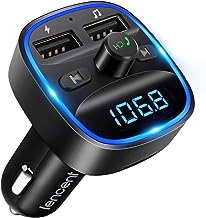
Best for: Drivers who want playback choices beyond Bluetooth streaming. The T25 can transmit phone audio over Bluetooth and also play music from a USB flash drive or microSD card, with listed support for drives and cards up to 32GB. Supported formats include WMA, MP3, WAV, APE, and FLAC.
The two USB ports are specified at 5V/2.4A and 5V/1A, so two devices can be charged at the same time. LENCENT also lists CVC noise suppression and echo cancellation for hands-free calls, along with voice navigation support. This combination makes it a flexible choice when a driver wants stored music available even without streaming from a phone.
Limitation: The listed card and flash-drive capacity limit is 32GB. The USB charging ports are specified by their voltage and current rather than as PD or QC fast-charging ports, so choose another model if those charging standards are a priority.
Nulaxy KM18 Plus Bluetooth FM Transmitter

Best for: Drivers who want transmitter information shown on a small adjustable screen. The 1.44-inch LCD can display information such as phone calls, FM channels, music, and vehicle battery voltage. Its flexible gooseneck lets the user adjust the screen angle for viewing.
This model uses Bluetooth 5.4 and offers a USB-C PD 30W port alongside a USB QC 3.0 port rated at 18W. The two ports allow simultaneous charging of two devices, according to the product details. It also lists TF card and AUX functions, giving buyers more connection options than an FM-only description would suggest. The stated vehicle range is 12V–24V.
Limitation: The screen and flexible neck add size compared with a compact adapter. Check that the placement does not obstruct the driver’s view or interfere with vehicle controls. The listed 12V–24V range should be compared with the vehicle’s power outlet requirements.
Scosche BTFM9 Bluetooth FM Transmitter

Best for: Drivers looking for a straightforward way to add Bluetooth audio and hands-free calling through a vehicle’s FM radio. The BTFM9 plugs into a 12V cigarette-lighter socket and connects a smartphone to the car stereo wirelessly. The listing also mentions Siri and Google Assistant support.
Dual USB-A and USB-C charging ports are rated at 12W in the product description. The combination can be useful when a driver wants to charge two devices while listening to music or taking calls. Compared with models emphasizing multiple media sources or a large screen, this one focuses on basic Bluetooth transmission, calls, and charging.
Limitation: The listed charging-port output is 12W, which may be less suitable for buyers prioritizing higher-output fast charging. This product requires a 12V cigarette-lighter socket, so confirm the vehicle has an appropriate outlet available.
Buying Guide: How To Choose A Phone-To-Radio Transmitter
How does an FM transmitter send phone audio to a car radio?
A Bluetooth FM transmitter pairs with a phone and broadcasts its audio over a selected FM frequency. The car stereo is tuned to that same frequency to play the sound through the vehicle speakers. This setup can provide music, podcasts, navigation prompts, and calls without replacing the factory radio, provided the device and vehicle can be connected as described by the manufacturer.
Most importantly, the transmitter does not make a phone call or music stream work by itself. The phone supplies the audio, Bluetooth carries it to the adapter, and the car radio receives the adapter’s FM broadcast. Follow the instructions for pairing and selecting a frequency rather than assuming the device will automatically find a clear channel.
What should I check before buying?
- Radio and power connection: Check that your car has an FM radio and the power outlet needed by the chosen adapter. The Scosche listing specifies a 12V cigarette-lighter socket; the Nulaxy KM18 Plus lists a 12V–24V vehicle range.
- Charging needs: Compare the number of ports and their stated output. The Nulaxy 54W offers four ports, while the LENCENT has two specified 5V ports. The Nulaxy KM18 Plus lists PD 30W and QC 3.0 18W charging.
- Audio sources: Choose Bluetooth for phone streaming. Consider the LENCENT if USB flash drive or microSD playback is useful. The KM18 Plus listing also identifies TF card and AUX functions.
- Calls and navigation: Look for hands-free calling and voice-navigation features if you need spoken directions or call audio through the car stereo. Keep phone handling to a minimum while driving.
- Display and placement: A screen can show channel or call information, but its position matters. Select a location that does not block the road view or distract the driver.
How can I reduce static or interference?
FM transmitters use radio frequencies, so audio quality can vary with location and nearby broadcasts. Choose a frequency that is not occupied by a strong local station, then tune both the transmitter and car radio to it. If interference appears during a drive, try another available frequency using the device’s instructions. LIHAN specifically describes noise-reduction features for busy city driving, while LENCENT lists anti-static design and CVC noise suppression. Those features do not guarantee a static-free signal in every location.
Which transmitter is better for charging?
Choose based on the number of devices you need to charge and the output stated for each port. The Nulaxy 54W is the clearest choice for buyers who want four charging ports. The KM18 Plus provides two ports with specified PD and QC ratings. The Scosche BTFM9 has USB-A and USB-C ports rated at 12W, while the LENCENT’s ports are specified at 5V/2.4A and 5V/1A. Port count alone does not indicate charging speed; compare the ratings with your devices.
Which option is best for calls and navigation?
The LIHAN, LENCENT, and Scosche listings expressly describe hands-free calls. LIHAN and LENCENT also identify GPS voice navigation support, and Scosche mentions Siri and Google Assistant. These descriptions can help narrow the shortlist, but they do not replace checking the device instructions and phone settings. For safer driving, set up the connection before starting a trip and avoid handling the phone on the road.
Frequently Asked Questions
Can I transmit music from my phone to a car radio without Bluetooth?
Yes. A Bluetooth FM transmitter can receive audio from a phone and broadcast it over an FM frequency that the car radio can tune to. The car needs a working FM radio and the transmitter needs a compatible power connection.
Do I need to tune the car stereo to a specific frequency?
Yes. In an FM-transmitter setup, the adapter and car stereo must use the same frequency. Select a frequency with minimal local broadcast interference and follow the product’s setup directions.
Can these devices play navigation directions through the speakers?
Several listings describe voice navigation or GPS prompts. The phone must provide the navigation audio, and the transmitter must be connected and tuned correctly for the sound to reach the car radio.
Can two phones connect to an FM transmitter at once?
Connection behavior depends on the model. The LIHAN listing specifically says one device connects at a time. Check the individual product instructions if multiple drivers need to take turns using the adapter.
Will an FM transmitter always sound as clear as built-in Bluetooth?
No. FM transmission can be affected by nearby radio stations and local interference. A clear, unused frequency may improve playback, but reception conditions vary by place and vehicle.