
If you are shopping for a 150-watt stereo receiver, compare the stated output per channel, speaker impedance, and whether the rating is continuous RMS or peak. None of the products below lists 150 watts of continuous output per channel: the Rockville is rated at 75 watts × 2 RMS at 4 ohms, while the Sony lists 100 watts × 2 at 8 ohms. The Sony is best for vinyl and everyday stereo listening; the Rockville is a flexible choice for several audio sources and karaoke; and the Yamaha suits buyers who want a straightforward receiver with Bluetooth and two speaker-system selection.
| Receiver | Best For | Listed Power or Key Detail |
|---|---|---|
| Sony STR-DH190 | Vinyl and traditional stereo listening | 100 watts × 2 at 8 ohms |
| Rockville BluAmp 150 | Input flexibility and karaoke | 75 watts × 2 RMS at 4 ohms |
| Yamaha R-S202BL | Simple stereo system with Bluetooth | Output rating not stated in supplied details |
| AK50 by Joengoep | Compact two-channel setup with mic input | 50 watts × 2 stated output |
| Donner 4-Channel Receiver | Multiple speaker groups and karaoke | 25 watts × 4 RMS |
Sony STR-DH190 Stereo Receiver

Best for: Buyers building a conventional two-channel system around a turntable, phone, or other analog sources. Its listed output is 100 watts × 2 at 8 ohms, so it is a useful comparison for shoppers seeking a strong stereo receiver, although it is not specified as a 150-watt-per-channel model.
The STR-DH190 includes a phono input for a turntable, four stereo RCA audio inputs, a 3.5 mm input, Bluetooth, and a stereo RCA output. Sony lists speaker impedance support of 6–16 ohms. This combination makes it a practical choice when you want both wired sources and wireless music playback without needing a multichannel home-theater receiver.
- Why it was selected: It is a clearly specified, two-channel home receiver with phono and Bluetooth connectivity.
- Consideration: Its stated output is 100 watts per channel, not 150 watts per channel. Check speaker impedance before connecting speakers.
Rockville BluAmp 150 Bluetooth Receiver
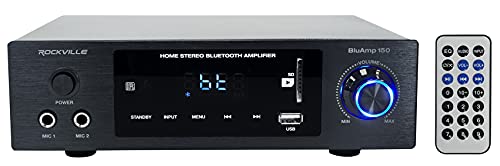
Best for: Buyers who want a compact stereo amplifier with a broad range of input types and microphone connections. The product name includes “150,” but its supplied specification is 75 watts × 2 RMS at 4 ohms. That is 150 watts total across two channels, not 150 watts per channel.
Rockville lists Class D circuitry and support for 4–8-ohm speakers. Connections include Bluetooth 5.0, optical, phono, RCA, USB, and SD inputs. Two 1/4-inch microphone inputs have echo and volume controls, and bass, treble, and balance controls allow adjustment of the sound. The product information states a Bluetooth range of 33 feet.
- Why it was selected: Its RMS specification is clear, and the phono, optical, wireless, and microphone inputs cover varied home-use needs.
- Consideration: The 75-watt-per-channel RMS figure is below a 150-watt-per-channel target. Avoid choosing it if that specific continuous output is essential.
Yamaha R-S202BL Stereo Receiver
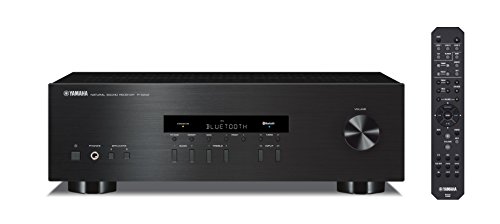
Best for: Buyers who want a conventional stereo receiver with Bluetooth, headphone listening, and the option to select between two speaker systems. The supplied product details do not give a watts-per-channel figure, so compare its full specifications with your speakers before treating it as a match for a 150-watt requirement.
The R-S202BL features advanced circuitry, a headphone terminal, an auto-power-standby function, and speaker terminals for two systems. Its Bluetooth feature supports wireless music streaming, and its FM/AM tuner offers 40 station presets. Yamaha also lists a frequency response of 10 Hz–100 kHz, with tolerances stated in the product details.
- Why it was selected: It is a two-channel receiver with useful everyday features, including Bluetooth, radio presets, and two-system speaker selection.
- Consideration: The provided information does not state its power output. Verify the manufacturer’s current rating and speaker-load requirements for your intended setup.
AK50 Two-Channel Bluetooth Amplifier

Best for: Buyers looking for a small two-channel system with Bluetooth, USB, SD, FM, AUX, and microphone features. The supplied specifications state 50 watts × 2 output and compatibility with 4–16-ohm passive speakers. Its listed output is well below 150 watts per channel, so it is better suited to shoppers prioritizing connection options over high rated output.
The AK50 has high- and low-frequency controls, two microphone interfaces, and an echo adjustment. The listing also describes microphone output connections and the ability to connect an active subwoofer or recording equipment. Bluetooth 5.0 is listed with a range of up to 50 feet in an open area.
- Why it was selected: It is a clearly identified two-channel option with a useful mix of wireless, media, and microphone connections.
- Consideration: The stated 50-watt-per-channel output does not meet a 150-watt-per-channel target. The Bluetooth range is specified for open areas.
Donner Four-Channel Home Amplifier

Best for: Buyers who need more than two independently controlled channels or want microphone features for karaoke. This is not a direct substitute for a high-powered, two-channel 150-watt receiver: Donner lists 25 watts × 4 RMS and 1,000 watts peak power. Peak power and RMS output describe different measures and should not be compared as though they were equivalent.
The receiver supports up to four groups of speakers, with listed speaker impedance of 4–16 ohms. Inputs include Bluetooth 5.3, USB, two pairs of RCA, AUX, FM radio, optical, and coaxial. It also has two microphone inputs, echo and talkover controls, and a multifunction remote. The product details say it has no HDMI input and note that the remote battery is not included.
- Why it was selected: It offers four-channel flexibility and optical/coaxial inputs for buyers whose needs extend beyond basic stereo playback.
- Consideration: Its 25-watt-per-channel RMS rating is not a 150-watt stereo output. It has no HDMI input, and the listing advises selecting external audio output on some TVs.
Buying Guide: How to Choose a 150-Watt Stereo Receiver
Does “150 watts” mean per channel or total?
Check whether a specification says 150 watts per channel or 150 watts total. A two-channel receiver rated at 75 watts × 2 produces 150 watts across both channels under the stated test conditions; that does not make it a 150-watt-per-channel receiver. The Rockville BluAmp 150 is an example: its supplied rating is 75 watts × 2 RMS at 4 ohms.
Also distinguish RMS output from peak power. RMS ratings are commonly used to describe continuous amplifier output, while peak figures describe short-duration maximums. Do not compare a product’s peak number directly with another model’s RMS rating. The Donner models in the product list provide peak figures alongside lower RMS channel ratings.
Which power rating should I compare?
Use the same conditions when comparing receivers: output per channel, speaker impedance, number of channels driven, and the measurement method. The Sony’s listed 100 watts × 2 is specified at 8 ohms and 1 kHz; Rockville lists 75 watts × 2 RMS at 4 ohms. Because the stated conditions differ, those numbers are not a perfect like-for-like comparison.
If a listing omits its output rating, as the supplied Yamaha details do, look up the current manufacturer specification before buying. Do not infer wattage from a model name, peak-power claim, or the number of speaker terminals.
Will the receiver work with my speakers?
Match the receiver’s supported impedance range to the speaker specifications. The Sony lists 6–16-ohm speakers, while Rockville lists support for 4–8 ohms. The AK50 and Donner four-channel model list support for 4–16-ohm speakers. Confirm the requirements for the exact receiver and speaker combination, especially if you plan to connect multiple speaker groups.
More speakers do not automatically mean more power per speaker. When an amplifier drives multiple speakers, the load and available output can change. Follow the receiver’s connection instructions and avoid connecting a speaker arrangement outside its stated impedance range.
Which inputs do you need?
For a turntable, look for a phono input. The Sony and Rockville product details both specify phono connectivity. For a television, an optical input can be useful; Rockville and the Donner models list optical connections, while the Donner four-channel model also lists coaxial input. It does not have HDMI, so check your TV’s audio outputs and settings before choosing it.
Bluetooth provides wireless playback from compatible devices, while RCA and AUX connections support wired sources. USB and SD inputs may suit buyers who play stored media. If you plan to sing or make announcements, check for microphone inputs and controls: Rockville, AK50, and Donner list microphone connections, though their channel layouts and features differ.
Do you need two channels or more?
A two-channel stereo receiver is generally the more direct choice for left-and-right music playback. The Sony, Rockville, Yamaha, and AK50 are presented as stereo or two-channel options in the supplied product information. The Donner four-channel receiver is aimed at buyers who need multiple controlled channels and speaker groups, rather than shoppers seeking straightforward two-channel output.
Check how the manufacturer describes speaker selection and channel control. A receiver’s ability to connect multiple speaker systems is not necessarily the same as independent volume control for every pair. Choose based on the specific layout you plan to use.
What is the best choice for vinyl, TV, or karaoke?
For vinyl, prioritize a built-in phono input; Sony and Rockville list one. For a TV, look for a compatible digital audio output and a matching receiver input, then check the TV’s audio-output settings. For karaoke, compare the number of microphone inputs and whether controls such as echo or microphone volume are included. Rockville and Donner specify microphone-related controls, while the AK50 lists microphone interfaces and echo adjustment.
There is no single best feature set for every room. A receiver with more inputs may be convenient, but it may not have the desired per-channel output. Start with speaker compatibility and the correct power rating, then choose the connection features you will actually use.
Frequently Asked Questions
Is the Rockville BluAmp 150 a 150-watt-per-channel receiver?
No. The supplied specification is 75 watts × 2 RMS at 4 ohms, or 150 watts total across two channels. It does not list 150 watts per channel.
Which product in this list has the highest stated two-channel output?
The Sony STR-DH190 lists 100 watts × 2 at 8 ohms and 1 kHz. Rockville lists 75 watts × 2 RMS at 4 ohms. Compare the stated test conditions as well as the wattage.
Which listed receiver includes a phono input?
The Sony STR-DH190 and Rockville BluAmp 150 list phono inputs. This feature can support a turntable, but confirm whether your turntable and system require any additional equipment.
Is peak power the same as RMS power?
No. Peak and RMS figures are different measurements. For a continuous-output comparison, use the RMS rating when available and compare it under similar impedance and channel conditions.
Can I use these receivers with any passive speakers?
No. Check each receiver’s supported speaker impedance and compare it with the speakers’ specifications. The listed impedance ranges vary, and a compatible connection should stay within the receiver’s stated limits.