
The best 2000-watt amp depends on whether you need powerful subwoofer output or amplification for several full-range speakers. The products below are amplifiers, not speaker-and-amp bundles, so you will need to choose speakers or subwoofers that match the amplifier’s RMS output and impedance. The Skar Audio RP-2000.1D is best suited to a 2,000-watt RMS subwoofer setup at 1 ohm, while the PRV Audio MDX2000.4 is designed for four-channel speaker systems. The other monoblock options suit different power and tuning needs.
| Product | Best For | Key Listed Output |
|---|---|---|
| Skar Audio RP-2000.1D | High-output subwoofer systems | 2,000W RMS at 1 ohm |
| PRV Audio MDX2000.4 | Four-channel speaker setups | 4 x 500W RMS at 2 ohms |
| ORION CBA2000.1D | Lower-rated mono subwoofer systems | 500W RMS listed in product name |
| Taramps HD 2000 | Full-range mono installations | 2,000W RMS; 10Hz–20kHz response listed |
| AUDIOZERONE ZE1000.1 | Subwoofer systems with flexible impedance | 1,000W RMS at 1 ohm |
Skar Audio RP-2000.1D

The Skar Audio RP-2000.1D is a Class D MOSFET monoblock amplifier intended for a subwoofer channel. Its listed RMS output is 2,000 watts at 1 ohm, with peak power listed as 2,800 watts at that impedance. It also has a 20Hz–250Hz frequency response, a remote subwoofer level control, and an onboard bass EQ switch offering +6 or +12dB boost at 45Hz.
Best for: Buyers building a high-output mono subwoofer system who need the listed 2,000 watts RMS at a 1-ohm load. It was selected because its stated RMS output directly matches the 2000-watt search intent.
Limitation: This is a monoblock subwoofer amplifier, not a four-channel speaker amp. Confirm that the subwoofer system’s final impedance and RMS power handling match the amplifier before purchase; peak output is not the same as continuous RMS output.
PRV Audio MDX2000.4

The PRV Audio MDX2000.4 is a four-channel Class D amplifier for full-range stereo speaker systems. Its listed output is 4 x 500 watts RMS at 2 ohms. The product information also describes bridging two channels to provide 2 x 1,000 watts RMS, with a minimum 4-ohm impedance per bridged channel. It is described for car audio as well as powersports applications such as motorcycles and ATVs.
Best for: Buyers who want to power multiple speakers from separate channels rather than run one subwoofer channel. It was selected because it offers four-channel output and a stated per-channel RMS rating.
Limitation: Bridged operation has a different minimum impedance requirement than individual channels. Check the speaker wiring plan and the 2-ohm-per-channel or 4-ohm-bridged requirements before connecting speakers. Do not assume that each speaker should receive the amplifier’s full system output.
ORION CBA2000.1D Cobalt

The ORION CBA2000.1D is a Class D, one-channel amplifier with a MOSFET power supply. The product name lists 2,000 watts maximum and 500 watts RMS. Its feature information describes operation with 1-, 2-, and 4-ohm loads, adjustable low-pass filtering, bass boost, a bass knob, and low-level RCA inputs for receiving a signal from a receiver.
Best for: Buyers who want a monoblock subwoofer amplifier with tuning controls and do not require 2,000 watts of continuous RMS power. It was selected because the product name clearly distinguishes its 2,000-watt maximum figure from its 500-watt RMS figure.
Limitation: Its stated RMS rating is substantially below 2,000 watts. Choose it based on the listed RMS output and the subwoofer’s requirements, not the maximum-watt figure. The listing’s claims about continuous low-impedance operation should be checked against the amplifier’s current installation instructions.
Taramps HD 2000

The Taramps HD 2000 is described as a 2,000-watt RMS, 2-ohm, full-range monoblock car amplifier. Its product name lists a 10Hz–20kHz response and variable high-pass filter, low-pass filter, gain, and bass boost controls. Full-range bandwidth and adjustable filters give buyers more flexibility in signal tuning than a subwoofer-only frequency range would suggest.
Best for: Buyers seeking a single-channel amplifier described for full-range audio, with filter and gain adjustments for shaping the output. It was selected because its stated RMS rating is 2,000 watts and its name identifies full-range operation.
Limitation: The provided product information does not specify per-channel speaker output because this is a monoblock model, nor does it provide a detailed power table across different loads. Verify the supported speaker impedance and output conditions in the current product documentation before choosing speakers.
AUDIOZERONE ZE1000.1
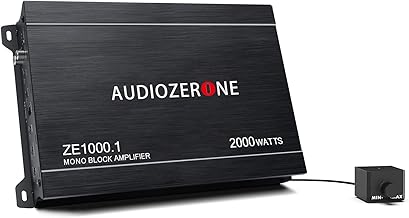
The AUDIOZERONE ZE1000.1 is a Class D MOSFET monoblock amplifier with a low-pass crossover and a listed 1–4-ohm stable range. Its stated output varies by load: 1,000 watts RMS at 1 ohm, 650 watts RMS at 2 ohms, and 400 watts RMS at 4 ohms. The product also lists 2,000 watts maximum at 1 ohm.
Best for: Buyers who want a mono subwoofer amplifier and need output figures for several impedance options. It was selected because the RMS ratings by load make it easier to compare with subwoofers than a maximum-watt label alone.
Limitation: Despite the 2,000-watt maximum figure in its name and specifications, its listed RMS output is 1,000 watts at 1 ohm. Choose it only if that continuous rating suits the planned subwoofer system.
Buying Guide: How To Match A 2000-Watt Amp And Speakers
Do you need a subwoofer amp or a speaker amp?
Start by deciding which speakers the amplifier will power. A monoblock amp has one output channel and is commonly selected for a subwoofer system. A four-channel amp can power several speaker channels independently, depending on the wiring and load requirements. The Skar, ORION, Taramps, and AUDIOZERONE models in this selection are monoblocks; the PRV model is four-channel.
Do not treat “amp and speakers” as a single specification. The listed products are amplifiers, and the supplied product information does not include a matched set of speakers or subwoofers. Select speakers separately by comparing their power handling, impedance, and intended use with the amplifier.
What does 2,000 watts mean on an amplifier?
Check whether a wattage figure is RMS or maximum/peak. RMS output is the more useful figure for comparing continuous amplifier power with speaker or subwoofer power handling. For example, the Skar listing gives 2,000 watts RMS at 1 ohm, while the ORION lists 2,000 watts maximum and 500 watts RMS. The AUDIOZERONE lists 2,000 watts maximum but 1,000 watts RMS at 1 ohm.
Always compare figures stated under the same conditions. An amplifier’s output can change with load impedance, and a system’s power distribution depends on channel configuration and wiring. A large number in a product name does not by itself establish how much continuous power reaches a particular speaker.
How should you match RMS power and impedance?
Look up the amplifier’s RMS output at the impedance you plan to use, then compare it with the speaker or subwoofer’s power-handling specifications. Check the final load after the drivers are wired together, not only the impedance printed on an individual driver. The amplifier must support that final load, and the speaker system must be appropriate for the resulting power.
For the PRV amp, the listed figures differ between individual-channel operation at 2 ohms and bridged operation at a minimum of 4 ohms per bridged channel. For the AUDIOZERONE, output varies from 1,000 watts RMS at 1 ohm to 400 watts RMS at 4 ohms. These examples show why the impedance-specific rating matters.
When is a four-channel amplifier the better choice?
A four-channel amplifier is worth considering when the goal is to power multiple speaker channels rather than a single subwoofer. The PRV MDX2000.4 lists four outputs at 500 watts RMS each at 2 ohms and provides a bridged configuration. Channel count, speaker load, and wiring determine how the available output is used, so plan those details before installation.
If the system’s main purpose is bass from a subwoofer, a monoblock may be a more direct match. Compare its frequency controls and RMS output with the subwoofer’s requirements. A four-channel label does not automatically make an amp suitable for every speaker combination, and a mono amp does not provide four independent speaker channels.
Which tuning controls are useful?
Filter controls help limit the frequencies sent to connected speakers. A low-pass filter is relevant to subwoofer setups, while a high-pass filter can limit lower frequencies sent to other speakers. Bass boost changes output around a selected frequency when provided. The Skar lists a bass EQ switch at 45Hz, the ORION lists low-pass adjustment and bass boost, and the Taramps lists variable high-pass and low-pass filters, gain, and bass boost.
These controls do not replace matching the amplifier to the speakers. Use settings appropriate to the connected drivers and their specifications. Where the product details provided here do not state a filter range or output condition, consult current product documentation rather than assuming a particular value.
What should you check before installation?
- Confirm the amplifier’s RMS rating at the intended impedance.
- Check the speaker or subwoofer power-handling and impedance specifications.
- Determine the final load created by the planned wiring configuration.
- For multi-channel or bridged use, follow the amplifier’s channel-specific impedance requirements.
- Review the product’s current installation instructions and required electrical connections.
- Choose a subwoofer-focused or full-range model based on the system’s actual role.
Do not select an amplifier solely because its headline wattage matches a speaker’s headline wattage. The rating type, load, channel configuration, and intended frequency range all affect whether the pairing is appropriate.
Frequently Asked Questions
Is a 2,000-watt amp always 2,000 watts RMS?
No. A 2,000-watt label may refer to maximum or peak output. Check the RMS rating and the impedance at which it applies. In this selection, the Skar lists 2,000 watts RMS at 1 ohm, while the AUDIOZERONE lists 2,000 watts maximum and 1,000 watts RMS at 1 ohm.
Can these amplifiers power speakers and subwoofers?
It depends on the model and system design. The PRV is a four-channel amplifier described for speaker systems. Several of the other models are monoblocks, commonly used for one subwoofer channel. Check frequency response, filters, impedance, and RMS power before connecting any speaker.
Which product is best for a four-speaker setup?
The PRV Audio MDX2000.4 is the four-channel choice in this list. Its product information states 4 x 500 watts RMS at 2 ohms. Confirm the individual speaker loads and wiring plan against its channel requirements.
Which amplifier has a listed 2,000 watts RMS?
The Skar Audio RP-2000.1D lists 2,000 watts RMS at 1 ohm, and the Taramps HD 2000 is described as a 2,000-watt RMS amplifier at 2 ohms. Their channel types and stated operating details differ, so compare the intended use and load before choosing.
Do I need speakers with exactly the same wattage as the amp?
No exact wattage match can be determined from the amplifier figure alone. Compare speaker power handling with the amplifier’s RMS output at the intended impedance, and account for how the system is wired. Follow the speaker and amplifier manufacturers’ specifications when selecting a pairing.