
The best amplifier-to-aux cable depends on the amplifier’s input: choose a 3.5mm-to-RCA cable for red-and-white RCA jacks, or a 3.5mm-to-1/4-inch cable for a large stereo jack. The JSAUX and UGREEN RCA cables suit amplifiers with RCA inputs, while the UGREEN and Highwings cables connect to 1/4-inch inputs. The VCE adapters are useful when you already have an aux cable and need a 1/4-inch connection.
| Product | Best For | Connection Type |
|---|---|---|
| JSAUX RCA to 3.5mm Cable | Color-coded RCA hookup | 3.5mm to dual RCA |
| UGREEN 3.5mm to 1/4 Cable | Durable 1/4-inch cable | 3.5mm to 6.35mm |
| Highwings Stereo Audio Cable | Flexible, braided cable | 3.5mm to 6.35mm |
| VCE 3.5mm to 1/4 Adapter | Reusing an existing aux cable | 3.5mm adapter to 6.35mm |
| UGREEN 3.5mm to RCA Cable | Home or professional RCA hookups | 3.5mm to dual RCA |
JSAUX RCA to 3.5mm Cable

The JSAUX cable connects a device with a 3.5mm audio output to equipment with left and right RCA inputs. Its 6.6-foot length can provide reach between a phone, tablet, or other playback device and an amplifier or receiver, depending on how the equipment is arranged.
- Best for: People who want a clearly marked left-and-right RCA hookup.
- Connection: 3.5mm plug to two RCA male connectors.
- Listed features: Gold-plated connectors, dual shielding, an oxygen-copper wire core, and grips on the RCA plugs.
Choose this cable if the amplifier has separate red and white RCA input jacks and the source has a 3.5mm headphone or line output. The color-marked plugs make it easier to match the left and right channels. The manufacturer describes it as bi-directional, but the connected equipment still needs to provide a compatible audio output and input.
Limitation: This cable does not connect directly to an amplifier that only has a 1/4-inch input. Check the amplifier’s jacks before choosing it.
UGREEN 3.5mm to 1/4 Cable

This 6.6-foot cable has a 3.5mm male plug at one end and a 6.35mm, or 1/4-inch, male plug at the other. It is intended for connecting a playback device with a standard 3.5mm output to audio equipment with a 1/4-inch stereo connection.
- Best for: Buyers who need a direct cable between 3.5mm and 1/4-inch ports.
- Listed features: 24K gold-plated connectors, double shielding, a copper core, zinc-alloy housing, and a braided nylon exterior.
- Useful distinction: The two ends are different sizes, so no separate adapter is needed for that connection.
Choose this cable if the amplifier or other audio device has a 1/4-inch stereo input and the source has a 3.5mm output. Its braided exterior and zinc-alloy casing are relevant for setups where the cable may be moved or handled often. UGREEN notes that stereo playback depends on the source device supporting stereo processing.
Limitation: It is not the right choice for an amplifier with only RCA inputs. Also confirm that the 1/4-inch jack is suitable for the stereo connection you need.
Highwings 3.5mm to 6.35mm Cable
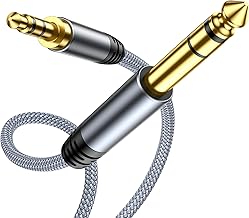
The Highwings cable is a six-foot option for connecting a 3.5mm source to a 6.35mm stereo port. The listed examples include devices with 3.5mm ports and audio equipment such as a keyboard, guitar, amplifier, or headphones with a 6.35mm connection.
- Best for: Buyers who want a braided 1/4-inch cable and do not need extra length beyond six feet.
- Listed features: Gold-plated connectors, a silver wire core, a copper shell, double-braided nylon, and a stated 15,000-plus bend lifespan.
- Connection: 3.5mm male to 6.35mm male.
Choose this cable if the source has a 3.5mm output and the amplifier has a matching 6.35mm stereo input. The double-braided exterior is a practical feature for frequent handling, while the six-foot length is a straightforward fit for nearby equipment.
Limitation: The product is a direct 3.5mm-to-6.35mm cable, not a dual-RCA cable. It will not plug into an amplifier that lacks a 6.35mm input.
VCE 3.5mm to 1/4 Adapter

The VCE product is a two-pack of adapters, rather than a complete cable. Each adapter lets a 3.5mm plug connect to a 6.35mm stereo port. It can be useful if you already own an aux cable with a 3.5mm plug and want to connect it to equipment with a 1/4-inch jack.
- Best for: Buyers who want to adapt an existing 3.5mm cable instead of purchasing a dedicated cable.
- Listed features: 24K gold-plated connectors, solid brass construction, a TRS interface, and knurled grip treads.
- Pack format: Two adapters are included, according to the product name.
Choose this option when minimizing extra cable purchases matters and the existing aux cable is long enough for the setup. The grip design can help when plugging or unplugging the adapter in a tight space behind audio equipment.
Limitation: An adapter does not add cable length. It also does not convert a 3.5mm connection to RCA; confirm that the amplifier has a 6.35mm stereo port.
UGREEN 3.5mm to RCA Cable

This 6.6-foot UGREEN cable connects a source’s 3.5mm output to two RCA inputs. The product description presents it for home or professional audio connections, including connecting a mobile device’s headphone jack to a sound system with RCA ports.
- Best for: People connecting a 3.5mm source to an amplifier, receiver, or other system with left and right RCA inputs.
- Listed features: Gold-plated connectors, copper conductors, a flexible PVC jacket, and a claimed 10,000-plus bend lifespan.
- Connection: 3.5mm plug to two RCA male plugs.
Choose this cable if you want a direct RCA connection and a flexible jacket for routing around home audio equipment. It serves the same basic connection type as the JSAUX cable, so compare their listed construction features and choose according to your routing and handling needs.
Limitation: This cable is not a 1/4-inch solution. It also requires an available 3.5mm audio output on the source and compatible RCA inputs on the amplifier.
Buying Guide: How to Choose an Amplifier-to-Aux Cable
Which input does the amplifier have?
Start by inspecting the amplifier’s input panel. The connector on the amplifier—not the word “aux” alone—determines which cable you need. A 3.5mm aux cable is a common output from phones, tablets, and portable audio players, but amplifiers may accept audio through RCA jacks or a larger 6.35mm jack.
- Two RCA inputs: Choose a 3.5mm-to-dual-RCA cable, such as the JSAUX or UGREEN RCA option.
- A 6.35mm stereo input: Choose a 3.5mm-to-6.35mm cable, such as the UGREEN or Highwings option.
- An existing 3.5mm cable and a 6.35mm input: The VCE adapter may be sufficient.
Look for labels such as “AUX,” “LINE IN,” or channel markings near the input, but verify the physical connector size and configuration. Do not confuse an amplifier’s audio input with a speaker output. Speaker terminals are not the same as line-level audio inputs and require a different connection approach.
Do you need RCA, 1/4-inch, or a different connection?
RCA inputs usually appear as a pair of red and white jacks. A stereo RCA cable uses one plug for each channel. A 6.35mm jack is larger than the 3.5mm plug commonly used for headphones and portable devices. The products in this list connect 3.5mm sources to either RCA inputs or 6.35mm ports.
Check the equipment manuals or labels if the input is unclear. A product listing’s phrase “stereo” does not mean every 1/4-inch jack on every device is configured identically. Make sure the amplifier’s port accepts the connection type you intend to use.
Should you buy a cable or an adapter?
A complete cable is usually the simplest choice when the source and amplifier are separated by some distance. It provides the required connector at each end and a set length. A short adapter can be a compact solution when you already have a suitable aux cable, but it cannot extend that cable or change the amplifier’s input type.
For example, the VCE adapters suit an existing 3.5mm cable and a 6.35mm stereo port. They do not provide a 3.5mm-to-RCA connection. If your amplifier has red and white RCA inputs, select one of the dual-RCA cables instead.
How much cable length do you need?
Measure the route from the source to the amplifier, allowing a little slack at both ends. A cable that is too short can put strain on the plugs, while excess length may be harder to route neatly. The listed full cables here are six or 6.6 feet long. The VCE adapters have no cable length of their own.
Consider where the cable will run. A cable routed behind furniture may need more reach than one connecting devices on the same shelf. Keep the cable away from walkways where possible, and avoid pulling it tightly around corners or equipment.
What construction features matter?
Construction details can help narrow choices when two cables have the same connectors. The listed products describe features such as shielding, gold-plated connectors, copper conductors, braided exteriors, flexible PVC, and reinforced housings. These are the manufacturers’ stated specifications; they do not guarantee a particular sound improvement in every setup.
For frequent handling, compare the jacket and strain-protection details. For a fixed installation, connector type and length may matter more. No cable can correct a mismatch between the source output and the amplifier input, so compatibility should come before material claims.
How do you connect a 3.5mm source to an amplifier?
- Identify the source output. Confirm that the playback device has a 3.5mm audio output.
- Identify the amplifier input. Check whether it uses RCA or a 6.35mm stereo jack.
- Choose the matching cable. Use dual RCA plugs for RCA inputs or a 6.35mm plug for the matching port.
- Connect the plugs securely. For RCA, match red and white plugs to the corresponding channel jacks.
- Set playback and amplifier levels cautiously. Start at a low volume and adjust gradually to avoid an unexpectedly loud signal.
If there is no sound, check that the amplifier is set to the input you used, that the source is playing, and that both ends are fully inserted. Also confirm that the selected source output is active and that the cable matches the ports.
Frequently Asked Questions
Can I connect a phone’s aux output to an amplifier?
Yes, if the amplifier has a compatible audio input. Use a 3.5mm-to-RCA cable for paired RCA inputs or a 3.5mm-to-6.35mm cable for a compatible 1/4-inch input. Confirm that the phone or other source provides audio through its 3.5mm port.
Which cable connects 3.5mm to red and white RCA inputs?
Choose a 3.5mm-to-dual-RCA cable, such as the JSAUX or UGREEN RCA cable listed above. Match the red and white plugs to the corresponding RCA jacks.
Is a 3.5mm-to-1/4-inch cable the same as an RCA cable?
No. A 3.5mm-to-1/4-inch cable has a 6.35mm plug at one end. An RCA cable has two separate RCA plugs, typically marked red and white. Choose based on the amplifier’s actual input ports.
Can I use an adapter instead of buying a cable?
Yes, if you already have a 3.5mm cable and need to connect its plug to a compatible 6.35mm stereo port. The VCE product is an adapter, not a full-length cable, and it does not convert the connection to RCA.
Will any 3.5mm-to-1/4-inch cable provide stereo sound?
Not automatically. The source and receiving equipment must both support the intended stereo connection. The UGREEN listing specifically notes that stereo output depends on the playback device supporting stereo processing. Check the equipment specifications if channel behavior is important.