
The best beginner keyboard for a child depends on whether the priority is simple musical play, guided lessons, or a fuller starter setup. The BIGFUN and Dollox models suit younger children who want a compact 37-key instrument, while the RockJam and pink 61-key keyboard offer more keys and beginner accessories. The Vangoa stands out for lighted-key lessons and a large sound library. Compare the key count, teaching tools, and included accessories before choosing.
| Keyboard | Best For | Standout Feature |
|---|---|---|
| BIGFUN 37-Key | Simple musical play | Recording and playback |
| RockJam RJ561 | A ready-to-practice setup | Stand, stool, headphones, and stickers |
| Pink 61-Key Kids Keyboard | Creative play with learning modes | Microphone and 100 tones and rhythms |
| Vangoa VGK611 | Guided beginner practice | Lighted keys with three teaching modes |
| Dollox 37-Key | Small spaces and younger beginners | Tabletop or stool setup |
BIGFUN 37-Key Kids Piano

The BIGFUN is best for a child who is starting with casual music-making rather than formal lessons. Its 37 keys offer a straightforward playing area, and its range of built-in sounds and activities can help keep early exploration varied.
Listed features include eight tones, eight rhythms, six demo songs, four percussion sounds, ensemble mode, and keyboard drums. A record-and-playback function lets children hear a saved performance. Dual speakers provide onboard sound, and an audio cable jack is also listed.
- Best for: Younger beginners who want several play modes in a compact keyboard.
- Why it stands out: It combines basic piano playing with rhythm, percussion, and recording features.
- Consider: Its 37 keys provide less range than the 61-key choices, so it may be limiting for lessons that use more of the keyboard.
The listed power arrangement uses a USB power cord connected to a 5V-1A USB adapter. The adapter itself is not specified as included in the supplied product details, so check what is in the package if a power adapter is needed.
RockJam RJ561 61-Key Keyboard Kit
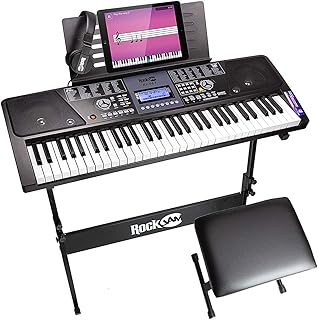
The RockJam RJ561 is best for families looking for a keyboard-and-accessory set for a beginner. Its 61 keys give a child more range to explore than a 37-key mini keyboard, and the listed kit includes a stand, stool, headphones, and key stickers.
It features 100 rhythms and 50 tones, as well as teaching functions and demo songs. The included stickers and lesson access guide are intended to help learners follow notes as they practice. These features make it a practical choice when a family wants accessories and learning aids included together.
- Best for: Beginners who need a keyboard setup with a place to sit and play.
- Why it stands out: The stand, stool, headphones, and stickers are part of the listed kit, alongside teaching functions.
- Consider: The product details do not specify the exact teaching method or lesson content, so review the available lesson information before relying on it as a curriculum.
Choose this model if a larger key range and bundled practice accessories matter more than lighted-key instruction. It is also described as suitable for adults, which may appeal to a household where more than one person plans to use the keyboard.
Pink 61-Key Kids Keyboard

This pink 61-key keyboard is best for children who want a full-size key count for beginner practice alongside creative play. Its listed target age is 3–10, and the package details include a microphone, music stand, key stickers, and adapter to help a child begin using the instrument.
The keyboard offers 100 tones, 100 rhythms, 10 demo songs, teaching mode, recording, sustain, tremolo, and drum sounds. Its dual speakers and LCD display are listed as controls for selecting sounds and rhythms. The microphone can add a performance element, while the stickers offer a visual aid for note identification.
- Best for: Children who want a 61-key instrument with a microphone and multiple play features.
- Why it stands out: It combines teaching mode and recording with a broad selection of tones and rhythms.
- Consider: The product information does not name a brand or explain how its teaching mode works, so compare the instructions and controls if structured lessons are a priority.
Choose this if a child is likely to enjoy switching between practice and imaginative music-making. If the main goal is following illuminated notes, the Vangoa’s listed lighted-key modes are a more direct match.
Vangoa VGK611 Lighted-Key Keyboard

The Vangoa VGK611 is best for a child who may benefit from visual guidance while learning. It has 61 unweighted ABS keys and three teaching modes. The listed lighted-key function guides the player through demo-note order, and the tempo can be adjusted from slow to fast.
Its feature list includes up to 350 timbres and rhythms, 30 demo songs, eight percussion sounds, and a large LED screen that displays music notes. Sustain, vibrato, dual keyboard, chord, recording, and playback functions provide additional ways to practice and create. A microphone is also listed as included.
- Best for: Beginners who want lighted-key practice and several teaching modes.
- Why it stands out: Its teaching lights, tempo control, and note display provide more explicit learning cues than a keyboard that relies on stickers alone.
- Consider: Its keys are unweighted, so choose another instrument if weighted keys are a requirement.
The lighted keys can make the first steps more approachable, but the number of sounds is not a substitute for instruction. For a simpler toy-style keyboard, the 37-key options may be easier to store and operate.
Dollox 37-Key Keyboard With Stool

The Dollox is best for a younger beginner who needs a small keyboard that can be set up on a table or used with its included legs and stool. The product description lists 37 black and white keys and says the instrument can be played flat or assembled with the table legs and stool.
Its features include eight instrument tones, eight accompaniment styles, eight percussion effects, 22 demo songs, and record-and-playback functionality. Adjustable volume and rhythm are also listed. The product is described as compact and easy to store, making its flexible setup relevant for households with limited room.
- Best for: Children who want an introductory keyboard with a stool and flexible placement.
- Why it stands out: The tabletop and assembled configurations allow the keyboard to suit different play spaces.
- Consider: Its 37-key range may be less suitable for lessons or songs that require more keys than a compact beginner instrument provides.
Choose the Dollox over the BIGFUN if the included stool and table-leg setup are priorities. Choose the BIGFUN if its listed audio jack, ensemble mode, and double speakers better match the desired play features.
Buying Guide: How To Choose A Child’s First Keyboard
How many keys should a beginner keyboard have?
Start with the child’s intended use. A 37-key keyboard can work well for early exploration, simple melodies, and play in a smaller area. Both the BIGFUN and Dollox use this key count. A 61-key keyboard gives more room to play a wider range of notes and may be a better fit when the child plans to follow lessons or continue learning.
More keys do not automatically make a keyboard easier to learn. A younger child who is mainly exploring sounds may prefer a simple layout, while a child working through lessons may benefit from the additional range. Consider the music or lesson materials the child will use before choosing.
Are lighted keys or stickers better for learning?
Lighted keys provide visual cues directly on the keyboard. The Vangoa lists three teaching modes and lighted-key guidance, making it the clearest choice among these options for a child who wants visual prompts. Key stickers, included with the RockJam and pink keyboard, label keys with a separate visual reference.
Neither feature alone guarantees progress. A parent can help a child connect key labels or lights to musical notes and encourage repeated practice. If the child is easily distracted by many effects, a simpler instrument or a limited set of sounds may be easier to focus on.
Which accessories should families look for?
Check whether the package includes the items needed for the planned setup. The RockJam kit lists a stand, stool, headphones, and stickers. The pink 61-key keyboard lists a microphone, music stand, stickers, and adapter. The Dollox includes a stool and legs for an alternate setup, while the BIGFUN’s power description specifies a USB power cord and a 5V-1A adapter requirement.
Confirm package contents and power needs on the product listing before purchase. The supplied details do not establish that every accessory mentioned in a feature description will suit every child’s preferred setup, so match the listed items to what the household already has.
Do sound effects and rhythms matter?
Extra tones, rhythms, percussion, and demo songs can make a beginner keyboard more engaging. The pink model and Vangoa list especially broad sound libraries, while BIGFUN and Dollox offer more compact sets of tones and rhythms. For a child who enjoys experimentation, variety may be useful. For focused note practice, teaching features and a comfortable playing setup may matter more.
Recording and playback are useful features to compare if a child likes hearing their own creations. BIGFUN and Dollox list those functions, as does the pink keyboard and Vangoa. These features support creative play, but they do not replace guided instruction or regular practice.
Should the keys be weighted?
Key feel is worth considering if the child is learning piano technique or may move to another instrument later. The Vangoa specifically describes its keys as unweighted. The supplied information does not state whether the other keyboards have weighted keys, so do not assume they do. If weighted keys are essential, verify that specification directly before buying.
For a first instrument intended mainly for exploration, families may prioritize size, teaching aids, and accessories instead. For formal lessons, ask the child’s instructor whether a particular key count or key action is recommended.
What is a sensible way to compare the five options?
- Choose BIGFUN for a compact 37-key keyboard with recording, rhythms, and an audio jack.
- Choose RockJam for a 61-key kit that lists a stand, stool, headphones, and note stickers.
- Choose the pink 61-key model for a microphone, teaching mode, and a broad set of tones and rhythms.
- Choose Vangoa for lighted keys, three teaching modes, and a note display.
- Choose Dollox for a 37-key option with a stool and tabletop or assembled placement.
Frequently Asked Questions
What is a good first keyboard for a young child?
A 37-key model such as BIGFUN or Dollox can suit a young child who is beginning with simple play. Consider a 61-key model if the child is starting lessons or needs more playing range.
Is a 61-key keyboard enough for a beginner?
A 61-key keyboard provides more range than the 37-key options in this selection and is a practical starting point for many beginners. Check the requirements of the child’s lessons or music before choosing.
Which keyboard has lighted keys?
The Vangoa VGK611 lists lighted keys and three teaching modes. The other supplied product descriptions emphasize features such as stickers, teaching functions, tones, rhythms, or demo songs instead.
Which models include a stool?
The RockJam RJ561 kit lists a stool and stand. The Dollox lists a stool and legs that allow its keyboard to be used in an assembled setup.
Can a child use a keyboard without formal lessons?
Yes. A child can explore sounds, rhythms, demo songs, and recording features without formal lessons. For structured note-reading and technique, consider teaching aids or lessons suited to the child’s age and goals.