
The best true bypass EQ pedal depends on how much frequency control you need and how much pedalboard space you can spare. The EX 7-Band EQ is a compact choice for focused guitar adjustments, while the JOYO 10-Band Graphic EQ offers broader control and an independent volume slider. The JOYO 6-Band suits players who want illuminated controls, and the Donner gives guitarists and bassists ten bands in a compact format. Compare the key differences below before choosing.
| Pedal | Best For | Key Feature |
|---|---|---|
| EX 7-Band EQ | Compact guitar setups | Seven bands, ±15 dB, true bypass |
| JOYO 6-Band EQ JF-11 | Visible stage adjustments | Illuminated sliders, ±18 dB |
| Donner EQ Seeker | Flexible guitar and bass shaping | Ten bands, ±15 dB |
| IOppWin 5-Band EQ | Small pedalboards | Five bands, ±18 dB, master level |
| JOYO 10-Band R-12 | Detailed guitar and bass EQ | Ten bands, independent volume |
EX 7-Band EQ Equalizer Mini Pedal
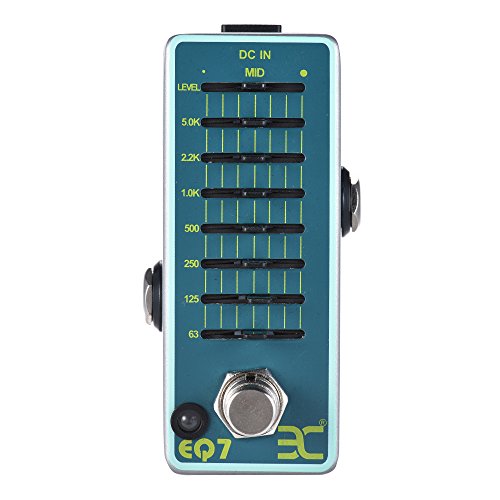
The EX is best for guitarists who want practical tone correction without giving up much pedalboard space. Its seven adjustable frequency bands run from 63 Hz to 5 kHz, with up to ±15 dB of boost or cut per band. This range can help players reduce muddy low frequencies, emphasize mids, or adjust treble detail.
The pedal uses true bypass switching, so the signal is described as unaltered when the effect is disengaged. Its compact dimensions, metal casing, and non-slip rubber feet make it a space-conscious option for a board used at rehearsals or onstage. An LED indicates whether the pedal is on or off.
- Best for: Guitarists seeking seven-band adjustment in a mini format.
- Why it stands out: It combines a useful frequency range, ±15 dB control, and true bypass.
- Limitation: Its seven bands provide less detailed adjustment than a 10-band EQ.
JOYO 6-Band EQ JF-11

The JOYO JF-11 is best for players who want visible, straightforward EQ controls for a guitar rig. Its six bands target 100 Hz, 200 Hz, 400 Hz, 800 Hz, 1.6 kHz, and 3.2 kHz. Each slider offers ±18 dB of boost or cut, providing more adjustment per band than the EX model.
Illuminated sliders are designed to make settings easier to see on dark stages. The center detents help identify the neutral position by feel, which can be useful when making adjustments between songs. The pedal also features true bypass switching.
- Best for: Guitarists who value clearly visible controls and strong adjustment at six selected frequencies.
- Why it stands out: Its illuminated sliders, center detents, and ±18 dB range support quick, readable changes.
- Limitation: The listed frequency range is guitar-focused, so it has fewer bands and less low-to-high coverage than a 10-band model.
The product information recommends a regulated 9V DC power supply to help minimize noise and switch pop; the supply is not included. Consider that requirement when planning a pedalboard power setup.
Donner EQ Seeker 10-Band Pedal

The Donner EQ Seeker is best for players who want ten frequency bands and a compact pedal. Its graphic equalizer is described as suitable for any instrument, making it a flexible option for guitarists or bassists who want more adjustment points than a five-, six-, or seven-band unit provides.
Each band has a ±15 dB adjustment range, and the product description lists sliders for output level and EQ level control. The pedal’s compact size is useful when a board has limited room but still needs a multi-band equalizer. Its product name identifies it as a true bypass EQ pedal.
- Best for: Guitar and bass players who want ten bands in a compact pedal.
- Why it stands out: Ten sliders offer more points for shaping the signal than the simpler EQ options here.
- Limitation: The supplied feature details do not identify the individual frequency values, so check the product listing if exact frequency points are important.
Choose the Donner if the number of bands and compact footprint matter more than having fully specified frequency ranges in the available product information. Its ±15 dB range is suitable for noticeable boosts or cuts, but detailed settings still depend on the frequency assigned to each slider.
IOppWin 5-Band Graphic EQ Pedal

The IOppWin is best for guitarists who need a small EQ pedal with a master level control. Its five frequency bands are set at 100 Hz, 250 Hz, 630 Hz, 1.6 kHz, and 4 kHz. Each band allows up to ±18 dB of adjustment, giving players substantial control across selected low, middle, and high frequencies.
The product description highlights a compact design and a rugged metal shell. It also lists true bypass switching, which is relevant for players who want the pedal removed from the active signal path when switched off. The master level control provides an additional way to adjust the output alongside the individual frequency sliders.
- Best for: Players with limited board space who want a compact EQ with level adjustment.
- Why it stands out: It combines five specified bands, ±18 dB adjustment, true bypass, and a metal enclosure.
- Limitation: Five bands give less frequency-by-frequency control than the 10-band options.
Choose this model when a smaller set of controls is preferable to a detailed graphic EQ. Avoid it if your main priority is making narrow adjustments across a wide range of bass and treble frequencies, since its listed bands are fewer than those on a 10-band pedal.
JOYO 10-Band Graphic EQ R-12

The JOYO R-12 is best for guitarists and bassists who want broad frequency coverage and separate control of output volume. Its ten bands span 31.25 Hz to 16 kHz, with listed center frequencies from 31.25 Hz through 16 kHz. That range gives it more adjustment points across lows, mids, and highs than the six-band JOYO JF-11.
A dedicated master volume slider adjusts output independently of the EQ settings. The ten frequency sliders are LED-backlit for visibility, and the product description identifies a neutral detent position for flat response when the controls are centered. It is listed as a true bypass pedal and is described for use with guitar, bass, and synth rigs.
- Best for: Players who need wide-ranging EQ and independent output-level control.
- Why it stands out: Ten bands, 31.25 Hz–16 kHz coverage, illuminated sliders, and a master volume slider offer broad control.
- Limitation: Its power supply is not included; the product recommends a regulated, isolated 9V supply to help reduce hum.
The R-12 is the most flexible choice in this selection for players who want to shape a wider range of frequencies. It can also be placed in different parts of a signal chain according to the product description, including before overdrive or in an amp’s effects loop.
Buying Guide: How To Choose A True Bypass EQ Pedal
A true bypass EQ pedal gives you a way to shape frequencies when engaged while routing the signal through a bypass path when switched off. The five pedals above list true bypass, but they differ in frequency coverage, number of bands, gain range, size, and controls. Start with the way you plan to use the pedal: quick correction, detailed tone shaping, output matching, or a space-saving addition to a crowded board.
How Many EQ Bands Do You Need?
More bands provide more adjustment points, but they also mean more sliders to set. A five- or six-band pedal can be easier to operate when you have a few repeatable changes in mind. Seven bands offer a middle ground. A 10-band pedal is better for players who want more detailed control across the frequency spectrum.
- Five or six bands: Consider the IOppWin or JOYO JF-11 for a simpler set of frequency controls.
- Seven bands: Consider the EX for a compact pedal with a broader selection than a basic EQ.
- Ten bands: Compare the Donner and JOYO R-12 for more adjustment points; the R-12 lists its frequency values and span.
Which Frequency Range Fits Your Instrument?
Check the actual frequency values, not just the band count. The JOYO R-12 lists coverage from 31.25 Hz to 16 kHz and is described for guitar and bass. The EX lists seven bands from 63 Hz to 5 kHz. The JOYO JF-11 lists six guitar-optimized bands from 100 Hz to 3.2 kHz, while the IOppWin specifies five bands from 100 Hz to 4 kHz. The Donner is described for any instrument, but its provided feature details do not specify its individual frequencies.
Do You Need A Master Volume Slider?
A master volume control adjusts output level separately from the frequency sliders. This can help when you want to match the pedal’s engaged volume to its bypassed level or create a level change for a particular part. The JOYO R-12 and IOppWin list a master or output-level control. The Donner feature list also refers to output level and EQ level controls. Check the controls on the exact model you are considering if this function is essential.
What Does The Boost/Cut Range Tell You?
The boost/cut figure describes how much each frequency band can be raised or reduced. The EX and Donner list ±15 dB, while the JOYO JF-11 and IOppWin list ±18 dB. A larger number indicates a wider adjustment range, but it does not automatically make a pedal the right choice. Consider whether you need strong changes or prefer smaller corrections, and compare the frequency values alongside the range.
Will The Pedal Fit Your Board And Power Setup?
Compare the pedal’s footprint with the space available on your board. The EX is specifically described as a mini pedal, and the IOppWin is also presented as a compact option. The JOYO JF-11 and R-12 have illuminated sliders, which may help with stage visibility. Power requirements also matter: the JOYO JF-11 recommends regulated 9V DC power, and the JOYO R-12 product information recommends regulated, isolated 9V power. Their listed power supplies are not included.
Frequently Asked Questions
What Is A True Bypass EQ Pedal?
A true bypass EQ pedal routes the signal through a bypass path when the effect is disengaged. This is intended to keep the EQ circuit out of the active signal path while the pedal is off. The product descriptions for the models in this article identify them as true bypass.
Can An EQ Pedal Be Used With Bass?
Some EQ pedals are specifically described for both guitar and bass. The Donner EQ Seeker is described as suitable for any instrument, and the JOYO R-12 is described for guitar and bass. Check the listed frequency range and controls to confirm that they suit your intended setup.
Is A 10-Band EQ Better Than A 6-Band EQ?
A 10-band EQ offers more frequency adjustment points, while a six-band pedal may be simpler to set. Neither is automatically better for every player. Choose based on how precise your adjustments need to be and whether you prefer fewer controls or broader coverage.
Does True Bypass Mean A Pedal Cannot Produce Noise?
No. True bypass describes the signal path when the pedal is off; it does not guarantee that the pedal will be noise-free when engaged or eliminate noise elsewhere in a rig. Power supplies, other pedals, cables, and gain settings can also affect noise.
Should All EQ Sliders Be Set To The Center?
Center positions generally represent no boost or cut for their corresponding bands. The JOYO R-12 specifically describes a neutral detent position and flat response when its sliders are centered. Use centered settings as a starting point, then adjust frequencies to suit your instrument and sound goals.