
The right AM/FM tuner setup depends on whether you need a complete radio, a component for an existing stereo, or an antenna to improve reception. The Facmogu is best for adding FM tuning to a home audio system, while the DORHEA antenna is aimed at improving AM reception on a compatible receiver. The portable SWDSTP and Pyle marine receiver are complete radios; the Rolls is an FM-only component tuner.
| Product | Best For | Important Detail |
|---|---|---|
| SWDSTP Mini Portable Radio | Walking and jogging | Portable AM/FM radio with rechargeable power |
| Pyle Marine Receiver | Marine stereo upgrades | Single-DIN AM/FM receiver with Bluetooth and media inputs |
| DORHEA AM Loop/FM Dipole Antenna | AM reception on a home stereo | Check the receiver’s antenna connection before buying |
| Facmogu Si4730 FM Receiver | Adding FM to a home audio setup | FM tuner with Type-C and 3.5 mm audio connections |
| Rolls HRS84 FM Digital Tuner | FM audio equipment setups | FM-only tuner with XLR and RCA outputs |
SWDSTP Mini Portable AM/FM Radio
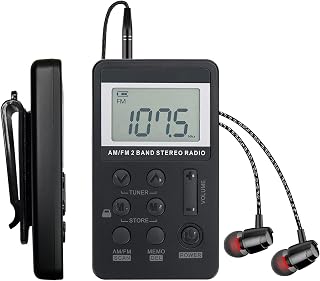
Best for: People who want to listen to AM or FM radio while walking, jogging, or moving around. This is a ready-to-use personal radio rather than a tuner component for an existing stereo.
Listed features include digital tuning, an LCD display, headphones, a back clip, easy key operation, and rechargeable power. Its pocket-oriented design and included headphones make it the most portable choice in this group. Choose it if mobility and simple radio listening matter more than connecting a tuner to a home audio system.
Limitation: The product information describes a personal radio, not a kit for upgrading a stereo. Buyers seeking component outputs or an external antenna connection should verify those requirements before choosing it.
Pyle Single-DIN Marine Radio Receiver

Best for: Buyers seeking a radio receiver for a marine stereo upgrade who also want Bluetooth and playback options. The listed features include an AM/FM tuner, Bluetooth wireless streaming, USB and AUX MP3 playback, hands-free calling, a remote control, RGB buttons, and a splash-resistant design.
Compared with a standalone home tuner, this receiver combines broadcast radio with several audio sources in a single-DIN format. Choose it if those features suit your intended installation and you want more than AM/FM reception alone.
Limitation: The listing does not provide installation dimensions, wiring details, or a complete compatibility list. Confirm that the receiver suits the vehicle or vessel and the planned installation before buying. Splash resistance should not be treated as proof that the unit is waterproof.
DORHEA AM Loop And FM Dipole Antenna

Best for: Home stereo owners who already have a receiver and want an antenna accessory, particularly for AM reception. The listed features describe an AM loop intended to improve AM signal stability and clarity, plus an FM dipole antenna.
The antenna is designed to connect to compatible receiver antenna jacks. Its stated connectors are a standard two-pin tin-plated bare-wire connector for AM and a 75-ohm FM antenna with an F-type male connector. Choose it if those connection types match your equipment and you need an antenna rather than a complete tuner.
Limitation: Connector fit matters. Check the receiver’s AM and FM antenna inputs before ordering; the listed connector details do not establish compatibility with every stereo receiver.
Facmogu Si4730 FM Radio Receiver

Best for: People who want a compact FM receiver for a home stereo or other audio setup that can use a 3.5 mm audio connection. The product is described as a professional Si4730 mini FM tuner with a 33-foot cable antenna, global FM frequency support, a Type-C interface, and 3.5 mm audio output.
Choose this if FM is the priority and the listed audio and power interfaces suit your setup. The included long antenna cable may be useful when the tuner and a suitable reception position are not close together.
Limitation: The supplied product description identifies this as an FM receiver, not an AM/FM tuner. Avoid it if AM reception is essential, and verify how the Type-C interface is used for your intended setup.
Rolls HRS84 FM Digital Tuner

Best for: Buyers who need a dedicated FM tuner with both XLR and RCA outputs. Listed features include digital tuning, output-level control, and the two output types, making this a component-style option rather than a pocket radio or antenna accessory.
Choose the HRS84 if your audio setup needs an FM source and can accept its available outputs. Its output-level control is a useful listed feature when adjusting the tuner’s signal level in a system.
Limitation: This product is identified as an FM tuner, so it is not the right choice for listeners who require AM. The listed information does not specify all connection or installation requirements; check your equipment before purchasing.
Buying Guide: How To Choose An AM/FM Tuner Kit
Do you need a tuner, a complete radio, or an antenna?
These product types do different jobs. A complete radio has its own tuning controls and is ready for personal listening. A tuner component receives radio broadcasts and sends audio to another system. An antenna connects to a compatible tuner or receiver to help receive signals; it does not tune stations by itself.
Start by identifying what you already own. If your stereo has no radio function, consider a tuner or a receiver that can connect to it. If the stereo already tunes stations but reception is weak, an antenna may be the more relevant purchase. If you want radio while walking, a portable radio is a better fit than a component kit.
Is AM, FM, or both required?
Check the band specification before ordering. The SWDSTP and Pyle listings identify AM/FM reception. The DORHEA product combines an AM loop and FM dipole antenna. The Facmogu and Rolls listings describe FM tuners, so they should not be selected when AM listening is required.
Also distinguish between a tuner and an antenna that supports AM and FM. A dual-band antenna cannot add AM tuning to an FM-only receiver. The receiver itself must support the stations and bands you plan to use.
Will the connections work with your equipment?
Compare the product’s listed outputs or antenna connectors with the inputs on your stereo. The Rolls has XLR and RCA outputs; the Facmogu has a 3.5 mm audio output and a Type-C interface. The DORHEA antenna lists a two-pin bare-wire AM connection and an F-type male FM connector.
For the Pyle receiver, confirm that the single-DIN format and installation requirements suit the intended location. Do not assume a connector will fit just because two products are described as audio equipment. When details are missing, check the manufacturer’s documentation or ask the seller before purchasing.
Where will you listen?
For portable listening, prioritize a self-contained radio with suitable controls and a carrying method. The SWDSTP’s back clip, headphones, rechargeable design, and digital tuning target this use. For a marine or vehicle installation, a receiver designed for that context may be more appropriate, but verify the mounting and wiring requirements.
For home use, decide whether you want a new radio source for a stereo or only an antenna. A component tuner needs a suitable audio connection to the rest of the system. An antenna needs a compatible receiver input and a placement that works in the intended room.
What should you know about reception?
Reception depends on more than the tuner. Location, nearby obstructions, antenna placement, and local station strength can affect the signal. An antenna marketed to improve reception is not a guarantee that every station will come in clearly. Before buying, check whether the antenna connection matches your receiver and whether you can position it appropriately.
For an FM dipole, placement can matter; for an AM loop, follow the receiver and antenna instructions. If you have a reception problem on only one band, identify whether the receiver, its existing antenna, or the local signal is the likely issue before replacing equipment.
Which option is the closest match?
| Your Need | Product Type To Consider | Check Before Buying |
|---|---|---|
| Radio while walking or jogging | Portable AM/FM radio | Controls, headphones, power, and carrying style |
| Radio for a marine stereo upgrade | Single-DIN AM/FM receiver | Mounting, wiring, and installation suitability |
| Better AM/FM reception on an existing stereo | AM loop/FM dipole antenna | AM and FM connector compatibility |
| Add FM to an audio setup | FM tuner component | Band support and audio output connection |
Frequently Asked Questions
What does an AM/FM tuner kit usually include?
The term can refer to different setups, including a tuner component, an antenna, or a complete radio. Check the item description to see whether it includes the tuner, antenna, audio connections, and power components you need.
Can an AM/FM antenna add AM tuning to an FM-only tuner?
No. An antenna can receive signals for a compatible device, but it cannot add a radio band the tuner does not support. Choose an AM/FM receiver if you need both bands.
Is the DORHEA antenna a complete radio?
No. It is an AM loop and FM dipole antenna accessory. It must connect to a compatible receiver or stereo that can tune radio stations.
Which listed product is portable?
The SWDSTP is described as a rechargeable pocket radio with headphones, an LCD display, digital tuning, and a back clip. The other options are a receiver, antenna, or tuner component.
Which products listed here are FM-only?
The Facmogu Si4730 and Rolls HRS84 are described as FM tuners. Choose a product explicitly identified as AM/FM if you need both bands.