
The best 4-pin stereo jack depends on whether you need a panel-mount socket, a PCB connector, or a cable adapter. For a 3.5 mm four-pole connection, the RLECS socket suits panel installations, the uxcell set is intended for PCB mounting, and the Poyiccot adapter connects a TRRS plug to screw terminals. The KAISH option is a 1/4-inch guitar jack, so it is relevant only if your project needs that larger format.
| Product | Best suited for | Connection type |
|---|---|---|
| RLECS 10-piece socket | Panel-mounted 3.5 mm connections | Female, 4-pole |
| Poyiccot adapter | Connecting a TRRS plug to screw terminals | Male, 3.5 mm to terminal block |
| uxcell PJ-320A sockets | PCB repairs and builds | Female, PCB mount |
| 6-piece panel-mount set | Several panel-mounted audio/video connections | Female, 3.5 mm, 4-pole |
| KAISH barrel jack | Guitar or bass projects using a 1/4-inch jack | Stereo or mono, 1/4 inch |
RLECS 3.5 mm Four-Pole Panel-Mount Sockets

The RLECS set contains 10 3.5 mm female sockets described as four-pole, gold-plated, solder connectors. Each socket is designed for panel mounting and includes a nut. This format is useful when a device enclosure needs a fixed socket rather than a loose cable connector.
Best for: Builders or repairers who need multiple 3.5 mm panel-mount sockets for an enclosure-based project. The included nuts help secure the connectors through a panel, while the solder terminals are suited to wired installation.
Why it stands out: The product listing specifically identifies the jack as four-pole and panel mount. That makes it a direct match for projects seeking a 3.5 mm four-contact socket, rather than a PCB-mounted part or a complete adapter cable.
Limitation: This is a solder connector, not a plug-and-play cable. Check the enclosure opening and confirm the contact layout before installation; the product name alone does not establish a particular TRRS wiring standard.
Poyiccot 3.5 mm TRRS-to-Terminal Adapter
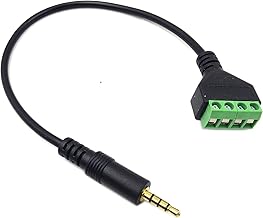
The Poyiccot is a 30 cm adapter cable with a 3.5 mm four-pole TRRS male plug on one end and a four-screw terminal block on the other. Its screw terminals provide connection points for separately prepared wires, avoiding the need to solder directly to a 3.5 mm plug.
Best for: Users who need to connect a four-pole 3.5 mm plug to individual wires or a terminal-based setup. It is a better choice than a bare socket when the project needs a cable adapter rather than a panel or circuit-board component.
Why it stands out: The listing identifies both the TRRS male connector and four screw terminals, making the connection format clear. The 30 cm cable length is also specified for planning a short wiring run.
Limitation: A terminal block does not by itself identify which terminal corresponds to each plug contact. Confirm the cable’s pinout and the receiving device’s wiring before connecting it; do not assume all four-pole 3.5 mm devices use the same arrangement.
uxcell PJ-320A 3.5 mm PCB Sockets

This uxcell product is a 15-piece set of 3.5 mm female audio jack connectors identified as PJ-320A and described as PCB-mount parts. It is designed for installation on a printed circuit board, making it distinct from the panel sockets in this list.
Best for: Electronics repairers and builders replacing or adding a board-mounted 3.5 mm socket. The 15-piece quantity can suit projects that require multiple connectors or spare parts.
Why it stands out: The product name specifies the PJ-320A model and PCB mounting. Choose it when the mechanical installation must be on a circuit board, rather than through an enclosure panel or at the end of a cable.
Limitation: The listing describes a 3.5 mm female socket but does not state a particular four-pole wiring standard in the supplied product details. Check the part’s physical footprint and pin arrangement against your board before ordering or soldering.
Six 3.5 mm Four-Pole Panel-Mount Jacks

This set contains six 3.5 mm four-pole panel-mount jack connectors. The product name describes them as solder connectors and notes that nuts are included. The listing also identifies the connectors as suitable for audio/video applications.
Best for: Projects that need several panel-mounted 3.5 mm sockets, such as enclosure builds or repeated repairs. It is a suitable alternative to the RLECS set when six connectors are enough and a panel-mount form is required.
Why it stands out: The four-pole designation, panel-mount construction, solder connection, and included nuts are all stated in the product name. These details help distinguish it from PCB sockets and male-to-terminal adapter cables.
Limitation: The available product details do not specify dimensions or contact-by-contact wiring. Measure the intended panel space and verify the terminal arrangement before fitting the jack into a finished device.
KAISH 1/4-Inch Stereo Guitar Barrel Jack

The KAISH connector is a copper barrel jack for guitar or bass input and output. Its listing describes a 1/4-inch format with four pins and says it can be used as a stereo or mono jack. It is not a 3.5 mm socket, so it should not be selected as a direct replacement for a standard 3.5 mm four-pole jack.
Best for: Guitar or bass projects that call for a 1/4-inch barrel jack with four pins. It is included as a relevant alternative for shoppers whose “four-pin stereo jack” search refers to instrument hardware rather than a 3.5 mm TRRS connector.
Why it stands out: The product is explicitly described for guitar and bass input/output and supports stereo or mono use. Its black nickel finish is also stated in the product name.
Limitation: The 1/4-inch size is substantially different in format from a 3.5 mm mini jack. Avoid this option if your device requires a 3.5 mm socket or plug.
Buying Guide: How to Choose a 4-Pin Stereo Jack
Do you need 3.5 mm or 1/4 inch?
Start by checking the plug or socket size your device requires. A 3.5 mm jack is commonly called a mini jack, while the KAISH product is a 1/4-inch instrument jack. These sizes are not interchangeable without the appropriate equipment. Match the connector’s physical diameter and style to the existing port or project design before considering pin count.
Should you choose a panel jack, PCB socket, or adapter cable?
The mounting method determines which product type is appropriate. A panel-mount socket passes through an enclosure and is secured with a nut. A PCB socket is mounted to a circuit board and must match its footprint and pin layout. A male adapter cable is useful when you want to terminate wires at a screw block instead of installing a new socket.
- Choose a panel-mount socket for a fixed connection through an enclosure wall.
- Choose a PCB socket when replacing or adding a connector directly on a circuit board.
- Choose a terminal adapter when you need to connect a TRRS plug to separately wired terminals.
- Choose a 1/4-inch barrel jack only when the project calls for that larger instrument connector.
What does four-pole or TRRS mean?
A four-pole 3.5 mm connector is often called TRRS, referring to its tip, ring, ring, and sleeve contacts. The presence of four contacts does not guarantee that every device uses the same assignment for audio channels, microphone, or other signals. Before wiring a replacement or adapter, check the device documentation or identify the contacts with an appropriate method. Do not infer a pinout from the connector’s appearance alone.
What should you check before installation?
For panel-mount parts, verify the required hole size, available clearance, and nut placement against the product’s dimensions. For PCB parts, compare the pin layout and footprint with the circuit board. For solder connectors, plan how each contact will be wired and use tools appropriate for the work. For screw terminals, confirm that the wire size and terminal arrangement suit the intended connection.
How many connectors should you buy?
Choose a quantity based on the number of devices or repairs, while allowing for spares if the project involves soldering or repeated prototyping. The listed options include sets of 10, 15, and six connectors, as well as a single 30 cm terminal-adapter cable. Quantity does not establish compatibility, so verify the connector style and mounting method first.
Frequently Asked Questions
Is a 4-pin 3.5 mm jack the same as TRRS?
Usually, a 3.5 mm connector with four contacts is described as TRRS. However, contact assignments can vary between devices, so check the required wiring before connecting it.
Can I use a panel-mount jack instead of a PCB socket?
Not as a direct mechanical replacement in every case. A panel-mount jack is secured through an enclosure, while a PCB socket is designed to attach to a circuit board. Select the form that matches the installation location and verify dimensions and pin layout.
Does a four-pole jack always support a microphone?
No. Four contacts describe the connector structure, not a guaranteed feature set. The device and wiring determine how those contacts are used.
Which option works without soldering directly to a jack?
The Poyiccot adapter provides a 3.5 mm four-pole male plug connected to a four-screw terminal block. You still need to identify the correct terminal wiring for your application.
Is the KAISH jack a 3.5 mm connector?
No. The KAISH product is listed as a 1/4-inch guitar or bass barrel jack. It is intended for projects requiring that larger connector format, not a 3.5 mm mini jack.